An investment company, not a reserve manager
Temasek and GIC are both owned by Singapore's government, but they work very differently. GIC manages the country's foreign reserves across many asset classes. Temasek is an investment company that owns and manages a portfolio of companies, often holding large stakes for many years. It pays dividends to its shareholder, raises money with its own bonds and holds credit ratings of Aaa from Moody's and AAA from S&P.
Its single shareholder is Singapore's Minister for Finance, and it operates on commercial principles.
See the numbers behind the chart
| Region | Share of portfolio |
|---|---|
| Singapore | 27% |
| Americas | 24% |
| China | 18% |
| Europe, Middle East and Africa | 12% |
| Asia Pacific (excluding Singapore, China and India) | 11% |
| India | 8% |
The size of the portfolio
Temasek reported a net portfolio value of S$518 billion as at 31 March 2026, up S$49 billion from a year earlier on a mark-to-market basis. It says this represents a doubling of the portfolio over the past decade. In US dollars, the value was about US$401 billion.
The 2026 review was the first to report the whole portfolio at market value. Previously, unlisted direct investments, about a quarter of the portfolio, were reported at book value, with the market-value uplift disclosed separately. Changes like this are worth noticing whenever you compare one year's figures with another's.
Three segments
Temasek describes its portfolio in three segments. Singapore-based Temasek Portfolio Companies, core holdings in which it typically owns large stakes, made up 43% of portfolio value in March 2026. Global Direct Investments made up 38%, and Partnerships, Funds and Asset Management Companies made up 19%.
This roughly 40-40-20 split mixes concentrated, hands-on ownership with broader exposure through funds and partners. It is a reminder that diversification can be built from a mix of large positions and wide holdings, as the library lesson on core and satellite describes.
Concentration with a purpose
Temasek's portfolio is more concentrated than a global index fund. Its Singapore-based portfolio companies are large holdings that it typically owns for the long term, and together they made up 43% of portfolio value in March 2026. That concentration is a deliberate choice, made by an owner with deep knowledge of those businesses, strong funding and no need to sell. Around that core, global direct investments and fund partnerships spread the rest of the portfolio across many more companies and regions.
For an individual, holding a large stake in one company, such as an employer's shares, is a very different matter. The library lesson on stock-based compensation explains why a concentrated position tied to your own job can double up your risk.
Where the money is
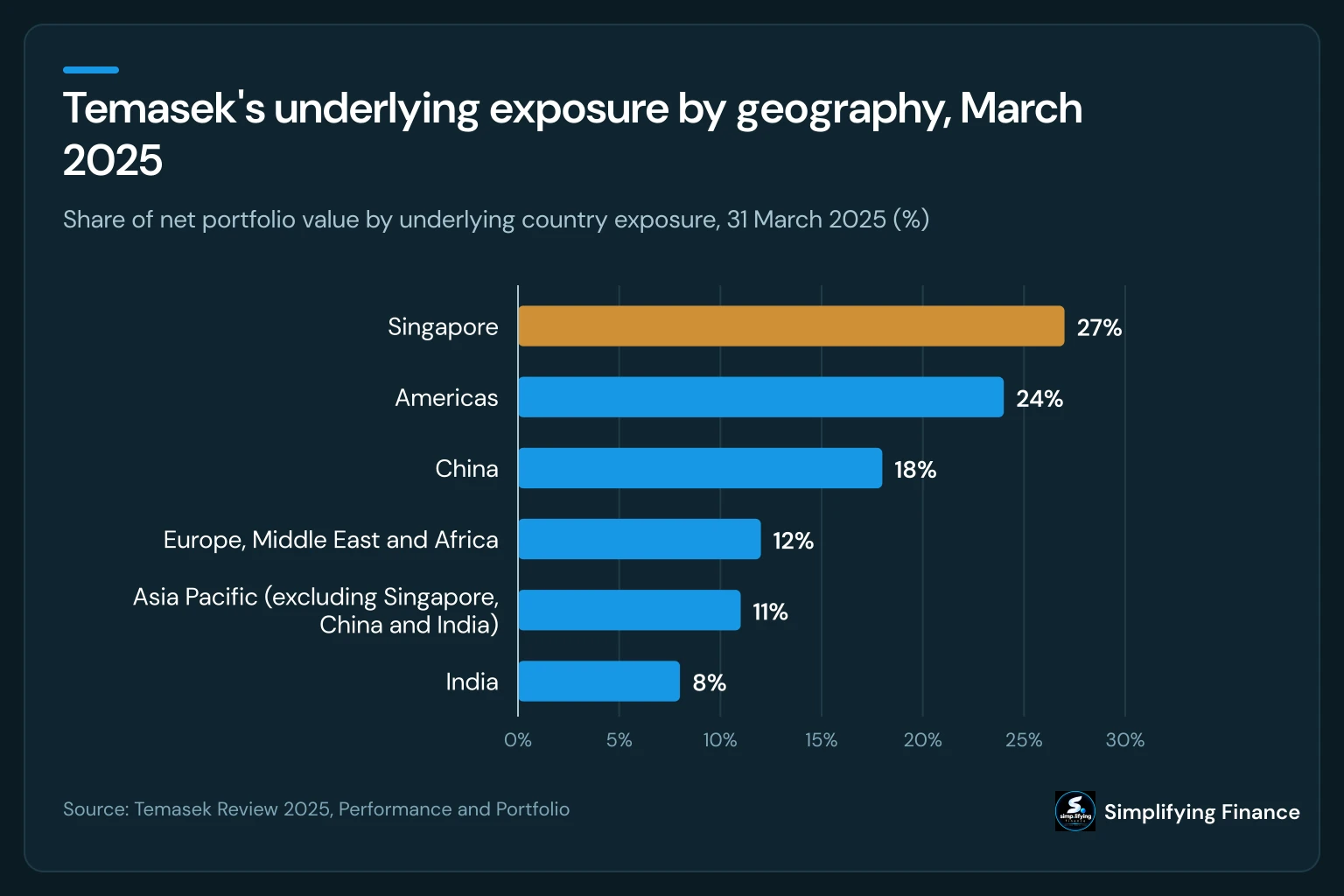
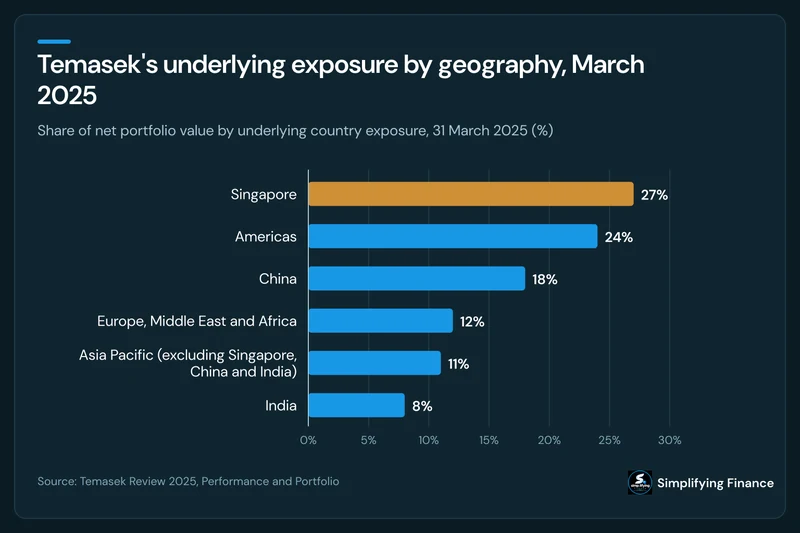
Temasek also reports where the businesses it owns actually earn their money. At 31 March 2025, its underlying exposure was about 27% Singapore, 24% the Americas, 18% China, 12% Europe, the Middle East and Africa, 11% the rest of Asia Pacific and 8% India. It reported that about 66% of its underlying exposure was to developed economies.
This distinction between where a company is headquartered and where it does business matters. A company listed in Singapore may earn much of its income abroad, so measuring exposure by underlying activity gives a truer picture of how diversified the portfolio really is.
How Temasek measures returns
Temasek reports a total shareholder return, which combines the change in portfolio value with dividends paid to its shareholder, after taking account of new capital. For the year to March 2026, it reported a 20-year return of 6.8% a year and a 10-year return of 7.1% a year in Singapore dollars, and a one-year return of 10.5%. In US dollar terms, its 20-year return was 8.0% a year and its 10-year return 7.5%.
The gap between Singapore dollar and US dollar returns shows how currency changes the picture. The Singapore dollar strengthened over the period, so returns measured in US dollars look higher.
Temasek also reports that its portfolio provides a steady flow of dividends and distributions, which helps it meet its own obligations without selling holdings at a poor moment. A reliable income stream plays the same role for a household as it does for a large investor.
Prudent funding
Temasek borrows modestly. For the year ended March 2025, its investor factsheet reported total debt of about 5% of net portfolio value. Low borrowing means a fall in markets is not magnified by debt, a point the library lesson on drawdown mathematics makes for individual investors.
What Temasek's long-run returns would compound to
Take S$10,000 growing at Temasek's reported 20-year return of 6.8% a year in Singapore dollars. After 20 years, it would be worth about S$37,300, nearly four times the starting amount.
| Starting amount | S$10,000 |
| After 20 years at 6.8% | about S$37,300 |
| After 10 years at 7.1% | about S$19,900 |
| Latest one-year return | 10.5% (to March 2026) |
Over 10 years at 7.1% a year, the same S$10,000 would grow to about S$19,900, roughly doubling, which matches Temasek's own description of a portfolio that doubled over the decade. These are long-run averages: the path from year to year was uneven.
Where people go wrong
- Treating Temasek and GIC as the same. One owns companies; the other manages reserves across asset classes.
- Comparing values across methods. A switch from book value to market value changes the starting point.
- Mixing currencies. Singapore dollar and US dollar returns differ because exchange rates move.
- Reading headquarters as exposure. Where a company earns its money can differ from where it is listed.
- Assuming concentration suits everyone. Temasek's large stakes come with deep research, strong funding and no need to sell.
Put it to work
- Check underlying exposure. Look at where your funds' companies earn their revenue, not just where they are listed.
- Keep borrowing low. Avoid using debt to invest unless you fully understand the downside.
- Mix core and wide holdings. Pair any large single positions with broad funds.
- Size large positions carefully. If one holding is a big share of your wealth, decide how far it could fall before it hurts your plan.
- Read on. Next: the Abu Dhabi Investment Authority (ADIA).
Temasek shows a different model: concentrated, long-term ownership of companies, mixed with funds and partnerships. Its returns are measured to shareholders, over 10 and 20 years.
Facts checked against the sources above on 27 November 2026. Figures are as of the dates stated and will change. Worked examples use round illustrative numbers to show the arithmetic, not forecasts. Educational content only, not personal investment advice.