A long-established global investor
Established in 1976, ADIA is a globally diversified investment institution that invests funds on behalf of the Government of Abu Dhabi, with a strategy focused on long-term value creation. Its stated mission is to sustain the long-term prosperity of Abu Dhabi by prudently growing capital through a disciplined investment process and committed people.
ADIA invests outside its home economy. Its 2024 Review notes that, as a matter of practice, ADIA does not invest in the UAE. That design spreads the emirate's long-term savings across the world's markets, the same principle the library lesson on international diversification describes for individuals.
See the numbers behind the chart
| Asset class | Minimum | Maximum |
|---|---|---|
| Developed equities | 32% | 42% |
| Private equity | 15% | 20% |
| Emerging market equities | 7% | 15% |
| Government bonds | 7% | 15% |
| Financial alternatives | 7% | 12% |
| Credit, real estate, infrastructure (each) | 2% | 7% |
Asset allocation comes first
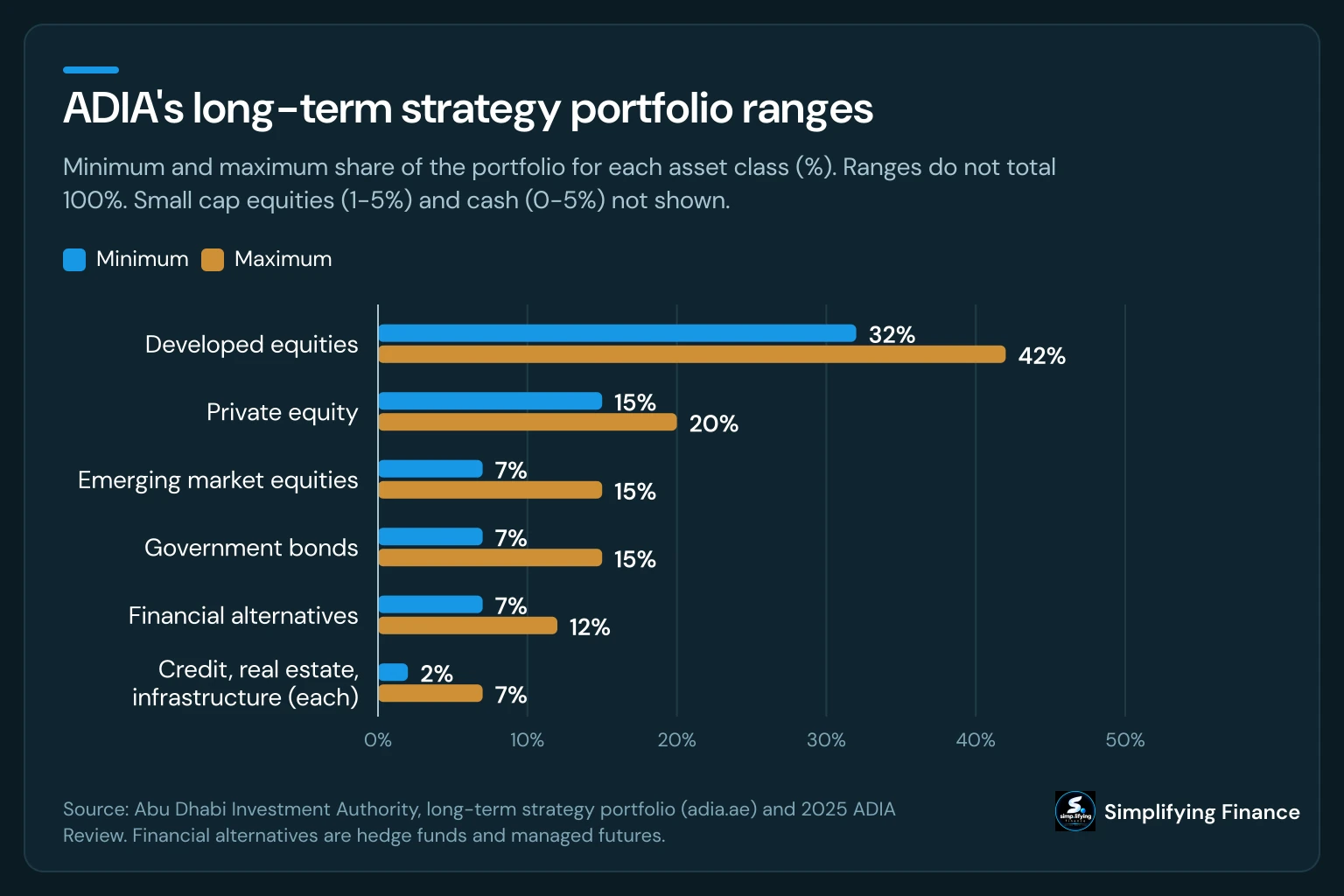
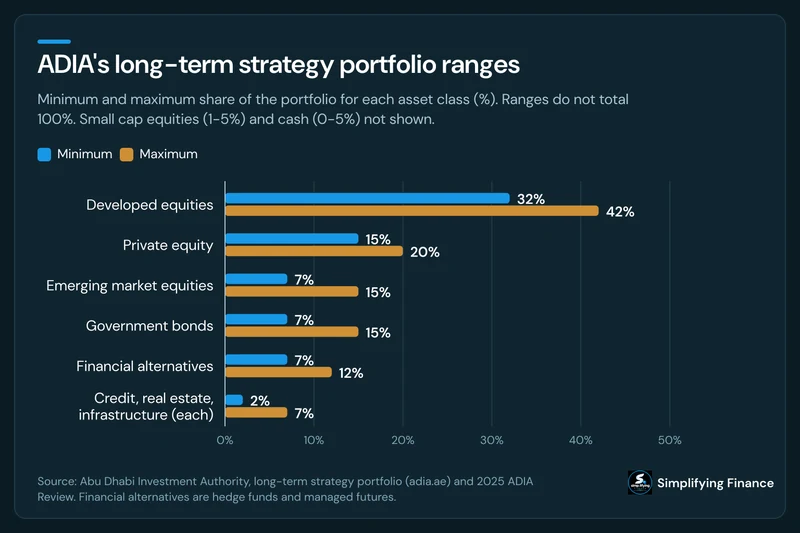
ADIA says it believes that asset allocation is the primary driver of long-term outperformance. It builds its portfolio through a strategic asset allocation process, diversifying across more than two dozen asset classes and sub-categories based on its long-term view of the world.
Rather than fixing a single weight for each asset class, ADIA publishes a minimum and a maximum. Allocations can move within those ranges as markets and opportunities change, which is why the ranges are not designed to add up to 100%. Developed-market equities have the largest range, at 32% to 42%, followed by private equity at 15% to 20%.
What changed in 2025
In its 2025 Review, ADIA updated three ranges. Financial alternatives, which ADIA defines as hedge funds and managed futures, rose from 5%-10% to 7%-12%. Private equity rose from 12%-17% to 15%-20%. Real estate moved from 5%-10% to 2%-7%.
Adjusting ranges in this measured way, a few points at a time and within a published framework, is a disciplined way to evolve a portfolio. It contrasts with the sudden, all-or-nothing switches that individual investors sometimes make after a strong or weak year.
Spread across regions
ADIA also publishes regional ranges for its long-term strategy portfolio: North America 45% to 60%, Europe 15% to 30%, emerging markets 10% to 20% and developed Asia 5% to 10%. These broadly reflect the relative size of the world's investment markets, with room to lean towards regions where ADIA sees opportunity.
Because the regional ranges, like the asset-class ranges, are not designed to total 100%, the portfolio can lean towards one region or another within those limits as conditions change, without ever abandoning the overall global spread.
Measured over decades
ADIA reports its performance as annualised returns over 20 and 30 years, on a point-to-point basis. As at 31 December 2025, its 20-year annualised return was 6.6% and its 30-year annualised return was 7.2%, compared with 6.3% and 7.1% a year earlier.
Reporting over such long periods reflects ADIA's horizon. A single year can be very good or very poor for any investor; what matters for long-term savings is the return compounded over decades.
Internal and external, active and passive
ADIA uses a mix of approaches. Its 2024 Review showed 65% of the portfolio managed internally and 35% by external managers, and 54% in active strategies with 46% passive, meaning index-replicating. Reports on the 2025 Review put internally managed assets at about 63% and active strategies at about 57%.
A large passive share is a reminder that even very sophisticated investors use low-cost index exposure as a core building block, a point the library lesson on index funds versus active funds explores.
Governance and process
ADIA's Review sets out a clear governance structure, with a Board of Directors and an Investment Committee, and defined roles and responsibilities designed to ensure accountability. Investment decisions follow a structured process, from the strategic asset allocation set at the top to the choices made by individual investment departments within their own ranges.
ADIA's 2025 Review also highlighted its increasing use of systematic, quantitative and data-driven investment methods. Combining a stable long-term framework with continual improvement in how each part of the portfolio is managed is a hallmark of mature institutional investing.
For individuals, the equivalent is a written plan: a simple investment policy statement that records your target ranges, how you will choose funds and when you will review them. The library lesson on investment policy statements shows how to write one.
Ranges in practice: a US$100,000 portfolio
Suppose a saver borrows ADIA's idea of ranges for their own US$100,000 portfolio and sets, for example, global shares at 55% to 65%, bonds at 25% to 35% and cash at 5% to 10%. They only rebalance when a holding moves outside its range.
| Global shares range (example) | US$55,000 to US$65,000 |
| Bonds range (example) | US$25,000 to US$35,000 |
| US$10,000 at 6.6% for 20 years | about US$35,900 |
| US$10,000 at 7.2% for 30 years | about US$80,500 |
Compounding shows why ADIA reports long periods. At ADIA's reported 20-year rate of 6.6% a year, US$10,000 would grow to about US$35,900 over 20 years. At its 30-year rate of 7.2%, US$10,000 would grow to about US$80,500 over 30 years. These are illustrations of compounding, not forecasts.
Where people go wrong
- Treating a range as a target to hit exactly. Ranges allow sensible movement; rebalancing is needed only when a limit is crossed.
- Adding up the ranges. ADIA's ranges are not meant to total 100%.
- Copying private-market weights. Private equity suits investors with very long horizons and no need for quick cash.
- Judging long-term investors on one year. ADIA reports 20- and 30-year results for this reason.
- Changing the whole plan after one year. ADIA adjusts ranges a few points at a time within a stable framework.
Put it to work
- Write your own ranges. Set a minimum and maximum for shares, bonds and cash in your plan.
- Rebalance at the edges. Act when a holding leaves its range, not on every market move.
- Use low-cost index funds as a core. Even large institutions hold a big passive share.
- Write it down. Record your ranges and review rules in a short investment policy statement.
- Read on. Next: Mubadala.
ADIA sets ranges, not fixed weights, for each asset class and region, and judges its results over 20 and 30 years. Both habits are useful lessons in patient diversification.
Facts checked against the sources above on 27 November 2026. Figures are as of the dates stated and will change. Worked examples use round illustrative numbers to show the arithmetic, not forecasts. Educational content only, not personal investment advice.