What happened
For an aluminium producer, electricity is a central production input. Aluar’s wind investment near Puerto Madryn gave it a way to change the mix and cost exposure of the power supplying its operations. The company also described energy sales. Owning generation is a physical hedge only to the extent that its output, timing, location and settlement terms match the electricity exposure that matters to the smelter.
A smelter evaluating power costs should compare the price of the electricity it would otherwise buy with the value of the electricity it can sell. Those prices need not be equal. If additional wind generation arrives when the smelter is already using all it can absorb under its arrangement, it may earn only the export price. Treating the extra generation as avoided industrial purchases would overstate the benefit. Conversely, well-timed generation can displace a comparatively expensive purchase. Match generation, demand and the applicable settlement rule in the same interval before adding the results for a month. Annual totals discard precisely the timing that makes the hedge valuable.
Eighteen turbines rated at 4.5 MW each add to 81 MW. Continuous operation at rated output for a non-leap year would yield 709,560 MWh. This is a theoretical ceiling. Wind varies, equipment needs maintenance and the grid can constrain dispatch. Multiplying expected generation by a generic average electricity price can therefore overstate the amount of purchased power actually displaced.
Aluar, Argentina’s only primary aluminium producer, runs a large smelter in Puerto Madryn, Chubut. Aluminium smelting uses huge amounts of electricity, so energy cost is central to its competitiveness. Argentine law 27,191 required large consumers to source 20% of their power from renewables by the end of 2025.
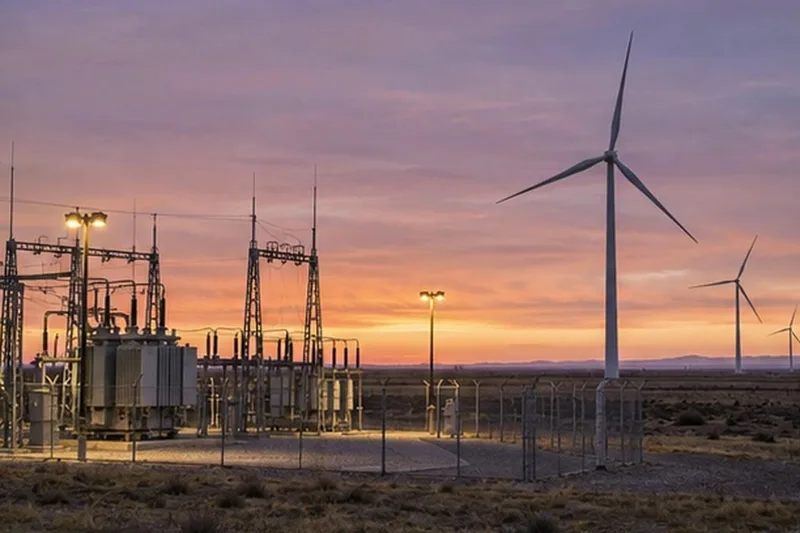
Aluar built its wind park at El Llano, about 20 kilometres from Puerto Madryn, in stages. Stages I and II used 31 Vestas turbines of 3.6 MW and Stage III 14 turbines of 3.8 MW. Stage IV added 18 Vestas V150 turbines of 4.5 MW, or 81 MW, with completion planned for December 2023, taking the park to about 245 MW and 63 turbines. Vestas also agreed to maintain the turbines for 20 years.
Aluar then built La Flecha, with 56 Goldwind turbines and 336 MW, the largest single-phase wind farm in Argentina. With it the park reached 582 MW and 119 turbines after a cumulative investment of about US$743 million, generating one in every eight wind megawatts in the country.
Key moments
Aluar develops wind generation to serve its industrial energy strategy.
The company specifies eighteen turbines at El Llano.
The assessment gives capacity and an expected commissioning window.
Stages I–II: 31 Vestas V126 at 3.6 MW; Stage III: 14 V136 at 3.8 MW; Stage IV: 18 V150 at 4.5 MW; La Flecha: 56 Goldwind turbines, 336 MW. Cumulative investment about US$743m. Sources: Aluar; Power Technology; Energía Estratégica.
The trade-offs at the heart of the case
Core tensions
Two projects can produce the same annual MWh and deliver different savings. Electricity generated during a low-price hour may displace cheap purchases or earn a low sale price. A still evening during peak demand may leave the smelter exposed to expensive supply. Correlation with hourly load and prices is what turns renewable output into a financial hedge. Buying a shaped power contract can move balancing risk to a supplier. The apparent premium can be worthwhile if the seller can diversify across many generators. Examine collateral and performance obligations during a system-wide energy shortage before accepting that hedge.
Testing the evidence
The appropriate unit of observation is one hour of smelter demand. Track purchased electricity cost avoided after balancing and record the baseline before the decision. The most useful records are hourly meters, industrial load records and settlement statements. Align their dates and definitions before drawing an inference. In particular, allow for correlation of wind generation with grid prices. A change in that factor can move the reported outcome even when the intervention has had no effect. Compare interval electricity data with the smelter’s load when operating at comparable production rates. Distinguish surplus sold to the grid from energy used internally. Repricing the same kilowatt-hour as both an avoided purchase and a sale would double count it.
A related Argentine case
Cauchari’s project financing starts with installed capacity. Aluar’s industrial hedge depends on the value of generation at particular hours, showing why the same nameplate MW can have very different cash consequences.
For your seminar, paper or interview
- Q1
Would two identical turbines with the same annual generation necessarily reduce the smelter’s bill by the same amount?
- Q2
How would you measure purchased electricity cost avoided after balancing for one hour of smelter demand using the available records?
- Q3
Which assumption in “What the wind output is worth at the meter” would you challenge first, and how would changing it affect the decision?
- Q4
Could correlation of wind generation with grid prices explain the observed change? What evidence would distinguish that explanation?
- Q5
Under what conditions would you prefer buying a contracted supply profile with explicit balancing terms, and who would bear the residual risk?
- Physical hedging
- Self-generation
- Renewable mandates
- Energy-intensive industry
How we would approach it
Simplifying Finance’s opinion, offered as a starting point for debate, not as fact or investment advice.
Match hourly wind production to actual load and contract settlement rules. Price residual purchases, surplus sales and backup capacity explicitly. Compare ownership with a long-term supply agreement that offers a defined delivery profile and assigns balancing risk to another party.
Build its own wind park
Supply the smelter from turbines near Puerto Madryn.
Expand in stages
Add capacity as earlier stages prove themselves.
Build private transmission
Connect new turbines with its own lines.
What this plan gives up
Owning wind power lowers and stabilises energy costs and meets renewable rules, but wind is intermittent, so the smelter still needs other power for steady operation.
The strongest counter-argument
For the industrial energy committee, the alternative worth costing is buying a contracted supply profile with explicit balancing terms. Give both choices the same information date. Specify what can still be reversed, who absorbs the cost if the forecast is wrong, and the point at which new evidence would justify changing course. Make the decision conditional on an observable change in purchased electricity cost avoided after balancing. That condition lets someone outside the original decision team distinguish a sensible revision of the plan from an attempt to explain away poor results.
Metrics to watch
- Share of smelter power from wind
- Aluminium prices
Propose your solution
Pick a discussion question and set out what you would do, why, and what it would cost. Strong, well-argued answers are reviewed and published below with your first name and programme.
Published solutions
Loading published solutions…
- Aluar: Environmental impact study, stage IV turbine specifications ↗
- Aluar: Exchange prospectus, wind supply to the primary aluminium plant ↗
- Río Negro: Vestas proveerá las turbinas para la cuarta etapa ↗
- Diario Jornada: Comienza la IV etapa del Parque Eólico Aluar ↗
- Energía Estratégica: Aluar inauguró el parque eólico más grande del país ↗
- Power Technology: El Llano wind park ↗
- Image: AI-generated editorial illustration
Figures are as reported by the companies or cited outlets as of 22 November 2026. Check the source before quoting. Corrections: let us know through the solution form.