What happened
Ford chemists at Greenfield Village explored industrial uses of soybeans, including automotive materials. The work connected agricultural supply with a manufacturer continually searching for suitable inputs. A demonstration object could make the idea memorable, but a purchasing department needed a repeatable specification, a supply commitment and an acceptable delivered price.
Henry Ford believed industry and agriculture should support each other. The Henry Ford says that in the 1930s he chose soybeans as a crop that might unite the two, and built a soybean laboratory in Greenfield Village.
The work began in 1931. By 1933, according to The Henry Ford, Ford was producing oil for paints and moulding ground soybean meal into small plastic car parts such as gear shift knobs.
Soy materials reached production cars. Ford says that in 1935 each vehicle was said to contain about two bushels’ worth of soybeans, in parts such as the horn button, gearshift knob, door handles and accelerator pedal.
Ford grew much of the crop itself. A photograph described in Ford R. Bryan’s book Beyond the Model T shows 60,000 bushels of soybeans stored at the Rouge glass plant in March 1936, the harvest of about 5,000 acres of Ford-owned land.
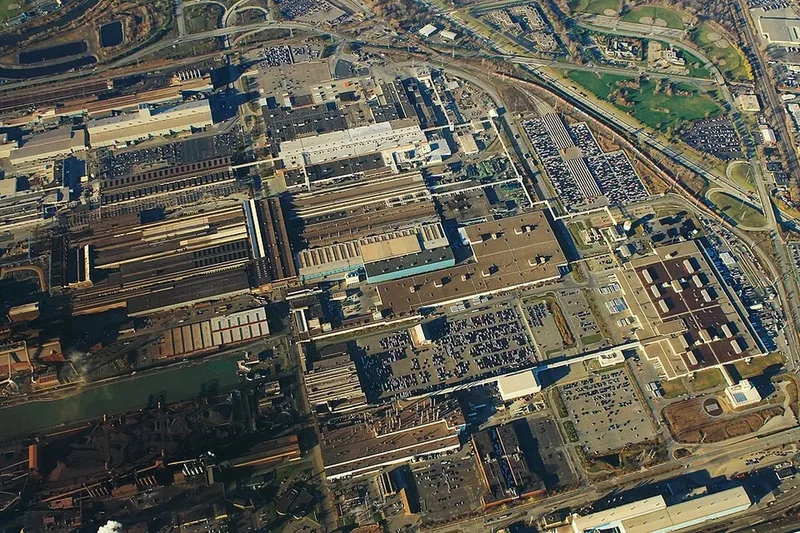
Processing took place at the Rouge, where soybeans were crushed and mixed with hexane to extract the oil, The Henry Ford explains. The remaining meal became an ingredient in soybean plastics.
The best-known result was a demonstration car. On 13 August 1941 Henry Ford unveiled a plastic-bodied car at Dearborn Days, with 14 plastic panels on a tubular steel frame, according to The Henry Ford.
The exact recipe of the panels is uncertain. The Henry Ford notes that one account lists soybeans, wheat, hemp, flax and ramie among the ingredients.
The project ended with the war. The Henry Ford says the outbreak of World War II suspended car production and with it the plastic car experiment.
The exhibit shows the scale of Ford’s soybean effort, from thousands of acres to a demonstration car.
Supply-chain thinking explains part of the motive. Growing its own materials could give Ford more control over inputs.
But crops vary from season to season, so a material must perform consistently before a factory can rely on it.
Risk and return matter in research spending. Many projects fail, so companies spread bets and look for smaller wins along the way.
Ford’s small soy-based parts were a practical success even though the plastic body did not go into production.
Today carmakers again use bio-based materials, such as soy-based foam and natural fibres, to cut fossil-fuel content.
This shows that some research ideas need decades and new technology before they become practical.
Students can ask how a company should decide when to keep funding a research project and when to stop.
Key concept: supply chains. A supply chain is the network of suppliers, factories, transport links and distributors that turns raw materials into a finished product in a customer’s hands. Decisions about who supplies what, where parts are made and how much stock to hold affect cost, speed and resilience.
A lean chain with few suppliers and little stock is cheap to run but vulnerable to disruption, while a chain with backup suppliers and buffer stock costs more but recovers faster from shocks. Car makers worldwide have spent the past decade rebalancing that trade-off.
Key concept: risk and return. In business and investing, higher potential returns usually come with higher risk. Entering a new market or launching a new kind of product can bring large rewards, but the chance of failure is also greater.
Managers weigh the size of the possible gain against the likelihood and cost of failure, and they often reduce risk by testing ideas on a small scale before committing large sums.
Key concept: opportunity cost. Opportunity cost is the value of the best alternative given up when making a choice. Money and time spent on one project cannot be spent on another.
Good decisions compare options against each other, not just against doing nothing.
Key moments
Ford studies industrial uses for soybeans
Chemists develop candidate materials
Components must meet automotive requirements
Sources: Ford R. Bryan, Beyond the Model T; Ford Motor Company; The Henry Ford.
The trade-offs at the heart of the case
A closer look
For an agricultural material, test one batch from a different crop season after it has been stored and processed under ordinary factory conditions. A laboratory result from a carefully chosen sample says little about that variation. Record rejected material and the cost of adapting the process. A promising soybean application becomes commercially interesting when its performance is repeatable at a delivered cost a parts buyer can contract for.
The alternative on the table
For comparison, consider the option to buy established materials and purchase agricultural research externally. The related case “Finding a market for a sawmill’s leftovers” supplies a useful reference point. Ford’s wood operations produced scraps as well as timber for vehicles. Charcoal offered an immediate input stream because timber scraps already existed. Soy-based parts required a new material to earn its place against an incumbent on specification and cost.
For your seminar, paper or interview
- Q1
What would a second crop season test that an initial materials sample cannot?
- Q2
Which finding in the records on qualified parts that survive real service conditions would persuade you to buy established materials and purchase agricultural research externally?
- Q3
Compare this decision with “Finding a market for a sawmill’s leftovers”. Which difference between the cases would change your recommendation?
- Materials research
- Bio-based materials
- Agricultural supply
- Innovation risk
How we would approach it
Simplifying Finance’s opinion, offered as a starting point for debate, not as fact or investment advice.
We think Ford’s soybean work was a sensible research bet that delivered real but modest results. Soy oil for paint and small moulded parts reached production, while the all-plastic body never did. The lesson is to separate proven, repeatable uses from eye-catching prototypes when judging research spending.
Start with small parts
Prove a material where failure is cheap.
Test across seasons
Check that crop quality stays consistent.
Keep the showpiece separate
Do not confuse a demonstration with a supply plan.
What this plan gives up
Research builds options but may not pay back for years.
The strongest counter-argument
Some argue the money would have been better spent on proven materials.
Metrics to watch
- Share of parts using crop-based materials
- Rejection rate of new materials
Propose your solution
Pick a discussion question and set out what you would do, why, and what it would cost. Strong, well-argued answers are reviewed and published below with your first name and programme.
Published solutions
Loading published solutions…
- The Henry Ford • Ford Motor Company Soybean Products Research, 1940 ↗
- The Henry Ford • Source document — Could an agricultural crop become a reliable car part ↗
- The Henry Ford • Henry Ford: Soybeans (expert set) ↗
- The Henry Ford • Soybean Car ↗
- Ford Motor Company (FordOnline) • TBT: Henry Ford’s ‘Soybean Car’ ↗
- Ford R. Bryan, Beyond the Model T (Project MUSE excerpt) ↗
- Photo: Fig 1 patent 2,269,452 by U.S. Patent Office, Public domain (cropped and resized) ↗
Figures are as reported by the companies or cited outlets as of 22 November 2026. Check the source before quoting. Corrections: let us know through the solution form.