What happened
Malaysia Rail Link and China Communications Construction Company signed a supplementary agreement in April 2019. The government described a revised engineering, procurement, construction and commissioning price of RM44 billion and a 640-kilometre alignment including spur lines. Reuters reported an earlier RM65.5 billion cost and the resumption of the suspended project. The figures describe the 2019 bargain. Subsequent design or expenditure decisions would need their own dated comparison.
The government’s revised 640 kilometres explicitly included spur lines. That matters for a comparison based on cost per kilometre. A changed mix of structures and branch connections can reduce a route’s average price while increasing the price of an unchanged, comparable section. The government also put construction cost at RM68.7 million per kilometre in the revised agreement versus RM95.5 million under the original terms.
Work on the East Coast Rail Link was suspended in 2018 after a change of government, with cost as the main concern. The government said it faced a choice between renegotiating the contract with China Communications Construction Company (CCCC) or paying termination costs of about RM21.78 billion. On 12 April 2019 Malaysia Rail Link and CCCC signed a supplementary agreement that reduced the construction cost for Phases 1 and 2 from RM65.5 billion to RM44 billion, a cut of RM21.5 billion or 32.8 percent.
Part of the saving came from a shorter route. Negotiator Daim Zainuddin said the new alignment was about 40 km shorter than the original 688 km, and officials insisted the line remained double-tracked. The deal also provided for a RM1 billion refund of advance payments in two RM500 million tranches, a 50:50 joint venture between MRL and CCCC to operate and maintain the line, and a larger share of civil works for local contractors. Malaysia’s prime minister said the renegotiation avoided a cancellation penalty that could have reached about US$5 billion.
The cost later changed again. In December 2022 the new prime minister said the realigned project would cost RM74.96 billion in total, including land, utilities and financing, against RM85.97 billion for the original version. Comparing headline construction prices across these dates therefore needs care, because each figure covers a different scope.
Key moments
Original ECRL contract signed with CCCC
Work suspended by the new government over cost concerns
Supplementary agreement signed; cost cut to RM44 billion
Prime minister sets out the revised terms
Total cost of the realigned project put at RM74.96 billion
Phases 1 and 2 construction cost fell from RM65.5 billion to RM44 billion. Sources: Prime Minister’s Office statement; paultan.org; Malaysiakini.
The trade-offs at the heart of the case
Build a bridge between the two specifications
Separate lower prices for identical work from shorter routes, deferred facilities and changed responsibilities. The first can be a saving without reducing service. The second may remove an expensive feature that hardly anyone needs, or might eliminate the only convenient freight connection for a customer. Operating risk also has value. A construction partner asked to share it may have stronger incentives to deliver a maintainable line, but only if the arrangement has enforceable terms.
Use one freight customer to test the deal
Ask a potential shipper to specify the siding, shipment frequency, acceptable arrival window and price that would induce it to move cargo from road. Show exactly where those requirements appear in the revised scope. If one expensive part of the alignment fails that test, it may deserve a redesign even after the overall contract price fell sharply. Conversely, preserving a costly spur can be rational if removing it would eliminate a committed revenue stream for decades.
Walk away or renegotiate
Cancelling would have avoided future construction spending but crystallised a large termination bill and lost sunk work. Renegotiating kept the project alive at a lower price, but committed the country to a still very large investment. The value of the deal depended on how credible the threat to cancel was.
For your seminar, paper or interview
- Q1
Which removed features would a freight customer pay to restore?
- Q2
What is the best alternative at the signing date?
- Q3
Whose signature makes a traffic forecast bankable?
- Q4
Which unspent cost could still be avoided at the signing date?
- Q5
What would make a freight-volume study worth buying?
- Renegotiation and BATNA
- Scope versus price
- Cancellation costs
- Public-private risk sharing
How we would approach it
Simplifying Finance’s opinion, offered as a starting point for debate, not as fact or investment advice.
The 2019 renegotiation shows how a credible alternative, in this case cancellation, can be used to reprice a large contract. Combining a shorter alignment, a lower unit cost and shared operating risk produced a real saving, although later scope changes mean the final bill is higher than the 2019 headline.
Separate price from scope
Report savings from unit costs and from route changes separately.
Share operating risk
Use joint ventures to keep the contractor tied to performance.
Update the business case
Re-test ridership and freight forecasts after every scope change.
What this plan gives up
A lower price today may come from removing features that add value later.
The strongest counter-argument
A shorter route and deferred features can reduce the price without improving value per kilometre of useful railway. The true test is whether the revised line still serves the freight and passengers that justified it.
Metrics to watch
- Final ECRL cost and opening date
- Freight volumes committed to the line
Propose your solution
Pick a discussion question and set out what you would do, why, and what it would cost. Strong, well-argued answers are reviewed and published below with your first name and programme.
Published solutions
Loading published solutions…
- Malaysia Rail Link: prime minister’s statement on the revised ECRL agreement ↗
- Reuters: Malaysia and China agree to resume the rail project, April 2019 ↗
- Malaysiakini: ECRL salient points, RM1 billion refund and risk sharing ↗
- paultan.org: ECRL back on, RM21.5 billion saved ↗
- The Star: neither MRL nor government claimed saving was from overpricing ↗
- Malaysiakini: Daim says new link is 40 km shorter ↗
- paultan.org: ECRL to proceed at RM74.96 billion ↗
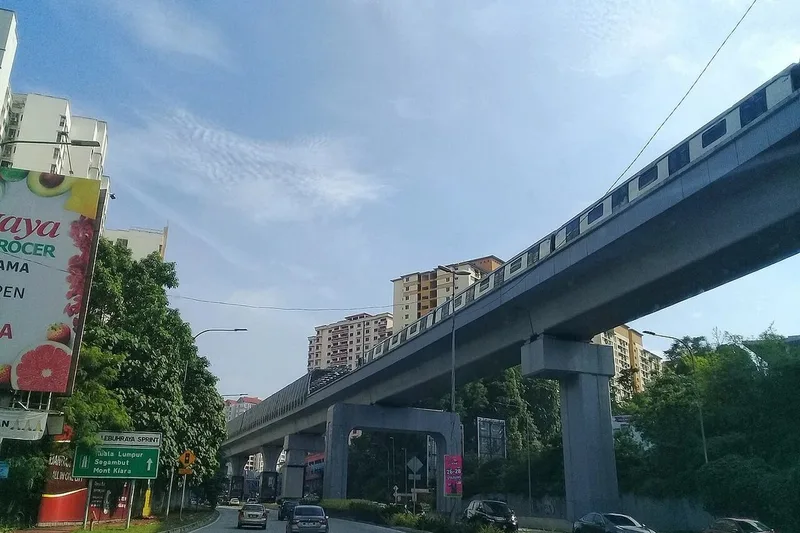
- Image: East Coast Rail Link works at Sungai Tua, Gombak, photographed in 2025, after the renegotiation. Photograph credit: Wiki Farazi. Original photograph · CC0. ↗
Figures are as reported by the companies or cited outlets as of 25 November 2026. Check the source before quoting. Corrections: let us know through the solution form.