What happened
Oldelval’s Duplicar project expanded the ability to move crude from the Neuquén Basin towards the Atlantic. At a bottleneck, producers may accept a lower local price or use a more expensive alternative to move a marginal barrel. Extra pipeline space can change both possibilities. The operator earns under its tariff arrangements. A producer can benefit through a better selling price even on barrels it was already selling. A government’s export receipts, meanwhile, depend on the value and destination of actual shipments.
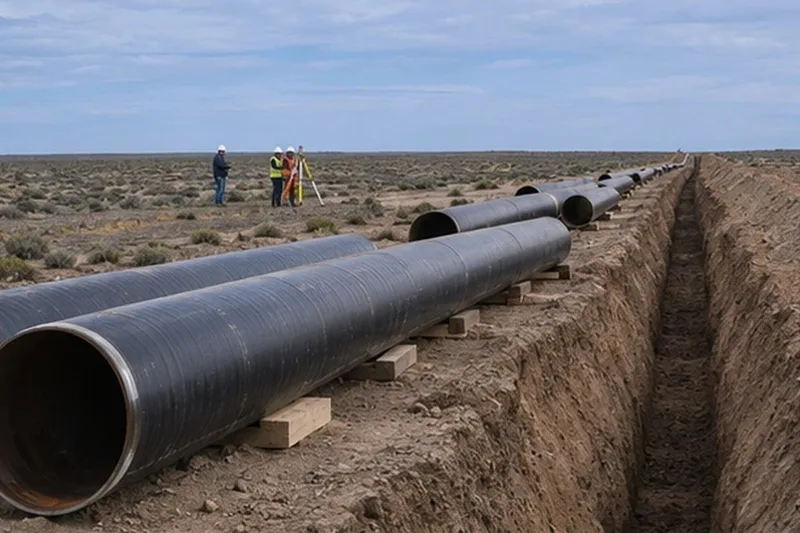
Oleoductos del Valle, or Oldelval, carries crude from the Neuquén basin, home to Vaca Muerta, towards the Atlantic. As shale output grew, pipeline space became a bottleneck. Oldelval’s Duplicar project added a 525-kilometre line from Allen to Puerto Rosales in Buenos Aires province, at a cost of US$1.4 billion.
It was inaugurated in April 2025, raising capacity from 225,000 to 540,000 barrels a day, with all the new capacity aimed at exports. Reuters reported it could boost exports by up to US$8 billion a year. Oldelval then started Duplicar Norte, a 207-kilometre line from Puesto Hernández to Allen costing about US$380 million, and Duplicar X, aiming for about 900,000 barrels a day.
The case shows that the value of a pipeline lies mainly in the higher prices producers can get, rather than in the tariff the pipeline earns.
For investors, pipelines such as Oldelval’s are often valued like utilities, on the basis of steady, contracted tariffs. Duplicar shows the other side: when a basin grows fast, the pipeline becomes the constraint on the whole industry. Producers then lobby for expansion, and the operator must decide how much capacity to build ahead of demand. Building too little leaves oil stranded; building too much leaves the operator with unused capacity if shale growth slows. Oldelval’s chief executive said at the inauguration that Duplicar would only cover upstream growth for about two years, which is why the next stages were approved so quickly. Demand had grown fast: in 2021 the system carried about 250,000 barrels a day, and by 2025 producers were already asking for far more space than that.
In 2026, Techint had completed the final weld on Duplicar Norte’s main line, which will connect at Allen with the rest of Oldelval’s system and with the Vaca Muerta Sur pipeline.
Key moments
The operator identifies a constrained route from the basin.
Oldelval announces the inauguration of Duplicar.
The scheduled inauguration marks the transition to expanded service.
Duplicar cost US$1.4bn; all the new capacity was geared to exports. Duplicar Norte was budgeted at about US$380m. Sources: Reuters via Pipeline & Gas Journal; BNamericas; El Economista.
The trade-offs at the heart of the case
Core tensions
A producer with no reserved slot might still benefit if local crude prices rise after congestion eases. A shipper that paid early to secure capacity may see part of its anticipated advantage accrue to competitors. Expansion can therefore create genuine economic value while distributing it differently from what the first subscribers expected. Reservation holders may be willing to pay extra for certainty that a cargo can meet its loading window. A shipper with variable output may instead prefer to keep its commitment small. Neither preference is irrational once missed sales and unused entitlements are priced separately.
Testing the evidence
The appropriate unit of observation is one nominated barrel-day. Track realised tariff revenue per available barrel of capacity and record the baseline before the decision. The most useful records are pipeline nominations, dispatch readings and shipper invoices. Align their dates and definitions before drawing an inference. In particular, allow for changes in world oil prices and basin production. A change in that factor can move the reported outcome even when the intervention has had no effect. Match shipments by origin and destination before comparing the cost of transport. Track local crude differentials at dates when the new route is available. A simultaneous oil-price move may raise invoice values at every destination without saying anything about the value of pipeline access.
A related Argentine case
Vaca Muerta Sur shows the lender’s view of firm capacity. The same minimum payment that strengthens a pipeline borrower’s credit can become a fixed burden for a producer when its drilling schedule slips.
For your seminar, paper or interview
- Q1
How could a producer gain from Duplicar without transporting an additional barrel?
- Q2
How would you measure realised tariff revenue per available barrel of capacity for one nominated barrel-day using the available records?
- Q3
Which assumption in “Firm capacity or pay as you go?” would you challenge first, and how would changing it affect the decision?
- Q4
Could changes in world oil prices and basin production explain the observed change? What evidence would distinguish that explanation?
- Q5
Under what conditions would you prefer allocating capacity first to existing constrained shipments, and who would bear the residual risk?
- Bottleneck economics
- Regulated tariffs
- Midstream investment
- Export capacity
How we would approach it
Simplifying Finance’s opinion, offered as a starting point for debate, not as fact or investment advice.
Assess pipeline collections, shipper cost savings and changes in local price differentials in separate schedules. Give priority to usage that replaces expensive transport already in operation. Treat future growth in basin production as an additional source of demand requiring its own evidence.
Expand ahead of demand
Build capacity for producers’ projected growth.
Tie capacity to exports
Dedicate new capacity to export volumes.
Plan the next stage
Start Duplicar X and Duplicar Norte immediately after.
What this plan gives up
New capacity removes a bottleneck and raises producers’ prices, but the operator only earns a transport tariff while producers capture most of the value, and the next bottleneck can appear quickly.
The strongest counter-argument
For the transport operator, the alternative worth costing is allocating capacity first to existing constrained shipments. Give both choices the same information date. Specify what can still be reversed, who absorbs the cost if the forecast is wrong, and the point at which new evidence would justify changing course. Make the decision conditional on an observable change in realised tariff revenue per available barrel of capacity. That condition lets someone outside the original decision team distinguish a sensible revision of the plan from an attempt to explain away poor results.
Metrics to watch
- Pipeline utilisation
- Duplicar Norte start-up
Propose your solution
Pick a discussion question and set out what you would do, why, and what it would cost. Strong, well-argued answers are reviewed and published below with your first name and programme.
Published solutions
Loading published solutions…
- Oldelval: Duplicar inauguration announcement ↗
- Oldelval: Duplicar project specifications and investment ↗
- Pipeline & Gas Journal (Reuters): Argentina opens $1.4 billion pipeline ↗
- BNamericas: US$1.4bn Oldelval pipeline ↗
- El Economista: Oldelval y Techint apuran el cuello de botella exportador ↗
- Oil & Gas Journal: Oldelval launches Duplicar Norte ↗
- Image: AI-generated editorial illustration
Figures are as reported by the companies or cited outlets as of 22 November 2026. Check the source before quoting. Corrections: let us know through the solution form.