What happened
A municipal allowance expressed per household sounds straightforward until several families use one connection, or one family is much larger than another. The municipality measures water at a meter. People use it in kitchens, bathrooms and shared yards. The relationship between those two units determines the practical value of a basic allowance.
Government guidance describes Free Basic Water as at least six kilolitres per household each month under the applicable arrangements, with local variation. Municipalities determine how they identify qualifying households and deliver basic services. The allowance addresses the price of a basic volume. A functioning connection and a reliable water supply are additional requirements.
The policy establishes a reference volume of 6,000 litres, not a national measurement of how much every person receives. The public guidance asks residents to confirm local rules. To establish delivery in a particular settlement, a reader would need local eligibility, connections, billing and service records for the period in question.
South Africa’s Constitution recognises a right of access to sufficient water. The Free Basic Water policy, introduced in 2001, sets a reference volume of at least six kilolitres per household each month at no charge.
Six kilolitres equals 6,000 litres. Spread over a month, that is about 200 litres a day for a household, or roughly 25 litres per person per day for a household of eight, a benchmark often used in South African policy.
Municipalities implement the policy and decide whether to provide free basic water to all households or only to registered indigent households. Many have moved from universal provision to targeted provision to protect revenue.
Stats SA data show the scale. In 2019, 13.1 million consumer units received water, and 4.0 million, or 31 percent, benefited from free basic water. In 2016 the figure had been 4.7 million.
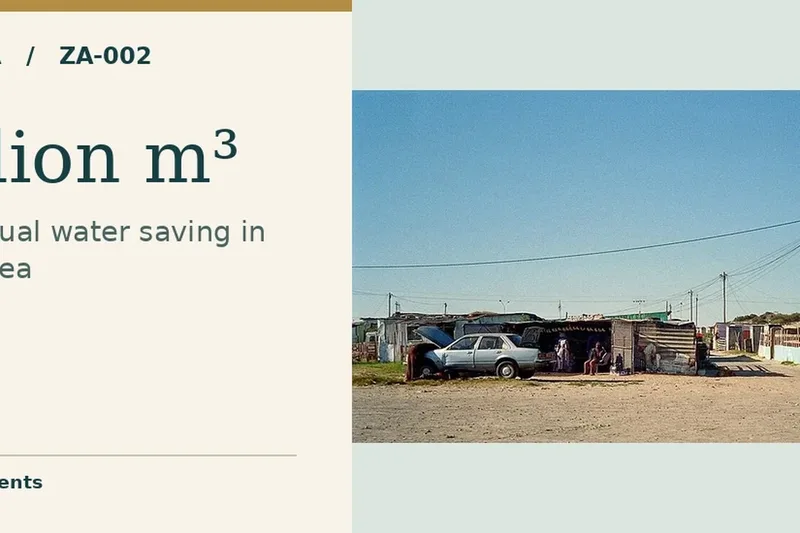
The challenge arises when one meter serves several families, as in backyard dwellings, or when a household is large. In these cases the free allowance may be used up quickly, and the extra water is charged at normal rates.
Many cities worldwide use rising block tariffs, where the first block of water is free or cheap and higher use costs more. This approach can fund the free allowance through charges on larger users.
The case also highlights the link between pricing and infrastructure. Free water only helps if the network delivers it reliably, so maintenance budgets must be protected.
Funding comes partly from national transfers to municipalities. The 2026 budget allocated R86.9 billion for free basic services, covering water, electricity, sanitation and refuse removal, to 11.2 million households.
A municipality’s ability to deliver free water also depends on collecting revenue from customers who can pay. Where billing and collection are weak, the cost of free services falls on a shrinking base, which can undermine maintenance.
Household size matters because the allowance is fixed. Spread across a thirty-day month, six kilolitres gives a household about 200 litres a day, so the amount available to each person falls as more people share the same connection. A large family or several families on one yard meter will reach the end of the free block much sooner than a small household.
This is why the unit of measurement matters. A meter records water used at a connection, not the number of people behind it, so any allowance set per connection treats a pensioner living alone and a crowded yard of tenants in exactly the same way. Designing a fairer allowance requires information on who lives where, which municipalities often do not have in a usable form.
The policy also shows how a legal right translates into a number. Choosing six kilolitres turned a constitutional principle into a quantity that municipalities could bill and budget for.
Key moments
Free Basic Water policy introduced.
4.7 million consumer units receive free basic water.
4.0 million of 13.1 million water consumer units receive FBW.
Source: Stats SA, Non-financial census of municipalities 2019.
The trade-offs at the heart of the case
Our assessment
Compare supporting an additional connection with changing the allowance on an existing one. The two choices have different consequences for privacy, continuity and who controls the bill. Use service and eligibility records together to find the households a purely financial adjustment would miss. A monthly allowance also creates a problem of financial incidence. If a property account receives a credit, the person listed on the bill and the people using the water may have different relationships to it. A tenant using a shared yard facility might pay an agreed charge that does not move automatically with the municipal bill. That is a possibility to investigate, not an assumption about every landlord or settlement. Interview intended users about the amount they actually paid and when service was available. A properly applied tariff credit can then be evaluated alongside the extent to which its benefit reached each household.
For your seminar, paper or interview
- Q1
Who could be missing from the reported measure of reliable access to the basic volume per eligible household?
- Q2
Which part of maintaining connections and matching households to accounts must be financed every year?
- Q3
How would evidence on occupancy and actual service at shared meters affect your choice?
- Lifeline tariffs
- Water rights
- Municipal finance
- Targeting
How we would approach it
Simplifying Finance’s opinion, offered as a starting point for debate, not as fact or investment advice.
We think a free basic allowance is a fair way to protect access to water, but a fixed volume per household can be unfair to large or shared households. Allowances based on the number of people would better match need.
Count people, not meters
Adjust allowances for household size.
Fix leaks
Prevent free water being lost before it is used.
Charge more for high use
Use rising block tariffs to fund the allowance.
What this plan gives up
A per-household allowance is easy to run but does not reflect household size.
The strongest counter-argument
Some argue free water reduces revenue that municipalities need for maintenance.
Metrics to watch
- Share of households receiving FBW
- Non-revenue water
Propose your solution
Pick a discussion question and set out what you would do, why, and what it would cost. Strong, well-argued answers are reviewed and published below with your first name and programme.
Published solutions
Loading published solutions…
- South African Government • access to free basic municipal services ↗
- South African Government • municipal service entitlements ↗
- Mail & Guardian • 2026 budget social wage ↗
- Stats SA • Non-financial census of municipalities 2019, media presentation ↗
- Stats SA • Non-financial census of municipalities 2016, media presentation ↗
- Photo: Communal tap (standpost) for drinking water in Soweto, Johannesburg, South Africa (2941729790) by SuSanA Secretariat, CC BY 2.0 (cropped and resized) ↗
Figures are as reported by the companies or cited outlets as of 22 November 2026. Check the source before quoting. Corrections: let us know through the solution form.