What happened
A pension appears in public accounts under the name of an older person. A child living in the same home may experience part of its benefit without appearing anywhere on the payment register. Evaluating the pension as if every household pooled and allocated its money in the same way would miss the importance of who actually received the payment.
Esther Duflo examined the expansion of South Africa’s old-age pension and the health of young children in households with older members. The analysis considered whether the pension recipient was a woman or a man and whether the child was a girl or a boy. Measures of growth allowed the study to examine outcomes beyond the amount of cash received.
Pensions received by women were associated with substantial improvements in girls’ height for age and weight for height in the study, with little corresponding change for boys. The result concerns a particular historical setting and household structure. It cannot be used as a general rule for how every grandparent spends money or how children will respond to a grant today.
In the early 1990s, as apartheid ended, the benefits and coverage of South Africa’s social pension were expanded for the Black population. By 1993 the pension was about twice the median income per person in rural areas, making it one of the largest cash transfers to poor households anywhere in the developing world.
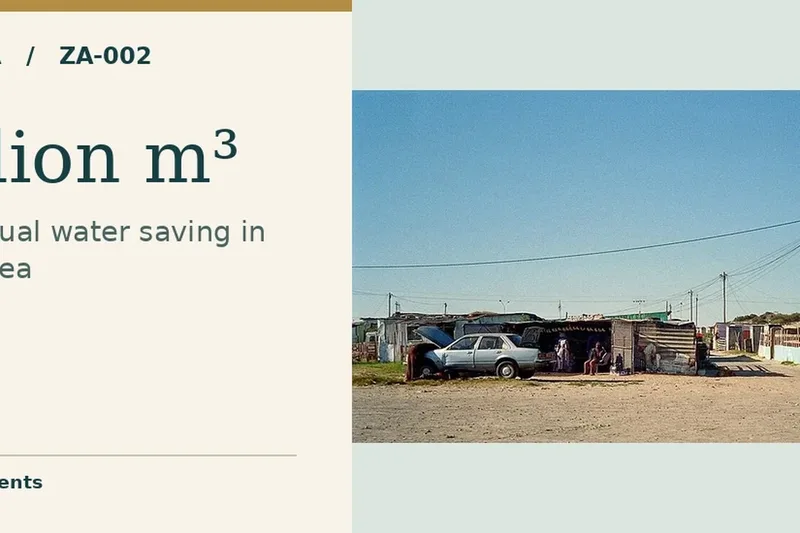
Many older South Africans lived in households with grandchildren, often because parents had migrated for work. Over a quarter of Black South African children under five lived with a pension recipient, so the pension effectively reached young children as well as the elderly.
Esther Duflo used data from a 1993 national household survey. A simple comparison would have been misleading: children living with pensioners were on average smaller for their age, because poorer families were more likely to include an older person. To get around this, she exploited the fact that pension eligibility changed sharply at specific ages, comparing children in households where the older member had just become eligible with those where they had not.
Her estimates suggest that pensions received by women improved girls’ weight given height by 1.19 standard deviations and their height given age by 1.16 standard deviations, while having little effect on boys. Pensions received by men had no similar effect.
The result challenged the ‘unitary’ model of the household, in which all income is pooled and spent according to a single set of preferences. If that model were right, it would not matter whether the grandmother or grandfather received the money.
The finding has influenced cash-transfer design worldwide. Programmes such as Mexico’s Progresa and Brazil’s Bolsa Família pay benefits mainly to mothers, partly on the basis of evidence like this.
For a finance student, the lesson is that money is not perfectly fungible inside a household. Who controls a payment can shape how it is spent, a principle that also applies to budgeting within families and organisations.
The study also illustrates a practical point about evaluating public spending. A pension budget line records payments to older people, yet some of the benefit shows up in children’s health. An evaluation that looked only at the recipients would have missed one of the programme’s most important effects.
Today the old-age grant remains one of South Africa’s main social grants, and the 2026 budget raised it to R2,400 a month. Its role in multi-generation households means it continues to support children as well as the elderly.
Duflo’s paper became one of the most widely cited studies of cash transfers in developing countries, and its finding that the gender of the recipient matters has been tested in many other settings since.
Key moments
Pension benefits and coverage expanded for Black South Africans.
National household survey used in the study.
Duflo’s study published in the World Bank Economic Review.
Source: Duflo, NBER Working Paper 8061 (2000). Estimates for girls; little effect for boys and none for pensions received by men.
The trade-offs at the heart of the case
Our assessment
Retain information on the composition of households when assessing an income-support program. The administrative cost of a grant is visible at payment. Some of its most important consequences emerge only when researchers follow other people who share that home. The study’s historical setting is central to the interpretation. A change in access to a pension in multigenerational households gave the researchers a way to ask whether income controlled by different adults had different consequences. It did not randomly assign grandparents to families. Before applying the result elsewhere, compare living arrangements, who cares for children, what other public support is available and how much the transfer changes household resources. A reader does not have to resolve every mechanism to recognize that a pension evaluation limited to the payee would omit an outcome the research was specifically able to observe.
For your seminar, paper or interview
- Q1
Who could be missing from the reported measure of child growth by age, sex and household composition?
- Q2
Which part of administering and delivering a pension must be financed every year?
- Q3
How would evidence on changes among children living with different recipients affect your choice?
- Intra-household allocation
- Cash transfers
- Programme evaluation
- Gender and finance
How we would approach it
Simplifying Finance’s opinion, offered as a starting point for debate, not as fact or investment advice.
We think this study changed how governments design cash transfers. The same rand had a different effect depending on who received it, which means the identity of the recipient is a policy choice, not an administrative detail.
Pay the caregiver
Direct transfers to the person who controls child spending.
Measure child outcomes
Track nutrition, not just payments.
Respect household diversity
Avoid assuming every household pools money.
What this plan gives up
Targeting a specific family member can improve outcomes but may create tension at home.
The strongest counter-argument
Some argue that households pool resources, so the recipient should not matter.
Metrics to watch
- Child growth indicators
- Share of grants paid to women
Propose your solution
Pick a discussion question and set out what you would do, why, and what it would cost. Strong, well-argued answers are reviewed and published below with your first name and programme.
Published solutions
Loading published solutions…
- Esther Duflo • Grandmothers and Granddaughters ↗
- National Bureau of Economic Research • old-age pensions and household allocation ↗
- BusinessTech • Social grant changes for South Africa in 2026 ↗
- World Bank Open Knowledge • Duflo (2003) publication page ↗
- Photo: Old South African Rand by South African Reserve Bank, Public domain (cropped and resized) ↗
Figures are as reported by the companies or cited outlets as of 22 November 2026. Check the source before quoting. Corrections: let us know through the solution form.