What happened
To take a job away from home, an adult may need money for travel and food before the first wage arrives. Someone must also care for children left behind. A pension changes income at home and may change who can provide care. Counting only the work of the pension recipient would miss a potential effect on the wider household.
Researchers followed rural South African households as they gained or lost a pensioner and tracked prime-aged members, including labour migrants. The longitudinal approach allowed them to examine changes around pension receipt. It also addressed a measurement problem. A person who leaves to work elsewhere can disappear from a simple count of adults at home.
The authors found greater employment among prime-aged adults, principally through labour migration. They identified resources to support a migrant and the presence of someone able to care for children as plausible mechanisms. The result concerns the studied households. It does not establish that pension receipts were usually transferred directly to an employer or that every move produced a secure job.
A common worry about cash transfers is that they discourage work. If a household receives a pension, might younger members stop looking for jobs?
Cally Ardington, Anne Case and Victoria Hosegood tested this using longitudinal data from rural KwaZulu-Natal. By following the same households over time, they could compare them before and after a member began, or stopped, receiving a pension.
This approach matters. Cross-sectional comparisons suggested pension households had lower employment, but that was because pension and non-pension households differed in other ways.
The longitudinal analysis found the opposite. Large cash transfers to elderly South Africans led to increased employment among prime-aged members of their households, mainly through labour migration.
The researchers identified two mechanisms. The pension increased household resources that could support a migrant until they found work, and pensioners could care for small children, allowing parents to leave.
The findings suggest that rural households face credit and childcare constraints that stop people moving to where jobs are. A pension can loosen those constraints.
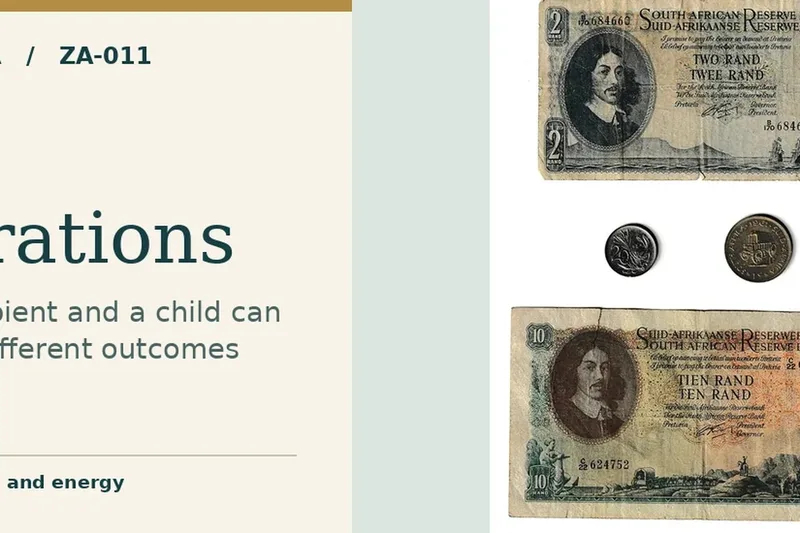
Today the old age grant pays R2,400 a month, and its role in multi-generation households means it can support employment as well as retirement.
The data came from a demographic surveillance area in rural KwaZulu-Natal, where researchers record who lives in each household and who has moved away. This made it possible to track migrants even after they left home.
In South Africa, differences in earnings and employment between rural and urban areas are large and persistent. Moving to a city can greatly improve a person’s job prospects, but it is costly and risky.
A migrant needs money for transport, a place to stay and food while looking for work. Without savings or access to credit, many rural households cannot afford to send a member to search for jobs, even when the expected payoff is high.
The pension acts like a source of finance. Its regular, reliable payments allow a household to support a family member through the search period, much as an emergency fund or line of credit would.
Childcare matters too. When a grandparent receives a pension and lives at home, parents can leave children in their care while they work elsewhere.
The finding cuts against the common assumption that transfers reduce work effort. Instead, by easing financial and childcare constraints, the pension appears to have helped people move to where jobs are.
The study also shows the value of longitudinal data. Following the same households over time revealed effects that a snapshot comparison would have hidden.
For policymakers, the lesson is that a transfer’s effects can spread well beyond the person who receives it.
Remittances sent home by migrants who found work can then add to household income, creating a cycle in which the pension helps finance a move that later brings more money back to the household. This is one reason researchers describe pensions as an investment in household mobility as well as support for the elderly.
Key moments
NBER working paper released.
Study published in AEJ: Applied Economics.
Old age grant rises to R2,400 a month.
Source: BusinessTech summary of the 2026 Budget Review.
The trade-offs at the heart of the case
Work through the evidence
Prepare a household roster that keeps a member working away visible. Record who paid for the first journey, when wages began, and who took over unpaid work. Contrast it with a survey counting only people physically present on interview day. Both surveys could be conducted accurately and still give different pictures of the effect on employment. Identify when money sent home is first observed. An adult may need support for some time after leaving and remit only later. A survey conducted between those dates might record only a cost to the household. Follow both the move and the later relationship with the family before judging the role of the pension in financing work.
For your seminar, paper or interview
- Q1
Who could be missing from the reported measure of employment among resident and migrant prime-aged adults?
- Q2
Which part of support for travel and care before the first wage must be financed every year?
- Q3
How would evidence on members who temporarily leave the household roster affect your choice?
- Credit constraints
- Labour migration
- Household economics
- Longitudinal data
How we would approach it
Simplifying Finance’s opinion, offered as a starting point for debate, not as fact or investment advice.
We think this study reveals a hidden benefit of the old-age pension. By funding the costs of searching for work and freeing up childcare, the pension helped younger adults migrate to jobs, showing that cash transfers can increase rather than reduce work.
Count household effects
Evaluate transfers across the whole household.
Support migrants
Reduce the cost of moving for work.
Expand childcare
Free parents to take jobs.
What this plan gives up
Transfers can enable work, but migration may separate families.
The strongest counter-argument
Some argue cash transfers discourage work among recipients’ relatives.
Metrics to watch
- Labour migration rates
- Employment of prime-aged adults
Propose your solution
Pick a discussion question and set out what you would do, why, and what it would cost. Strong, well-argued answers are reviewed and published below with your first name and programme.
Published solutions
Loading published solutions…
- Ardington, Case and Hosegood • Labor Supply Responses to Large Social Transfers ↗
- Longitudinal evidence on pension arrival and migration • research paper ↗
- NBER • Ardington, Case & Hosegood, Labor Supply Responses (w13442) ↗
- PMC • Ardington, Case & Hosegood (2009) full text ↗
- BusinessTech • Social grant changes for South Africa in 2026 ↗
- Image: original title graphic by Simplifying Finance
Figures are as reported by the companies or cited outlets as of 22 November 2026. Check the source before quoting. Corrections: let us know through the solution form.