What happened
When a bag is handed over as part of a purchase, shoppers have little reason to think about its price separately. An explicit charge makes the choice visible. Whether it keeps changing behavior depends on its size, alternatives and how quickly a customer becomes accustomed to the charge.
South Africa combined standards for plastic carrier bags with a charge at checkout in 2003. Researchers studied demand after introduction and as the price changed. The retail amount visible to a shopper and the portion accounted for as a government levy serve different purposes in the financial analysis.
The early rules and pricing reduced bag demand in the short run. A later analysis found a rebound when the price was set lower. The evidence concerns purchases of bags in the settings studied. It does not directly measure litter on beaches, total plastic waste or the environmental effect of every alternative bag.
Plastic shopping bags were once handed out free at South African checkouts and became a common source of litter. On 7 May 2003, the government introduced regulations that set minimum standards for bag thickness, imposed a levy and required retailers to sell bags rather than give them away.
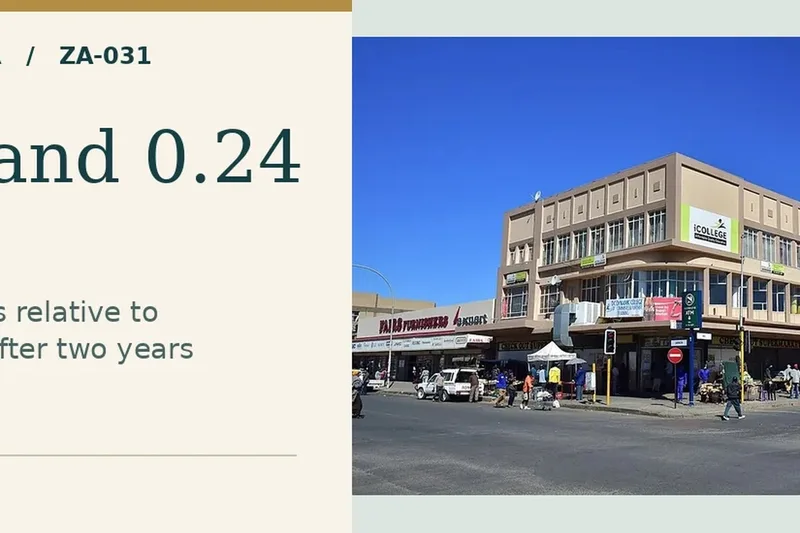
Charging began with a fixed nominal price of 46 cents for 24-litre bags across retailers, a price later lowered.
The policy sharply reduced plastic bag use in the short term. Researchers suggested that the initial fall reflected loss aversion: having long received bags free, shoppers disliked paying for them.
Over time, however, the effect faded. Once consumers became used to paying for bags, demand slowly rose back towards historic levels, unlike in Ireland and Denmark where levies curbed use more lastingly.
Researchers concluded that the levy was too small. Plastic bag demand was relatively price inelastic, so a small charge alone had limited long-run effect.
The experience has influenced later debates in South Africa and other countries about whether to raise charges, ban bags outright or encourage reusable alternatives.
The case is a useful example of hedonic adaptation in consumer behaviour: people adjust to a new price, and its power to change behaviour declines.
The case also shows the value of tracking a policy over many years. Early evaluations suggested the policy was working; only later studies revealed that the effect was fading.
Since then, many retailers have introduced their own measures, such as promoting reusable bags or removing single-use plastic bags entirely, alongside the government levy.
For policymakers, the lesson is that behavioural responses to a new charge can be strong but temporary, so policies should be designed and monitored with that pattern in mind. A charge that keeps pace with inflation, combined with cheap reusable alternatives, is more likely to sustain its effect.
It also illustrates the importance of price elasticity in tax design: when demand barely responds to price, only a substantial charge will change behaviour.
South Africa’s experience is now widely cited in international discussions of plastic bag policy, alongside the contrasting results from Ireland and Denmark, where levies curbed use more lastingly.
Key moments
Plastic bag regulations and checkout charges take effect.
First study finds short-run success but signs of decline.
Studies find demand returning towards historic levels.
Source: Dikgang, Leiman and Visser (2012).
The trade-offs at the heart of the case
Work through the evidence
Separate bags per shopping trip from bags per month. A shopper making fewer large trips may use more bags at each visit while using fewer overall. A switch to heavier bags may reduce the unit count without reducing material proportionally. To connect a checkout response to waste management, add evidence about material, reuse and disposal rather than valuing every bag avoided as an identical environmental saving. If the price of a bag becomes smaller relative to the cost of groceries, it may become less noticeable even without a formal policy reversal. Look at the price actually faced at checkout over the period studied. Then follow whether bags are reused, replaced by another material or discarded quickly. Each route has different financial consequences.
Our assessment
Review the price signal and waste outcome on separate calendars. An immediate fall in demand after a new charge can fade. Repeat observations once households have adjusted, and track alternatives that could shift the burden from one waste stream to another. A checkout charge can also perform more than one task. It can remind the shopper to bring a bag, change the cost of accepting one and provide revenue. These mechanisms need not have identical effects over time. A shopper who forms a habit may continue carrying a reusable bag after the price signal weakens, while another may return to disposable bags when the charge becomes less noticeable. A useful reassessment samples frequent and occasional shoppers and counts material, not merely bags. This makes it possible to distinguish a short-lived response after introduction from a more durable change in how goods are carried.
For your seminar, paper or interview
- Q1
Who could be missing from the reported measure of bags and material used per shopping trip?
- Q2
Which part of administration and collection of physical waste data must be financed every year?
- Q3
How would evidence on the durability of behavior change after the initial charge affect your choice?
- Environmental taxes
- Price elasticity
- Behavioural economics
- Policy evaluation
How we would approach it
Simplifying Finance’s opinion, offered as a starting point for debate, not as fact or investment advice.
We think the plastic bag levy is a clear example of how a small charge can lose its effect over time. Shoppers reacted sharply at first, but once paying for bags became normal, demand drifted back, which suggests charges must be large enough and paired with alternatives.
Set meaningful charges
Make the price high enough to matter.
Index the levy
Raise it over time to keep its bite.
Promote reusable bags
Make alternatives easy and cheap.
What this plan gives up
Small levies are easy to accept but lose effect as people adapt.
The strongest counter-argument
Some argue bans are more effective than charges.
Metrics to watch
- Bags sold per shopper
- Use of reusable bags
Propose your solution
Pick a discussion question and set out what you would do, why, and what it would cost. Strong, well-argued answers are reviewed and published below with your first name and programme.
Published solutions
Loading published solutions…
- Dikgang, Leiman and Visser • analysis of the plastic-bag levy ↗
- Hasson, Leiman and Visser • economics of South African bag legislation ↗
- Dikgang, Leiman & Visser • Analysis of the plastic-bag levy in South Africa (EconPapers) ↗
- Dikgang, Leiman & Visser • Elasticity of demand, price and time (Applied Economics, 2012) ↗
- Hasson, Leiman & Visser • The economics of plastic bag legislation (2007) ↗
- Image: original title graphic by Simplifying Finance
Figures are as reported by the companies or cited outlets as of 22 November 2026. Check the source before quoting. Corrections: let us know through the solution form.