Silver trading for complete beginners
Silver trades like gold but moves faster and is quoted in much smaller numbers. This chapter covers the basics: ways to get exposure, the key words and how one silver trade works from start to finish.
Ways to get silver exposure
Physical silver
Bars, coins and silverware. No leverage, but wide dealer spreads and bulky storage.
Silver funds
Shares in a fund that holds silver; no leverage.
Spot or CFD accounts
Trade XAG/USD long or short with leverage through a broker.
Futures
COMEX contracts: 5,000 ounces standard, 1,000-ounce Micro and a 100-ounce contract.
Silver is two metals in one
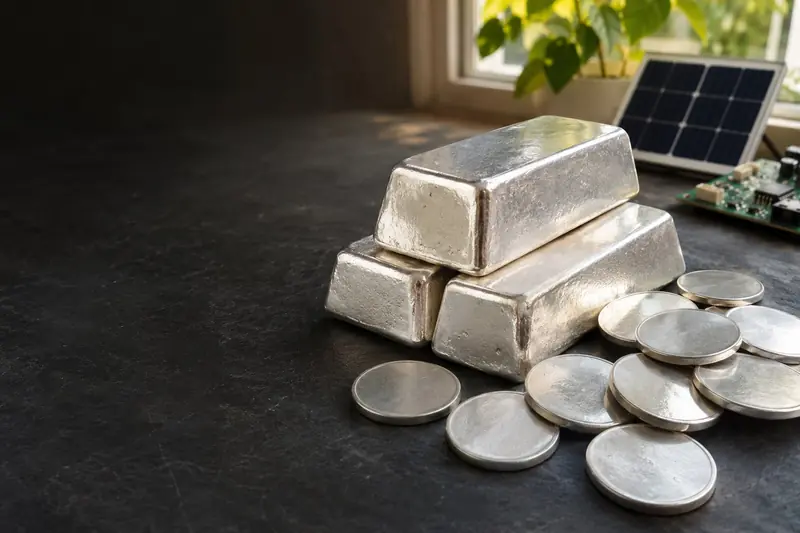
Silver is both a precious metal and an industrial metal. Like gold, it is bought as an investment and a store of value. Unlike gold, roughly half of annual demand comes from industry, where silver's unmatched electrical conductivity makes it valuable in electronics, solar panels, electrical contacts and medical products.
This dual role explains much of silver's behaviour. When investors seek safety or fear inflation, silver often rises with gold. When the global economy weakens and industrial demand falls, silver can lag gold or fall more sharply. Traders need to watch both sets of drivers.
The solar effect
Solar panels have become one of the largest sources of industrial silver demand. Each panel uses a small amount of silver paste to conduct electricity, and as solar installations have grown rapidly, especially in China, total demand from this sector has risen strongly.
Manufacturers continually try to use less silver per panel to reduce costs, so growth in solar does not translate one-for-one into silver demand. Still, the energy transition has become an important part of silver's long-term story and a factor that analysts watch closely.
Supply: mostly a by-product
Most silver is not mined for its own sake. Around 70% or more is produced as a by-product of mining other metals, such as lead, zinc, copper and gold. Mexico, China and Peru are among the largest producers.
This means silver supply does not respond quickly to silver prices. A rise in silver prices may not lead to much new production if the main metals at those mines are not also rising. Recycling, from old jewellery, silverware and industrial scrap, adds a further source of supply.
A volatile history
Silver has a history of dramatic price swings. In 1979 and early 1980, an attempt by the Hunt brothers and their associates to corner the market helped push silver to around USD 50 an ounce before it collapsed when exchanges tightened rules. In 2011, silver rallied close to USD 50 again before falling by more than half over the following years.
These episodes show how quickly silver can move when investor enthusiasm, leverage and limited liquidity combine. They are a reminder to treat silver positions with extra caution and smaller size.
The gold–silver ratio
The gold–silver ratio is the number of ounces of silver needed to buy one ounce of gold. Over recent decades, it has often moved between about 50 and 90. In times of financial stress, it can spike: in March 2020, it rose above 100 as silver fell much faster than gold.
Traders use the ratio to judge whether silver looks cheap or expensive compared with gold. A very high ratio suggests silver is relatively cheap, a low ratio that it is relatively expensive. The ratio can stay at extremes for a long time, so it is a guide to relative value, not a precise timing tool.
Ways to own silver in the UAE
Silver bars and coins are widely available from dealers in the UAE, including in Dubai's gold souk. Because silver is much cheaper per ounce than gold, storing a meaningful amount takes considerably more space, and dealer premiums over the spot price are usually higher than for gold.
Silver funds traded on international exchanges offer exposure without the storage challenge. Leveraged trading accounts allow both long and short positions but magnify risk, which is particularly important given silver's volatility.
Silver's volatility in numbers
Silver typically moves about twice as much as gold in percentage terms. If gold moves 1% in a day, a 2% move in silver would be normal. On days with major economic news, silver can easily move 4% to 6%.
For a trader, this means stops need to be wider and position sizes smaller than for a comparable gold trade. Keeping the amount at risk per trade the same, rather than the number of ounces, is the simplest way to adjust.
Common beginner mistakes with silver
- Confusing lot sizes and trading far more ounces than intended.
- Using the same stop distance as for gold, which is often too tight.
- Buying silver simply because it looks cheap compared with gold.
- Ignoring industrial demand and the state of the global economy.
- Holding leveraged positions for months and paying high overnight costs.
Most of these mistakes come from treating silver as a cheaper version of gold. It is a related but distinct market with its own risks.
Silver price drivers at a glance
- Gold's direction, which silver usually follows.
- Real interest rates and the US dollar.
- Industrial demand, especially from electronics and solar.
- Investment flows into silver funds and coins.
- Mine supply, much of it linked to other metals.
- Speculative positioning in futures markets.
On most days, gold and the dollar explain much of silver's move. Over months and years, industrial demand and supply become more important.
Understanding silver quotes
Silver is quoted in US dollars per troy ounce, usually to two or three decimal places. A move from USD 46.00 to USD 46.50 is 50 cents, or just over 1%. Because the numbers are small, it is easy to underestimate how much money is at stake. On a 5,000-ounce futures contract, that 50-cent move equals USD 2,500.
Retail platforms may quote silver in different lot sizes, such as 1,000 or 5,000 ounces per lot, or allow trades in single ounces. Always confirm the size of one lot and the value of a one-cent move before placing a trade.
Silver in a long-term portfolio
Some investors hold a small amount of silver alongside gold as part of a precious metals allocation. Silver's higher volatility means it can add more upside in strong precious metals markets but also larger losses in weak ones.
Because silver pays no income and can underperform for long periods, it is usually treated as a small, optional holding rather than a core investment. Physical silver also carries higher storage costs relative to its value than gold.
Frequently asked questions
Why is silver more volatile than gold?
It is a smaller market with large industrial demand, so it typically moves about twice as much as gold.
What is the gold–silver ratio?
The number of ounces of silver needed to buy one ounce of gold; traders use it to judge relative value.
What is silver used for?
Investment, jewellery and industry, including electronics and solar panels.
One silver trade from start to finish
You buy 500 ounces of silver at $46.00 with a stop at $45.20 and a target at $47.60.
If silver hits $47.60: profit = $1.60 × 500 = $800, minus the spread.
If silver hits $45.20: loss = $0.80 × 500 = $400.
A move of just 80 cents cost $400 — silver’s small numbers hide big money.
Beginner rules
Check lot size
On some platforms 1 lot of silver is 5,000 ounces — a $1 move is then $5,000.
Use stops
Silver can fall 5–10% in a day; never trade it without a stop-loss.
Start smaller than gold
Because silver swings more, begin with smaller sizes.
Learn gold too
Silver follows gold; read the gold guide’s basics as well.
- Confirm how many ounces one lot is on your platform.
- Always set a stop-loss.
- Practise on demo first.
Educational content, not investment or trading advice. Trading leveraged products carries a high risk of losing money.