What a target-date fund is
A target-date fund is an all-in-one portfolio designed around a retirement year, such as 2050. It holds a diversified mix of shares and bonds, often through other funds, and gradually shifts from mostly shares towards more bonds and cash as the target year approaches. This planned shift is called the glide path. The library lesson on target-date funds explains the basics.
Because a target-date fund is usually the default option in US workplace retirement plans, it is how many millions of people invest without making any active choice.
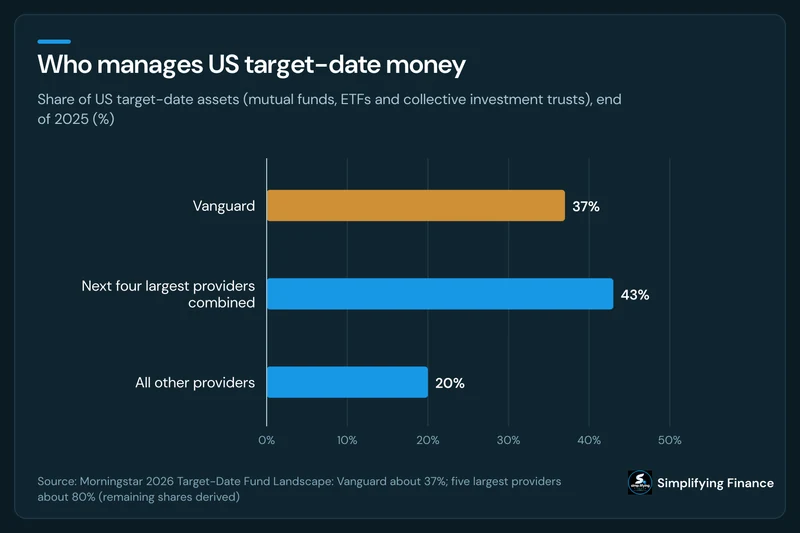
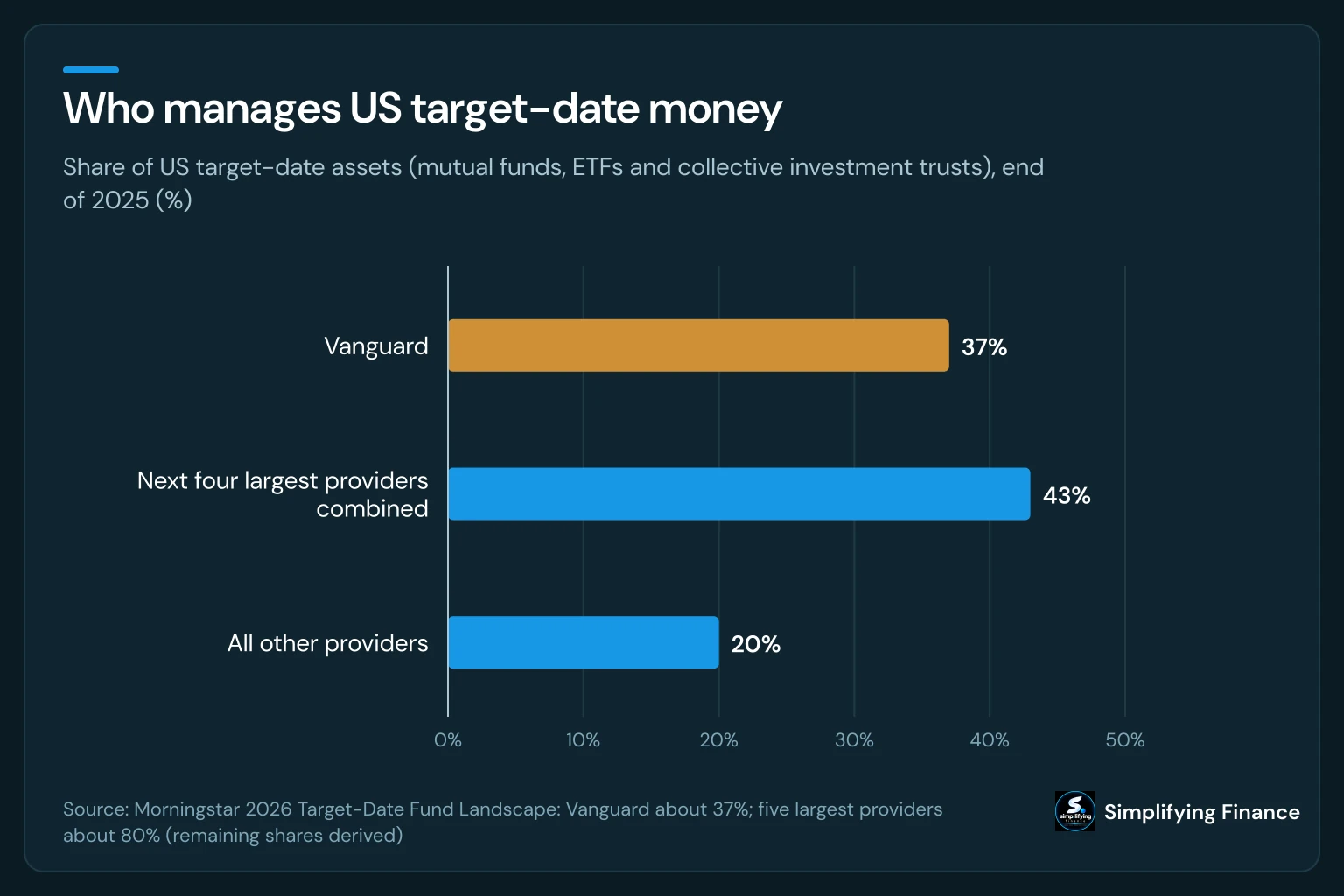
See the numbers behind the chart
| Provider | Share of assets |
|---|---|
| Vanguard | 37% |
| Next four largest providers combined | 43% |
| All other providers | 20% |
How big the market is
Morningstar reports that US target-date assets reached US$4.8 trillion in 2025, up 20.3% in a year, and have grown 11.9% a year over the past decade. The market is concentrated: the five largest providers control about 80% of assets, and Vanguard alone oversees about US$1.8 trillion, or 37%.
Collective investment trusts, lower-cost pooled vehicles available inside workplace plans, made up 54% of target-date assets at the end of 2025, having overtaken mutual funds in 2024. Some firms, such as Fidelity and Capital Group, lead in target-date mutual funds, while others, such as State Street and BlackRock, lead in collective investment trusts, according to Morningstar.
Costs are falling
Morningstar reports that the asset-weighted average expense ratio of target-date mutual funds fell to 0.27% in 2025, from 0.29% in 2024, and that fees have roughly halved over the past decade. Lower costs leave more of the return for savers, and the shift to collective investment trusts has pushed costs down further.
Glide paths differ
Providers make different choices about how much to hold in shares at each age. Morningstar found that the median gap in equity exposure between the most aggressive and the most conservative target-date series narrowed to 34 percentage points in 2025, from 49 in 2015. Even so, two funds with the same target year can hold quite different amounts in shares, and therefore carry different risks near retirement.
Model portfolios
Model portfolios are ready-made mixes of funds that financial advisers use to build clients' portfolios, usually from a single manager's funds. Large managers publish model portfolios for different risk levels, from cautious to adventurous. Like target-date funds, they package diversification into a single decision. The guide's page on model portfolios explains how they are built and what to compare.
Retirement income, not just a date
Some providers design their glide paths to reach the most cautious mix at the target date, while others keep reducing risk for years after it. The first approach is often called "to" retirement and the second "through" retirement. Knowing which approach a fund takes helps you understand how much it will hold in shares in your first years of retirement.
Mutual funds versus collective investment trusts
Target-date strategies are offered in two main wrappers in the United States. Mutual funds are open to the public and publish detailed reports. Collective investment trusts are available only within workplace retirement plans; they are usually cheaper but publish less information, as Morningstar notes. Many providers offer the same strategy in both wrappers, and plan sponsors have increasingly moved assets to the cheaper trusts.
Outside the United States, similar ready-made funds exist under different names, such as lifestyle or lifecycle funds, multi-asset funds and default pension funds. The principles are the same: a diversified mix that becomes more cautious over time.
When a ready-made mix fits
A ready-made mix suits investors who want broad diversification and automatic rebalancing without managing several funds. It is less suitable for someone whose circumstances differ from the assumptions built into the glide path, such as someone with a large pension, other big assets or a very different retirement date. In those cases, building a mix from a few index funds, as described in the guide's earlier pages, gives more control.
Reviewing a ready-made mix
Even a ready-made fund deserves an occasional review. Once a year, check that the target date still matches your plans, that the cost has not risen and that the share in equities fits the risk you can accept. If your circumstances change, for example if you plan to retire earlier or later, switching to a fund with a different target date is a simple way to adjust the mix.
A note on this page
This page describes these firms as fund managers for educational purposes. It is not a recommendation of any firm, fund or service. Figures are taken from each firm's own reports or from named data providers, as of the dates stated.
Two 2050 funds, two different mixes
Suppose two savers each have US$100,000 in a 2050 target-date fund, but from different providers. Ten years before retirement, one fund holds 70% in shares and the other 50%.
| Fund A: 70% shares | falls about 21% in a 30% share fall |
| Fund B: 50% shares | falls about 15% |
| Loss on US$100,000 | about US$21,000 vs US$15,000 |
| What to check | glide path and cost |
If shares fall 30% in a bad year and bonds are flat, the first saver's fund falls about 21% (about US$21,000) and the second's about 15% (about US$15,000). Same label, different risk. Checking the glide path is as important as checking the cost.
Where people go wrong
- Assuming all funds with the same year are alike. Equity shares near retirement can differ widely.
- Adding other funds to a target-date fund. This can undo the planned mix.
- Ignoring cost. Even small fee differences compound over decades.
- Choosing a year that does not fit you. Pick a date that matches when you will need the money.
- Ignoring other assets. A pension, property or savings elsewhere change the mix you need.
Put it to work
- Check the glide path. See how much the fund holds in shares at each stage.
- Compare costs. Look at the expense ratio of your default option.
- Keep it simple. If you use a target-date fund, avoid adding overlapping funds.
- Look at the whole picture. Count all your savings and pensions when judging your overall mix.
- Explore further. Return to the Portfolios & Diversification hub for the hedge funds section.
A target-date fund holds a mix of shares and bonds that becomes more cautious as a chosen year approaches. It is a simple, diversified default for many savers, but providers differ in their mixes, costs and assumptions.
Facts checked against the sources above on 27 November 2026. Figures are as of the dates stated and will change. Worked examples use round illustrative numbers to show the arithmetic, not forecasts. Educational content only, not personal investment advice.