What a hedge fund is
A hedge fund is a private investment fund open mainly to institutions and wealthy investors. Unlike most mutual funds and ETFs, hedge funds can sell short (profit when a price falls), borrow to increase their positions, use derivatives such as options and futures, and trade across shares, bonds, currencies and commodities. Many aim for returns that do not depend on the stock market going up.
Hedge funds traditionally charge both a management fee, a percentage of assets, and a performance fee, a share of profits. The classic structure was often described as "2 and 20": 2% of assets a year plus 20% of gains. Actual fees vary widely by firm and fund.
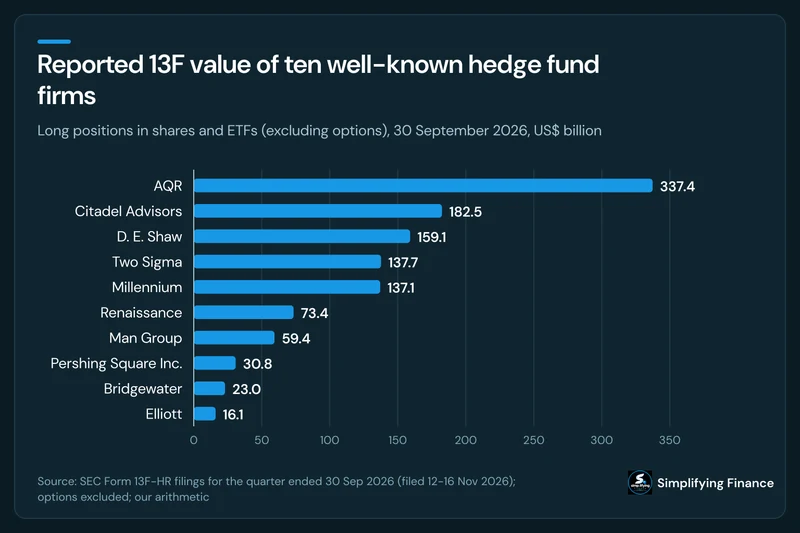
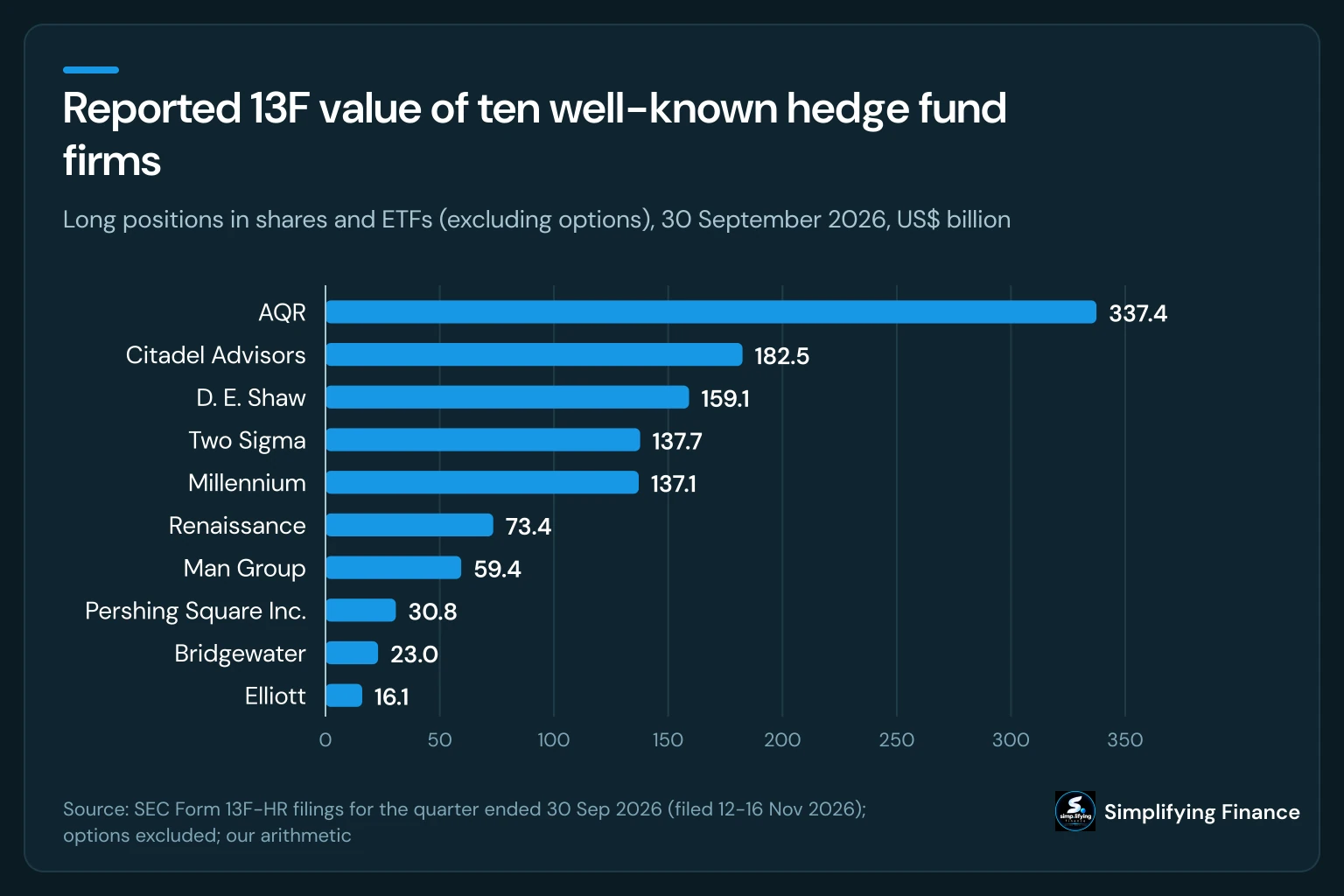
See the numbers behind the chart
| Firm | US$ billion |
|---|---|
| AQR | 337.4 |
| Citadel Advisors | 182.5 |
| D. E. Shaw | 159.1 |
| Two Sigma | 137.7 |
| Millennium | 137.1 |
| Renaissance | 73.4 |
| Man Group | 59.4 |
| Pershing Square Inc. | 30.8 |
| Bridgewater | 23.0 |
| Elliott | 16.1 |
What Form 13F is
In the United States, any institutional investment manager that exercises investment discretion over US$100 million or more in "Section 13(f) securities" must file Form 13F with the Securities and Exchange Commission (SEC) each quarter. Section 13(f) securities are mainly US exchange-traded shares, shares of exchange-traded funds and closed-end funds, and certain options, warrants and convertible bonds, as listed on the SEC's official list.
The filing is due within 45 days of the end of each quarter. For the quarter that ended on 30 September 2026, the filings used in this section were made between 12 and 16 November 2026.
What a 13F does not show
A 13F is a list of long positions only. Short positions, which are central to many hedge fund strategies, are not reported. Nor are most bonds, cash, currencies, commodities, futures, private investments, or shares listed only outside the United States. Borrowing is invisible. So a 13F can make a fund that is carefully hedged look like a simple stock portfolio.
Options are reported by the value of the shares they relate to, not by what the option itself cost. That is why some firms' 13F totals look enormous: in the quarter to September 2026, Citadel Advisors reported about US$717 billion of call and put options on that basis, against about US$183 billion in shares. A put option is often protection against a fall, not a bet on a rise.
The 45-day delay
By the time a 13F is public, the positions are at least six weeks old, and some funds trade very actively. Renaissance Technologies' filing for the quarter showed 591 new positions and 580 positions sold out completely compared with June, according to a tally of its filings. A snapshot this old may say little about what a fast-trading fund holds today.
How this section uses 13F data
The following pages describe ten well-known firms: Bridgewater, Renaissance Technologies, Citadel, Millennium, D. E. Shaw, Two Sigma, Elliott, Pershing Square, Man Group and AQR. For each, we show only what its own 13F for the quarter ended 30 September 2026 discloses, with the filing date, and we explain what the filing can and cannot tell you. We do not estimate assets or returns that firms do not publish.
How to read a 13F yourself
Every 13F is free to read on the SEC's EDGAR system. Search for the firm's name, choose the filing type 13F-HR, and open the information table. Each row lists the issuer, the class of security, a CUSIP identifier, the value in US dollars, the number of shares, and whether the row is a put or call option. The cover page shows the quarter-end date ("period of report") and the date the filing was made.
Some firms file under more than one entity, and some change filer over time, so check which entity filed each report before comparing quarters. Totals published by data websites may differ slightly depending on whether they include options and how they group share classes. The figures in this section were calculated directly from the filings, excluding options unless stated.
Main types of hedge fund strategy
Hedge funds follow many different strategies. Long-short equity funds buy shares they like and short those they dislike. Global macro funds trade interest rates, currencies and commodities based on economic views. Quantitative funds use computer models. Multi-strategy firms combine many teams and approaches under one roof. Activist funds take large stakes and press companies for change. Event-driven funds trade around mergers, restructurings and other corporate events.
Each strategy produces a very different-looking 13F, or in some cases almost none, because its main positions are not Section 13(f) securities.
A note on this page
This page is educational only. Holdings come from the firm's SEC Form 13F-HR for the quarter ended 30 September 2026, as filed; values are as reported and percentages are our arithmetic on the filing. A 13F is a snapshot of certain long US-listed positions on one date. It does not show short positions, most non-US holdings, bonds, cash or private investments, and positions may have changed since. Nothing here is a recommendation to buy or sell any security.
Why a 13F can mislead
Imagine a fund with US$1 billion of capital. It buys US$800 million of shares it likes and sells short US$800 million of shares it dislikes in the same industries. Its net exposure to the market is roughly zero.
| Capital | US$1 billion |
| Long shares (on 13F) | US$800 million |
| Short shares (not on 13F) | US$800 million |
| Net market exposure | about zero |
Its 13F would show only the US$800 million of long positions. A reader might conclude the fund is fully invested in shares and would lose heavily in a crash. In reality, the short positions are designed to offset much of a market fall.
Where people go wrong
- Treating a 13F total as a fund's size. It excludes shorts, bonds, cash, non-US shares and leverage.
- Reading put options as bets on a rise. Puts usually gain when prices fall; they are often protection.
- Assuming the positions are current. Filings arrive up to 45 days after the quarter ends.
- Ignoring what is missing. Short positions can change the whole picture.
- Comparing filings from different filers. Check which entity filed each 13F.
Put it to work
- Read the filing yourself. Search a firm's name on SEC EDGAR and open its latest 13F-HR.
- Check the date. Note both the quarter-end date and the filing date.
- Separate shares from options. Look at the put/call column before drawing conclusions.
- Use the official source. Prefer SEC EDGAR over third-party summaries when figures differ.
- Read on. Next: Bridgewater Associates.
A 13F lists certain long positions in US-listed shares, ETFs and options on one day each quarter, filed up to 45 days later. It is a useful but partial snapshot: no short positions, no bonds or cash, and often a very different picture from the fund's real risk.
Facts checked against the sources above on 27 November 2026. Figures are as of the dates stated and will change. Worked examples use round illustrative numbers to show the arithmetic, not forecasts. Educational content only, not personal investment advice.