Two returns in one
When you buy shares or bonds priced in another currency, your result in your own money has two parts: the return of the investment in its local currency, and the change in the exchange rate between that currency and yours. If the foreign currency strengthens against yours, it adds to your return; if it weakens, it subtracts.
The library lessons on exchange rates and currency pegs explain how currencies are priced. This page shows how large the currency part of a portfolio's return can be.
See the numbers behind the chart
| Year | In local currencies | In US dollars |
|---|---|---|
| 2020 | +6.0% | +10.7% |
| 2021 | +13.0% | +7.8% |
| 2022 | -9.6% | -16.0% |
| 2023 | +14.1% | +15.6% |
| 2024 | +12.6% | +5.5% |
| 2025 | +24.4% | +32.4% |
What the numbers show
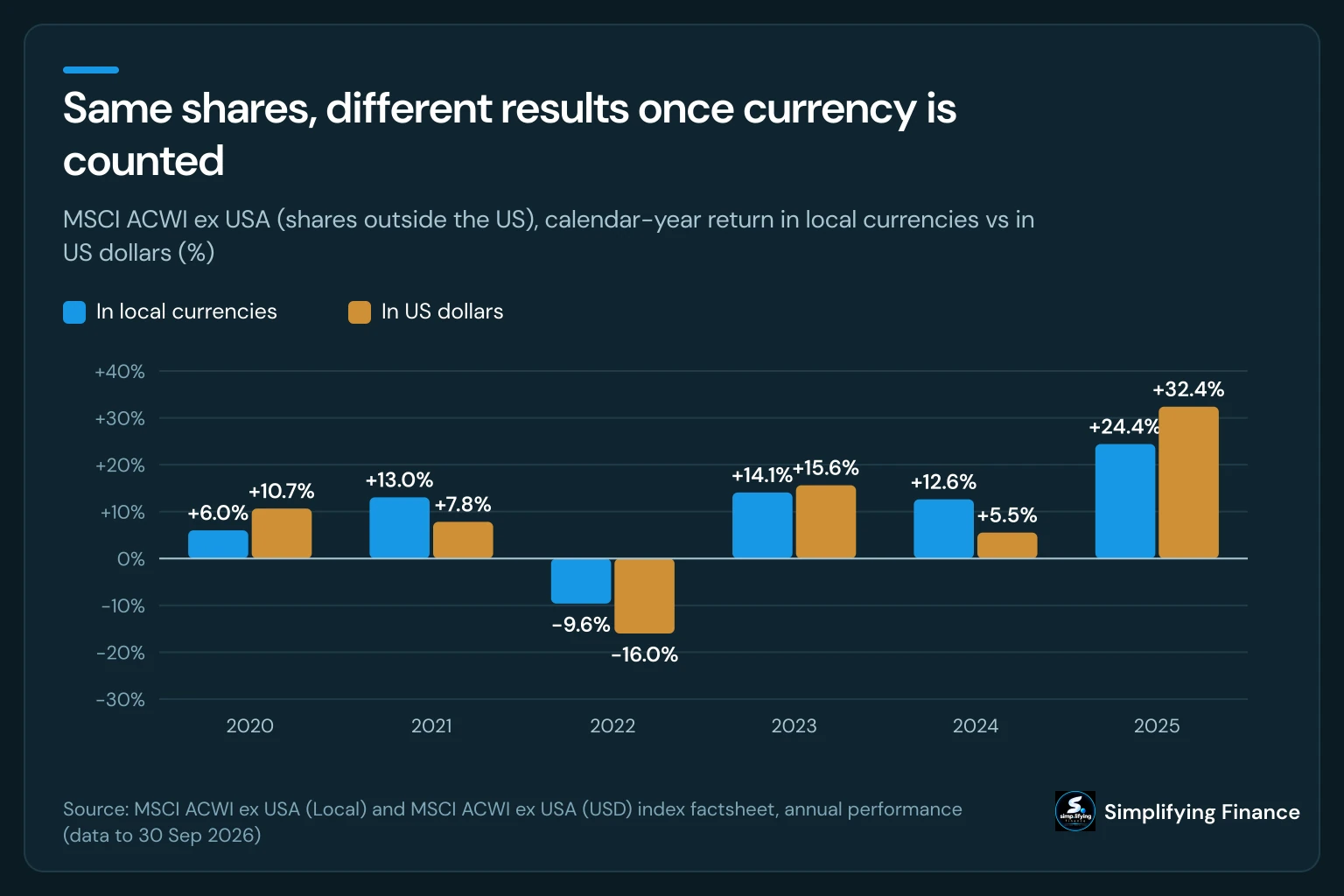
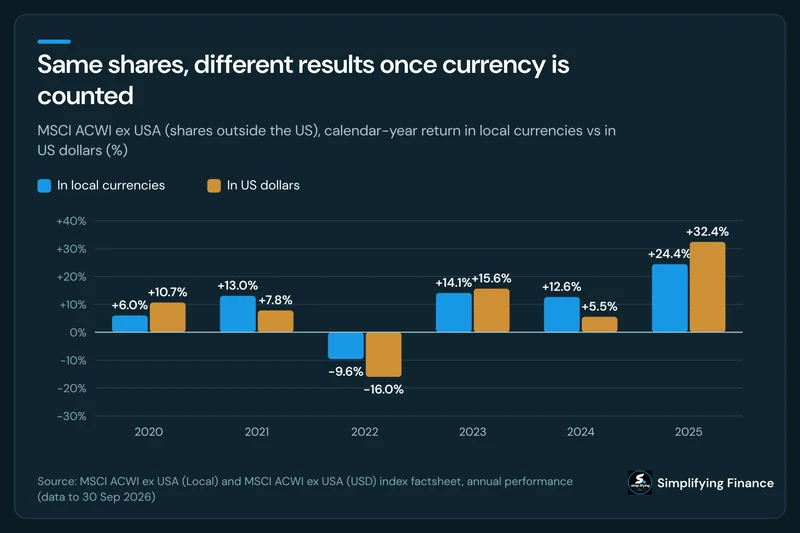
MSCI publishes the same index of shares outside the US in local currencies and in US dollars. In 2022 the index fell about 9.6% in local currencies but about 16.0% for a US-dollar investor, because the dollar strengthened. In 2024 it rose about 12.6% in local terms but only about 5.5% in dollars. In 2025 it was the reverse: about 24.4% in local currencies and about 32.4% in dollars, as the dollar weakened.
The shares were the same in each case. Only the currency in which the result was measured changed, and that alone moved the yearly return by up to about eight percentage points.
Currency risk from your point of view
Currency risk always depends on where you live and spend. For a US investor, a weaker dollar helps foreign holdings. For a saver in Europe, India or Brazil, the same move in the dollar can hurt the US part of their portfolio. MSCI noted in 2022 that US investors with unhedged foreign holdings saw the strong dollar take a bite out of their returns just as markets were falling.
Because a world share fund is now mostly US companies, as an earlier page showed, savers outside the US often have a large exposure to the US dollar without thinking of it as a currency decision.
Over longer periods
Currency effects tend to be large in single years and smaller, though not zero, over long periods, because exchange rates often move back and forth. Over the decade or more that most long-term savings are invested, the asset's own return usually matters more than the currency. But "usually" is not "always": some currencies have weakened steadily for decades against others, and investors in them have gained from holding assets abroad.
That is why the currency decision is best made as part of the overall plan, not in response to one year's move.
When currency risk helps
Currency exposure is not only a risk. For a saver whose home currency tends to weaken in crises, owning assets in stronger currencies can act as protection: when the home currency falls, the value of foreign holdings rises in local terms. Many people in countries with a history of currency falls hold some savings abroad for exactly this reason.
For savers whose currency is pegged to another, such as currencies fixed to the US dollar, the picture is different again: holdings in the anchor currency carry little currency risk while the peg holds.
Shares versus bonds
Currency swings matter most relative to the asset's own volatility. Shares already move a lot, so currency adds a smaller proportion of extra risk. Bonds are meant to be steady, so currency swings can easily dominate their returns. That is why, as the next page shows, many investors treat currency differently for shares and bonds.
Matching currencies to spending
A useful starting point is to ask which currency your future spending will be in. Money for school fees, a home or retirement in your own country is best measured in your own currency. Holding some assets in other currencies spreads risk, but holding most of your near-term money in a foreign currency adds risk you may not need.
Currency as a source of diversification
Holding assets in several currencies spreads a risk that every saver faces: that their own currency loses value. A portfolio held entirely in one currency is exposed to that country's inflation, interest-rate decisions and economic shocks. A modest spread across currencies reduces dependence on any one of them, even though it adds some year-to-year noise.
The right amount depends on your situation: where you will spend your money, how stable your currency has been, and what you can legally and practically hold.
A euro saver and a US fund
Take a saver in Ireland with €20,000 in a US share fund. Suppose US shares rise 10% in dollars over a year. These are round illustrative numbers.
| US shares in dollars | +10% |
| Dollar +5% vs euro | about +15.5% (+€3,100) |
| Dollar -10% vs euro | about -1% (-€200) |
If the dollar also rises 5% against the euro, the saver gains roughly 15.5% in euros, about €3,100. If instead the dollar falls 10%, the gain shrinks to roughly -1%, a small loss of about €200, even though the US shares did well. Same shares, very different outcome.
Where people go wrong
- Ignoring currency when comparing returns. Always check which currency a return is quoted in.
- Assuming a "global" fund has no currency risk. A world fund in your local currency still holds foreign assets.
- Holding near-term money in a foreign currency. Money needed soon is safest in the currency you will spend it in.
- Judging currency effects by one year. Currency moves often reverse; yearly gaps can partly cancel over time.
- Forgetting hidden currency exposure. A local-currency fund that holds foreign assets still carries their currency risk unless it is hedged.
Put it to work
- List your currencies. Estimate how much of your savings sits in each currency, including inside funds.
- Compare with your spending. Note which currencies your future bills will be in.
- Look at bonds first. Check whether your foreign bond holdings are currency-hedged.
- Note the fund currency. Check whether your funds are hedged, and to which currency.
- Read on. The next page asks whether to hedge currency risk at all.
Foreign investments carry two risks in one: the asset and the currency. Over a single year the currency part can be as large as the asset part.
Facts checked against the sources above on 27 November 2026. Figures are as of the dates stated and will change. Worked examples use round illustrative numbers to show the arithmetic, not forecasts. Educational content only, not personal investment advice.