What hedging does
A currency-hedged fund uses contracts, usually rolling one-month forward contracts, to lock in exchange rates on its foreign holdings. The aim is that your return reflects the investments themselves rather than currency moves. The library lesson on currency hedging explains the mechanics. This page looks at when it helps a portfolio.
Hedging is not free. Its cost or benefit depends partly on the difference in interest rates between the two currencies, and the fund has to trade the contracts regularly.
See the numbers behind the chart
| Year | Hedged to US dollar | Unhedged, in US dollars |
|---|---|---|
| 2022 | -15.4% | -18.1% |
| 2023 | +24.3% | +23.8% |
| 2024 | +21.9% | +18.7% |
| 2025 | +19.0% | +21.1% |
Why it matters more for some savers
For a saver in a large economy with deep markets at home, foreign holdings may be a modest share of the portfolio, and the hedging choice makes a limited difference. For a saver in a smaller economy who holds most of their investments abroad, the choice affects a much larger share of their wealth. The more of your portfolio sits in foreign currencies, the more carefully the hedging decision deserves to be made.
It also matters more as the date you need the money gets closer, because there is less time for currency swings to even out.
Hedging shares: a close call
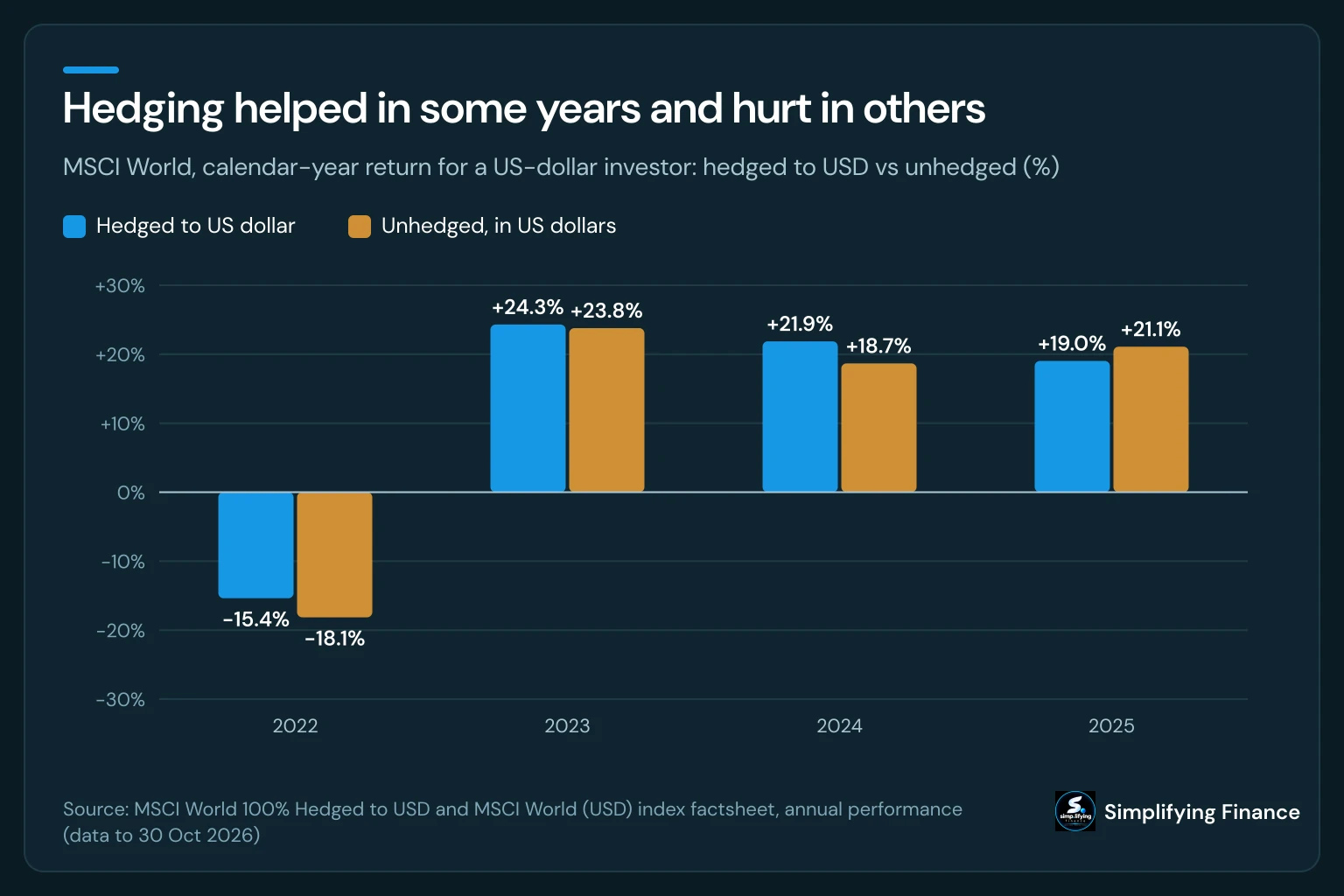
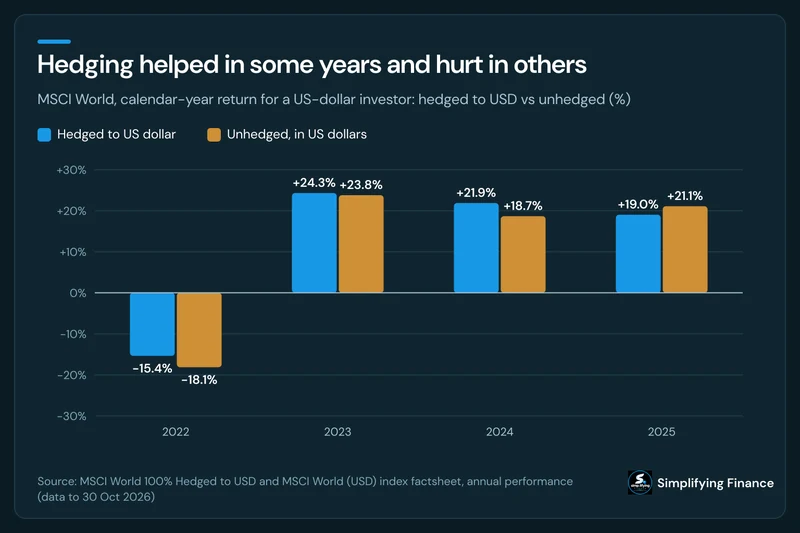
MSCI's figures for its world share index show how mixed the results are. For a US-dollar investor, the hedged index returned about -15.4% in 2022 against about -18.1% unhedged, then about 24.3% vs 23.8% in 2023, about 21.9% vs 18.7% in 2024, and about 19.0% vs 21.1% in 2025.
Over a few years the differences partly cancel. Because shares already swing a lot, currency adds only a modest amount of extra volatility, and for some investors currency exposure even reduces risk, as the previous page explained.
Hedging bonds: usually clearer
Vanguard's research on global bonds has found that currency hedging is crucial to generating returns with lower volatility, because unhedged currency moves can swamp the steady returns that bonds are meant to deliver. Its 2026 multi-asset study proposes a practical rule of thumb: hedge bond exposures, while leaving most foreign equities unhedged.
The logic is that bonds are held for stability. If the currency part of their return is larger than the bond part, they stop doing their job.
Why the hedged return differs
A hedged investor gives up the currency's ups and downs but takes on a different effect: the difference in short-term interest rates between the two currencies. When a saver's home interest rates are higher than the foreign ones, hedging tends to add a little to returns; when they are lower, it tends to subtract. Over long periods this effect can be meaningful, especially for bonds.
Vanguard's analysis notes that forward rates, and therefore hedge returns, follow spot exchange rates closely over time, so hedging reduces year-to-year swings more than it changes long-run wealth.
Your currency changes the answer
Vanguard's research also notes that hedging reduces standalone currency risk, but its effect on total portfolio volatility depends on whether the currency acts as a stabiliser or an amplifier of asset returns. For savers whose home currency tends to fall in global crises, unhedged foreign shares can soften losses. For savers whose currency tends to rise in crises, hedging may reduce risk more.
For currencies with limited hedging markets, or with high local interest rates, hedging can be expensive or unavailable. In those cases many investors simply accept currency exposure as part of holding assets abroad.
Practical availability
Not every fund is offered in a hedged version for every currency. Investors in smaller currencies may find few hedged options, or options with high costs. In practice, many savers end up with hedged bond funds in a major currency close to their own, and unhedged share funds. That is often a reasonable outcome.
Partial hedging
Hedging does not have to be all or nothing. Some investors hedge half of their foreign share holdings, accepting some currency movement while reducing the extremes. What matters most is choosing deliberately, rather than owning whichever version of a fund happened to be offered.
Keep the decision simple
For most savers, the currency decision does not need to be complex. Decide once for bonds and once for shares, write down the reason, and review it only if your circumstances change, for example if you move country or start spending in a different currency.
A UK saver's two global bond funds
Take a UK saver with £30,000 in global bonds. Suppose the bonds themselves return 3% in a year and sterling rises 8% against the other currencies they are priced in. Use round illustrative numbers and ignore hedging costs.
| Bond return in local currencies | +3% |
| Hedged to sterling | about +3% (+£900) |
| Unhedged, sterling up 8% | about -4.6% (-£1,400) |
In a fund hedged to sterling, the saver gets roughly the 3% bond return, about £900. In an unhedged fund, the stronger pound turns that into a loss of roughly 4.6%, about £1,400, even though the bonds did their job. That gap is why many bond investors choose hedged funds.
Where people go wrong
- Assuming hedging always wins. For shares, hedged and unhedged results swap places from year to year.
- Leaving foreign bonds unhedged by accident. Currency swings can overwhelm the steady return bonds are meant to provide.
- Ignoring the cost. Interest-rate differences and trading costs affect hedged returns.
- Switching after a currency move. Changing your hedging choice after a big move is a form of market timing.
- Hedging to the wrong currency. A fund hedged to US dollars does not protect a saver who spends in another currency.
Put it to work
- Check your bond funds. Look on the fact sheet for "hedged" and the currency it is hedged to.
- Decide on shares. Choose unhedged, hedged or a split for foreign shares, and write down why.
- Think about your currency. Consider how your home currency usually behaves in global crises.
- Match the hedge. If you hedge, choose a fund hedged to the currency you spend.
- Read on. The next page looks at saving in high-inflation economies.
A common rule of thumb from research: hedge foreign bonds, and leave most foreign shares unhedged. Your own currency and goals can change that answer.
Facts checked against the sources above on 27 November 2026. Figures are as of the dates stated and will change. Worked examples use round illustrative numbers to show the arithmetic, not forecasts. Educational content only, not personal investment advice.