What drift is
Every portfolio starts with a chosen mix, such as 60% shares and 40% bonds. As each part earns a different return, the mix changes by itself. When shares rise faster than bonds, the share slice grows; after a crash, it shrinks. This is called drift.
The library lesson on rebalancing explains how to bring a portfolio back to its target. This page shows how far drift can go when nobody steps in.
Drift is not a mistake by the investor; it is simply what happens when different assets earn different returns. The only question is whether you manage it or let it run.
See the numbers behind the chart
| End of year | Share in shares |
|---|---|
| Start 2009 | 60% |
| 2010 | 69% |
| 2013 | 76% |
| 2017 | 81% |
| 2021 | 88% |
| 2025 | 92% |
A real 17-year example
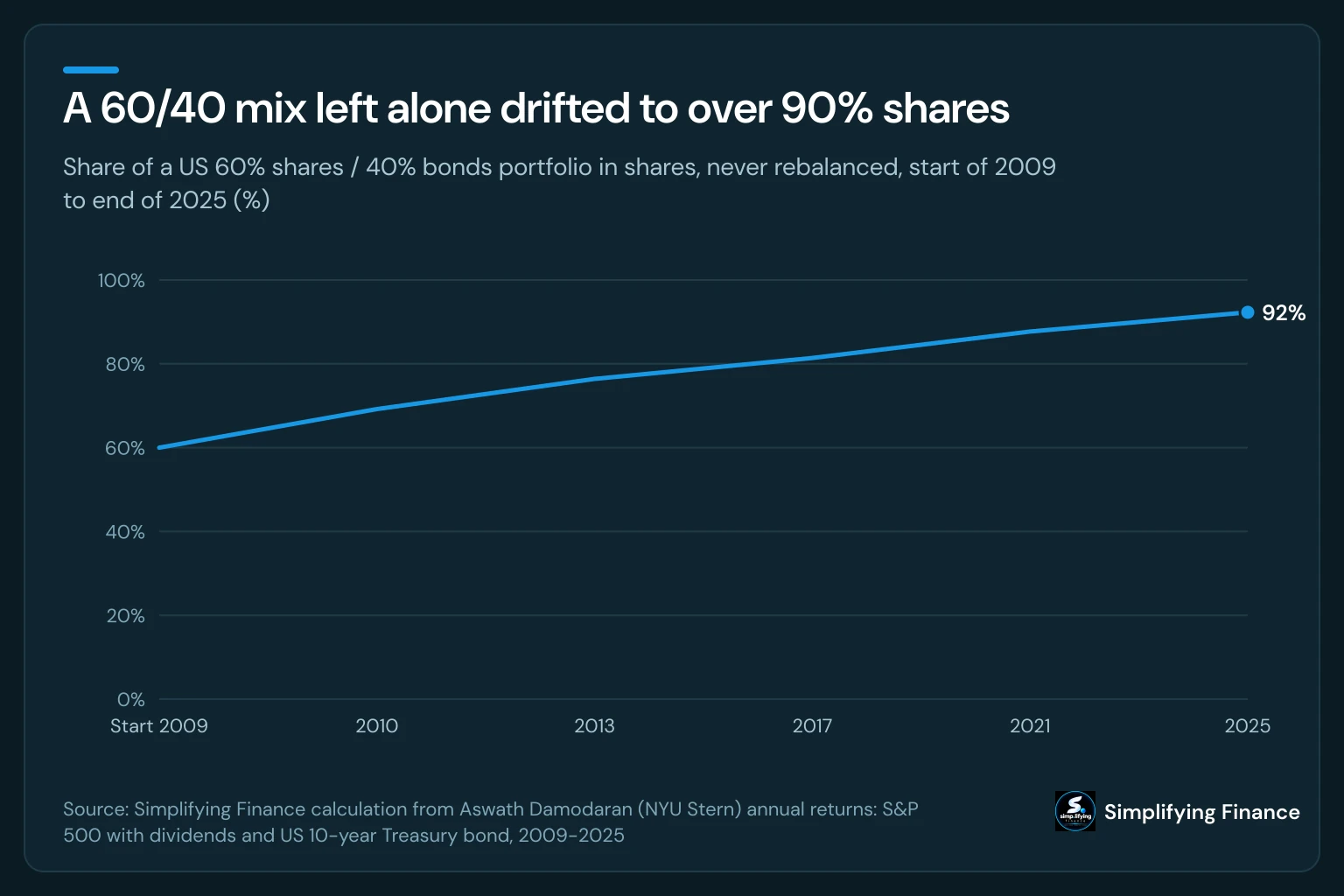
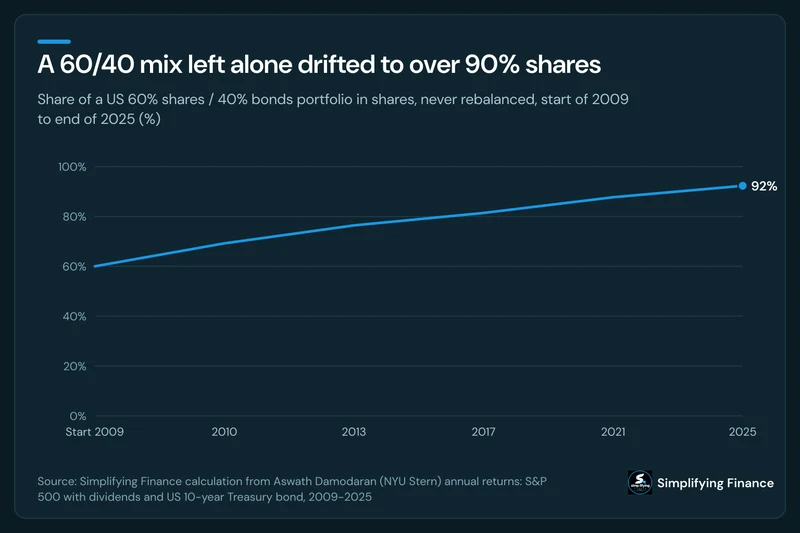
We took Aswath Damodaran's annual returns for the S&P 500 (with dividends) and the US 10-year Treasury bond and followed a 60/40 portfolio from the start of 2009 with no rebalancing. By the end of 2013 it was about 76% shares, by the end of 2017 about 81%, by the end of 2021 about 88% and by the end of 2025 about 92%.
That happened because US shares had a long, strong run while bonds earned much less, and in 2022 both fell. The investor who chose a balanced mix in 2009 ended up with something close to an all-share portfolio, without ever deciding to take that risk.
Why drift matters
A portfolio that is 90% shares will fall much further in a bad year than one at 60%. The extra risk builds up slowly, often during calm, rising markets, when it is least noticeable. Then it shows up all at once in a fall.
Drift also works in reverse. After a crash, shares shrink as a share of the portfolio, and an investor who never rebalances ends up holding less in shares just when they are cheapest.
In practice, that means the investor who never rebalances tends to own the most of whatever has already risen most, which is the opposite of buying low and selling high.
Why 2022 did not reset the drift
Many people assume a bad year automatically brings a portfolio back into balance. In 2022, however, US shares fell about 18% and 10-year Treasury bonds fell about 17.8% in Damodaran's data. Because both parts fell by similar amounts, the drifted portfolio stayed at roughly 88% shares. Only deliberate rebalancing would have brought it back to 60%.
This is a good illustration of the earlier page on 2022: when the usual cushion fails, the mix you hold going into a bad year is the mix you keep.
Drift happens inside asset classes too
The same effect works within shares. A single sector, country or company that does well grows as a share of your holdings, as the pages on sector concentration and the top 10 showed. Rebalancing is the tool that turns those drifts back into deliberate choices.
Ways to manage drift
There are three common approaches. Calendar rebalancing resets the mix on a fixed date, for example once a year. Threshold rebalancing resets it whenever a part moves more than a set amount, such as five percentage points, from its target. And cash-flow rebalancing uses new savings or withdrawals to top up whatever is underweight, which avoids selling.
Each has costs, including trading fees and, in some countries, taxes on gains. Many investors find that checking once a year and acting only on large gaps is enough.
Choosing to let it drift
Some investors deliberately let shares grow, for example when they are young and adding money for decades. That is a reasonable choice if it is made knowingly. The risk lies in drifting by accident and discovering the true mix only after a fall.
A simple yearly check
A practical routine is to pick one date each year, such as your birthday or the start of the tax year, and write down the current split of your portfolio. If any part is more than a few percentage points from its target, move money back, preferably by redirecting new savings first. The whole exercise usually takes less than an hour and keeps the risk you hold close to the risk you chose.
Writing the choice down helps.
What the drift did to the risk
Use the same calculation in US dollars. US$ 100,000 invested at 60/40 at the start of 2009 grew to about US$ 665,800 by the end of 2025, of which about US$ 614,500 was in shares (92%).
| Value at end 2025, never rebalanced | about US$ 665,800 |
| Share in shares | about 92% |
| Loss in a 30% share fall, drifted | about US$ 184,300 (28%) |
| Loss in a 30% share fall, at 60/40 | about US$ 119,800 (18%) |
Suppose shares then fell 30%, an illustrative fall similar in size to past bear markets, with bonds flat. The drifted portfolio would lose about US$ 184,300, or 28%. The same portfolio rebalanced to 60/40 would lose about US$ 119,800, or 18%. The difference, about US$ 64,500, is the cost of risk the investor never chose.
Where people go wrong
- Setting a mix once and never checking it. Long rises can quietly double the risk you chose.
- Rebalancing too often. Frequent trading adds costs and taxes with little extra benefit.
- Only rebalancing after a crash. Drift builds in good times. That is when it is easiest to correct.
- Ignoring drift inside shares. Sectors, countries and single companies drift too.
- Assuming a crash rebalances for you. When shares and bonds fall together, as in 2022, the drift can remain.
Put it to work
- Check your current mix. Compare today's split with the target you chose.
- Pick a rule. Choose a calendar date, a threshold, or rebalancing with new savings.
- Mind the costs. Prefer rebalancing inside tax-sheltered accounts or with new money where possible.
- Use new money first. Direct fresh savings to the underweight part before selling anything.
- Read on. The next page looks at currency risk in a portfolio.
If you never rebalance, your mix is decided by the market, not by you. After long rises, that usually means far more risk than you chose.
Facts checked against the sources above on 27 November 2026. Figures are as of the dates stated and will change. Worked examples use round illustrative numbers to show the arithmetic, not forecasts. Educational content only, not personal investment advice.