The Enron story
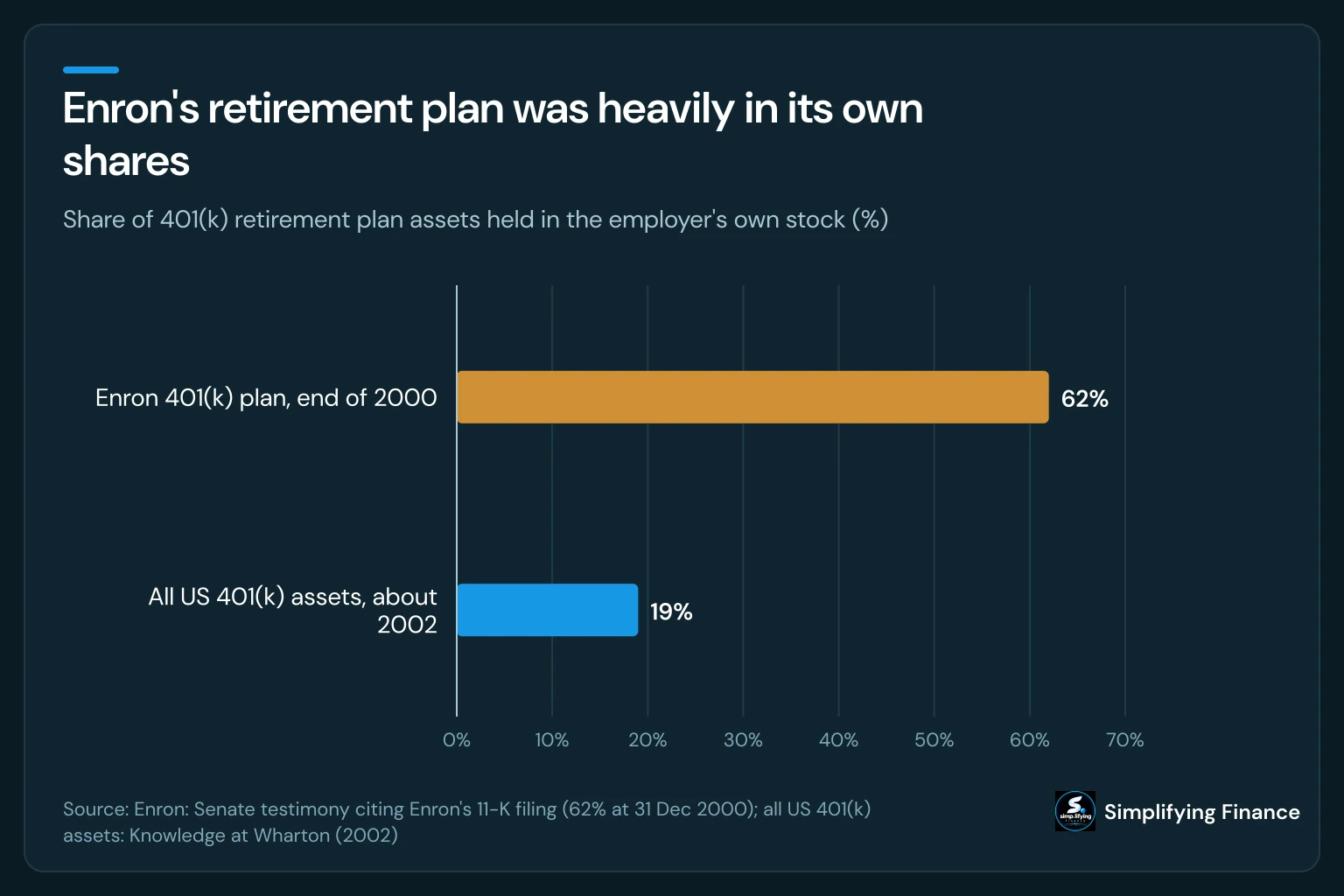
At the end of 2000, 62% of the assets in Enron's 401(k) retirement plan were invested in Enron's own shares, according to testimony to the US Senate citing the company's filings. Some employees held even larger shares. Knowledge at Wharton reports that the share price fell from a peak above $90 in August 2000 to less than $1 when the company went bankrupt in late 2001.
Employees lost their jobs and, in many cases, much of their retirement savings at the same time. A Senate hearing heard that Enron workers lost more than $1 billion from their 401(k) plans.
See the numbers behind the chart
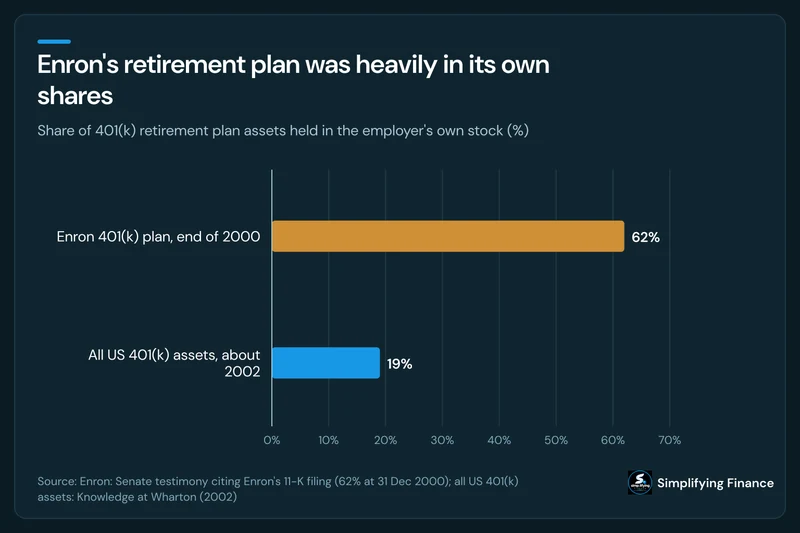
| Plan | In employer stock |
|---|---|
| Enron 401(k) plan, end of 2000 | 62% |
| All US 401(k) assets, about 2002 | 19% |
It was not unique
Enron is the best-known case, but not the only one. The same Senate testimony noted that most large US 401(k) plans offered an employer stock fund, and that across all US 401(k) assets about one-fifth was in employees' own company stock at the time, according to Wharton. Workers at other companies that later failed suffered similar double losses.
The pattern appears around the world wherever employees are paid partly in shares, offered discounted share schemes or encouraged to hold their employer's stock out of loyalty.
Why people hold too much
Employees often know and trust their company, which makes its shares feel safer than they are. Shares may come as part of pay, through matching contributions or discounted purchase plans, and selling them can feel disloyal. Some schemes also restrict when shares can be sold. Familiarity, loyalty and inertia together can lead to a large, unplanned concentration.
Employers and colleagues may also speak confidently about the company's prospects, which can make selling feel like a vote of no confidence. It is not: diversifying is a personal risk decision, not a judgement on the company.
What changed afterwards
Enron led to reforms. In the United States, later rules gave employees more freedom to sell employer shares held in retirement plans and required more information about diversification. Some employers also stopped paying matching contributions in their own shares. These changes reduced, but did not remove, the risk. Discounted share schemes and share-based pay remain common worldwide, and the decision about how much to keep still rests with each employee.
Your job is already a bet on the company
As the previous page explained, your salary is a form of human capital tied to your employer. Owning a lot of its shares adds a second bet on the same outcome. If the company does well, both pay off. If it fails, both can fail together, at the worst possible moment.
The numbers behind the risk
The Economic Policy Institute gave a striking illustration at the time: a worker earning average wages who had put 10% of pay into a 401(k) invested entirely in Enron stock since 1980 would, by 2001, have lost 94 cents of every dollar contributed, in real terms. Years of steady saving can be undone by one company's failure.
Most companies do not fail, and many employee shareholders have done well. The issue is the size of the loss in the cases that go wrong, and the fact that it arrives alongside the loss of income.
Using employee shares sensibly
Employee share schemes can still be valuable, especially when shares are offered at a discount or matched by the employer. The library lessons on employer matching and stock-based pay explain how these work. A common approach is to take the benefit but sell regularly once any holding period ends, moving the money into a diversified mix.
Many investors set a personal limit, such as keeping no more than a small percentage of their total savings in any single company, including their employer.
Beyond shares
The same idea applies to other ties to your employer: a company pension held in its own shares, a loan from the employer, or deferred pay that depends on the company's survival. It also applies to business owners, whose business is often most of their wealth. For them, building savings outside the business is the equivalent of selling down employer shares.
The question in every case is the same: if this one organisation ran into trouble, how much of my income and wealth would be affected at once?
Selling down an employer holding
Take an employee in India with ₹20 lakh of savings, of which ₹8 lakh (40%) is in their employer's shares from a share scheme. They decide to keep no more than 10% of their savings in any single company.
| Total savings | ₹20 lakh |
| Employer shares before | ₹8 lakh (40%) |
| Sold and diversified | about ₹6 lakh |
| Employer shares after | about ₹2 lakh (10%) |
They sell about ₹6 lakh of employer shares over a few months, after checking any tax due and any rules on when they can sell, and invest the proceeds in a diversified fund. Their employer holding falls to about ₹2 lakh, or 10%, while the rest of their savings no longer depends on the company that pays their salary.
Where people go wrong
- Mistaking familiarity for safety. Knowing a company well does not protect you from its failure.
- Keeping every share from a share scheme. Shares received as pay can build up into a large, unplanned holding.
- Ignoring selling rules and tax. Check holding periods, trading windows and tax before selling.
- Holding out of loyalty. You can be loyal to your employer without tying your savings to it.
- Forgetting other ties to the employer. Deferred pay, company pensions and loans can add to the same risk.
Put it to work
- Find your employer weight. Work out what percentage of your savings is in your employer's shares.
- Set a personal limit. Choose the most you are willing to hold in any single company.
- Plan a sell-down. If you are above your limit, plan gradual sales within the scheme's rules.
- List all your ties. Include deferred pay, pensions and any loans linked to your employer.
- Read on. The next page looks at your home as part of your portfolio.
If your employer struggles, you may lose your job. Do not let it also take your savings.
Facts checked against the sources above on 27 November 2026. Figures are as of the dates stated and will change. Worked examples use round illustrative numbers to show the arithmetic, not forecasts. Educational content only, not personal investment advice.