Human capital
Economists call the value of your future earnings "human capital". For a 30-year-old with decades of work ahead, it is usually far larger than their savings, home equity and pension combined. It is also an asset with its own risks: your industry, your employer, your health and your skills all affect how much it is worth.
This part of the guide looks at the parts of your life that act like investments. The starting point is your job.
Unlike shares, it cannot easily be sold or spread across many companies, which makes managing the rest of your wealth around it all the more important.
See the numbers behind the chart
| Industry | Unemployment rate |
|---|---|
| Leisure and hospitality | 39.3% |
| Other services | 23.0% |
| Wholesale and retail trade | 17.1% |
| Construction | 16.6% |
| All workers | 14.7% |
Jobs carry market-like risk
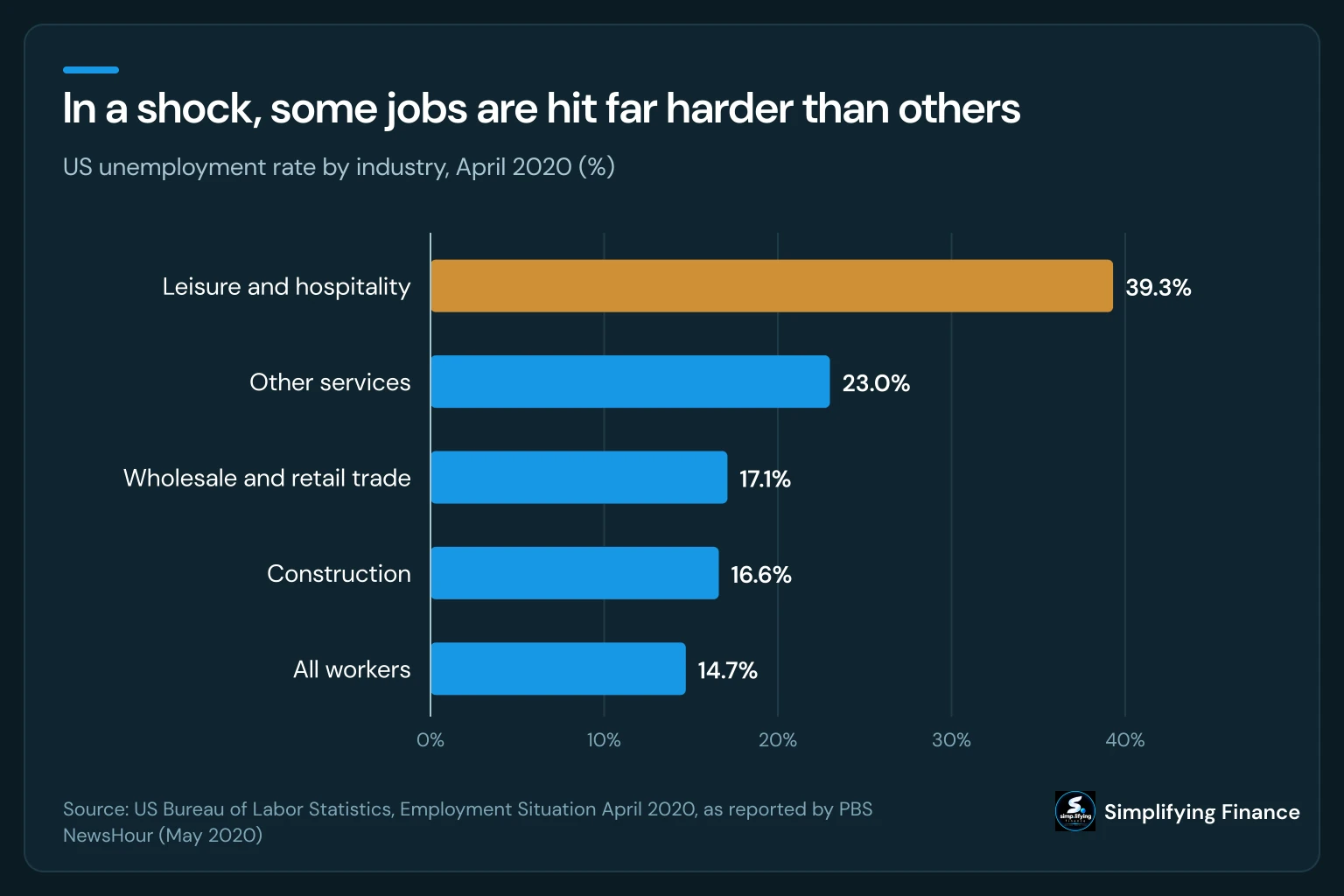
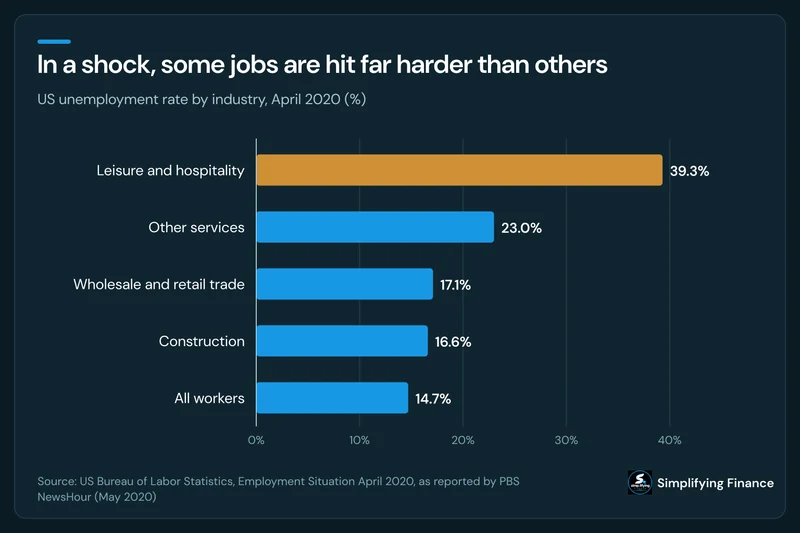
The chart shows how unevenly a sudden shock can fall. In April 2020, as the pandemic closed many businesses, the US unemployment rate rose to 14.7%, according to the Bureau of Labor Statistics. For leisure and hospitality workers it reached 39.3%, compared with 4.5% a year earlier. Construction reached 16.6%, and wholesale and retail trade 17.1%.
Other shocks affect other industries: banking in a financial crisis, energy when oil prices collapse, technology when a bubble bursts. Every job has a "sector", just as every share does.
Stock-like and bond-like jobs
Some incomes behave like bonds: steady and fairly predictable, such as many public-sector or tenured roles. Others behave like shares: higher potential rewards but more variable, such as sales roles paid on commission, small business ownership or jobs in cyclical industries.
A person with a bond-like job may be able to take more risk with their savings, because their income is a steady base. A person with a share-like income may want a steadier portfolio, because their earnings already carry a lot of risk.
The recovery matters too
Shocks to jobs are often followed by recoveries, but not always to the same place. In May 2020, the BLS reported that US employment rose again, with the largest gains in leisure and hospitality and construction. Yet some workers changed industries permanently, and others took years to regain their earlier income.
For savers, the key point is timing. A job loss tends to come in the same downturn that pushes share prices down. That is the moment when a household is most likely to need cash and least able to wait for markets to recover.
Avoid doubling up
The most direct way to apply this idea is to avoid saving heavily in the same industry that pays your salary. An airline worker whose savings are mostly airline shares, or a banker whose portfolio is mostly bank shares, could lose income and savings at the same time. The next page looks at the most extreme version: holding shares in your own employer.
Self-employed and business owners
For people who run their own business, human capital and financial capital are often the same thing: the business is both the source of income and most of the savings. That is a highly concentrated position. Building savings outside the business, in assets unrelated to its industry, is one of the most effective forms of diversification available to them.
Protecting the asset
Human capital can also be protected and grown. An emergency fund protects against a gap in income. Insurance, covered in the library lesson on insurance basics, protects against illness or disability that could stop earnings. New skills make your earning power less dependent on one employer or industry. Some people add a second income stream, which a later page covers.
Human capital changes over life
Early in a career, human capital is large and savings are small. Near retirement, the reverse is true. This is one reason many people gradually move from growth assets towards steadier ones as they age: the bond-like cushion of future earnings is shrinking, so the portfolio has to provide more of that stability itself.
Putting it together
Thinking of your job as an asset does not require complex calculations. It means asking three plain questions: how steady is my income, which industry does it depend on, and what would I do if it stopped for six months? The answers shape how large your emergency fund should be, how much risk your savings can take, and which sectors to avoid doubling up on.
Two workers, same savings
Take two people in the Philippines, each with ₱500,000 saved. One is a government teacher with a steady salary. The other works in tourism, where income can drop sharply in a downturn. These are illustrative cases, not advice.
| Savings, each worker | ₱500,000 |
| Teacher's income | steady, bond-like |
| Tourism worker's income | cyclical, share-like |
| Tourism worker: avoid | heavy holdings in travel and leisure shares |
The teacher's income behaves like a bond, so a growth-oriented mix may be easier to hold. The tourism worker's income already rides on the economy and travel, so a larger emergency fund and a steadier mix, with little in travel and leisure shares, would reduce the chance of losing income and savings together.
Where people go wrong
- Ignoring your job when choosing investments. Your income is part of your total wealth and has its own risks.
- Saving in your own industry. A downturn could hit your income and your savings together.
- Underinsuring your earning power. Illness or disability can stop income; insurance can protect it.
- Letting skills stand still. Broader skills make your income less dependent on one employer.
- Assuming a downturn will not affect you. Job losses tend to arrive in the same downturns that push share prices down.
Put it to work
- Label your income. Decide whether your income is more bond-like or share-like.
- Check for doubling up. Note how much of your savings sits in your own industry.
- Review protection. Check your emergency fund and any income-protection insurance.
- Answer the six-month question. Write down what you would do if your income stopped for six months.
- Read on. The next page looks at why not to bet twice on your employer.
Your earning power is often your biggest asset. Diversify your savings around it, not on top of it.
Facts checked against the sources above on 27 November 2026. Figures are as of the dates stated and will change. Worked examples use round illustrative numbers to show the arithmetic, not forecasts. Educational content only, not personal investment advice.