The biggest asset many people own
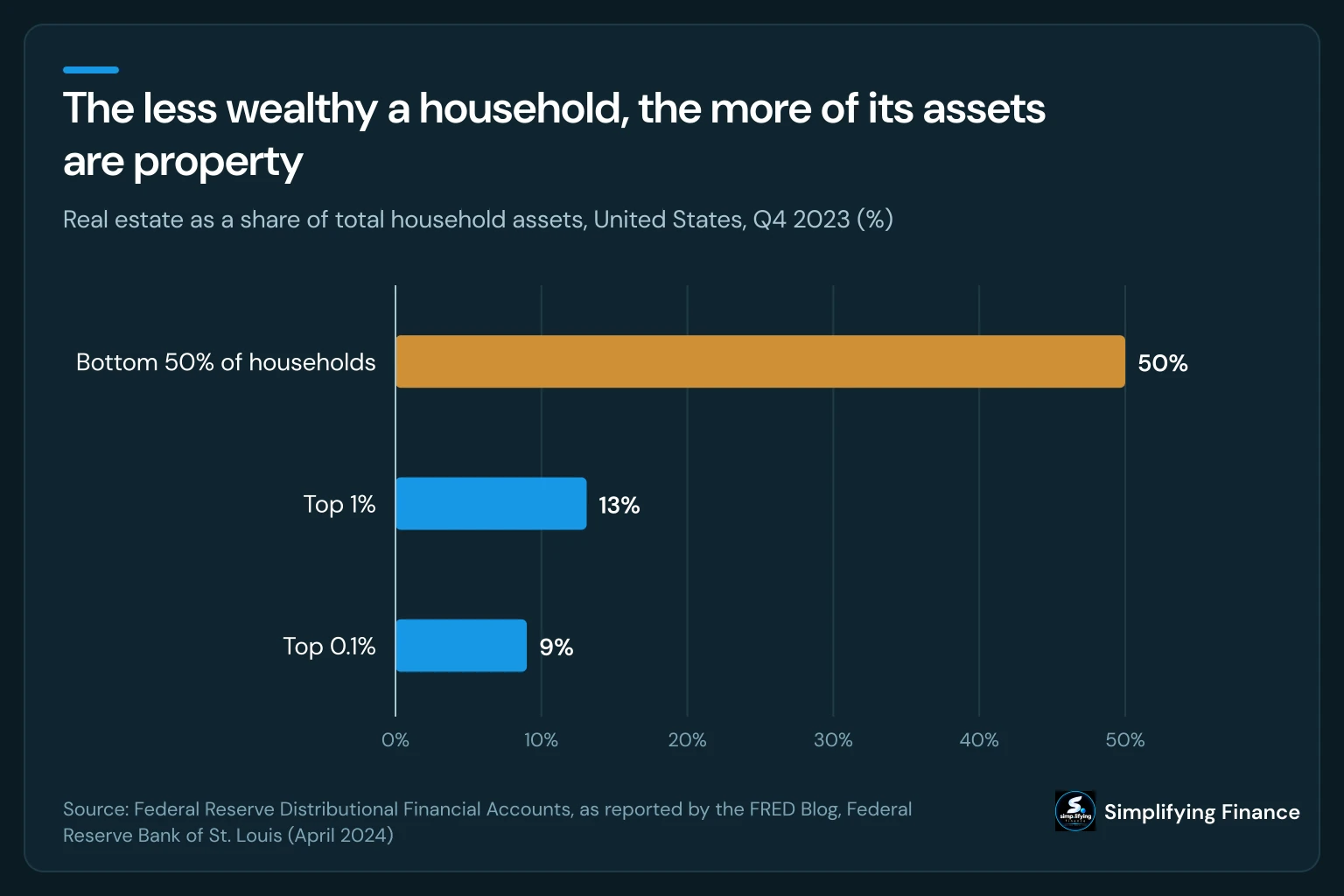
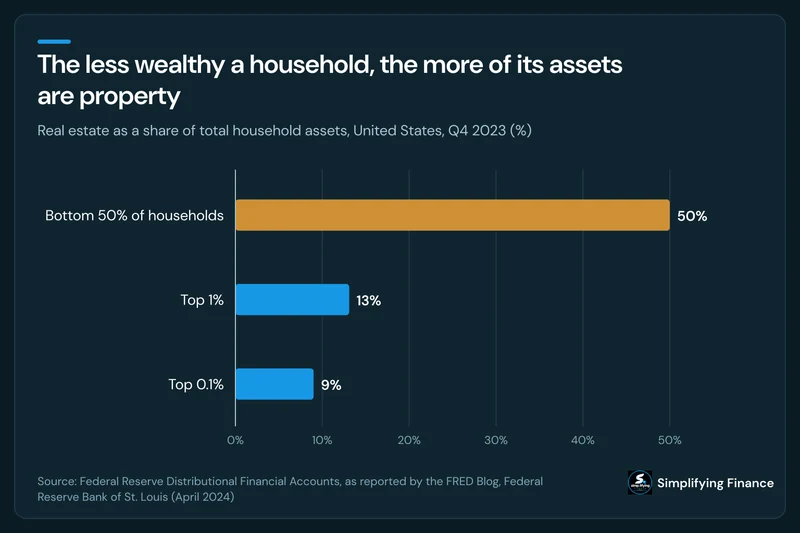
For most homeowners, the home is worth more than all their other investments combined. According to the FRED Blog, which uses the Federal Reserve's Distributional Financial Accounts, the bottom half of US households by wealth held just over 50% of their assets in real estate at the end of 2023, while the top 1% held 13.1% and the top 0.1% held 9%.
A 2018 article from the Federal Reserve Bank of St. Louis, using the 2016 Survey of Consumer Finances, found that the median household had 68% of its wealth in its primary residence. Similar patterns appear in many countries, where homeownership is the main way ordinary families build wealth.
That makes the home central to any honest view of diversification.
See the numbers behind the chart
| Wealth group | Share in real estate |
|---|---|
| Bottom 50% of households | 50% |
| Top 1% | 13% |
| Top 0.1% | 9% |
A home is a concentrated investment
From a diversification point of view, a home is unusual. It is one property, in one city, usually bought with borrowed money. Its value depends on the local economy, local jobs, interest rates and the condition of one building. It cannot be sold in parts, and selling it takes time and money.
That does not make it a bad investment. A home provides shelter, security and, for many families, protection against rising rents. But it means that a household whose wealth is mostly its home is far less diversified than its share portfolio alone suggests.
Borrowing magnifies the bet
Most homes are bought with a mortgage. Borrowing magnifies both gains and losses on the equity you own. If a home bought with a 20% deposit falls 10% in value, the owner's equity falls by half. The library lesson on property leverage shows the arithmetic in detail.
House prices can fall for years
It is easy to assume that homes always gain value, especially after long rises. History in many countries shows otherwise. Property markets have had long periods of flat or falling prices, sometimes lasting a decade or more after a boom, as the library lesson on house price cycles describes. During those periods, a household whose wealth is mostly its home sees little growth and may find it hard to sell or borrow against the property.
Even when prices recover in the long run, the timing matters for a family that needs to move, downsize or release money at a particular moment.
What it means for the rest of your savings
If your home is already a large property holding, adding more property through rental flats or property funds increases the same bet. For many homeowners, the rest of their savings may do more good spread across shares, bonds and other countries, rather than adding more property in the same city.
Location matters too. If your job, your home and your local property investments all depend on one city's economy, a local downturn can affect all three at once, as the earlier pages on human capital explained.
Renters can also diversify property exposure more freely, for example through a modest slice of listed property spread across many countries, rather than one building in one city.
Renting and owning
Renters face a different picture: their wealth is usually held in savings and pensions rather than property, which can be easier to diversify. The library lesson on renting versus buying looks at the full trade-off. Neither choice is right for everyone; what matters is understanding the risks of the position you hold.
Planning around the home
A practical approach is to write down the value of your home, the mortgage, and your other savings. Work out what share of your net worth the home represents. Then choose the rest of your investments with that figure in mind. If the home is half or more of your net worth, broad diversification elsewhere becomes even more valuable.
The home in retirement
Later in life, the home can play different roles. Some people sell and move to a smaller home, releasing money to invest or spend. Others stay and rely on other savings. Either way, a home is not easy to spend in small pieces, which is why most retirement plans also need assets that can be sold gradually. Counting the home as part of your wealth, but not as a ready source of income, keeps the plan realistic.
Seeing the whole picture
Take a family in Mexico with a home worth MXN 3,000,000, a mortgage of MXN 1,500,000 and other savings of MXN 500,000. These are round illustrative numbers.
| Home value | MXN 3,000,000 |
| Mortgage | MXN 1,500,000 |
| Other savings | MXN 500,000 |
| Home equity share of net worth | 75% |
Their net worth is MXN 2,000,000, of which MXN 1,500,000, or 75%, is home equity. If the family is considering putting their MXN 500,000 savings into a rental flat in the same city, they would move to almost 100% local property. Spreading the savings across a mix of shares and bonds instead would keep a quarter of their wealth outside that one bet.
Where people go wrong
- Leaving the home out of the picture. For many families it is the biggest asset and the biggest single risk.
- Adding more local property by default. A rental flat in the same city deepens the same bet.
- Forgetting the mortgage leverage. Borrowing magnifies changes in the value of your equity.
- Assuming house prices only rise. Property markets in many countries have had long periods of falls.
- Counting the home as spendable savings. A home cannot easily be sold in parts to pay bills.
Put it to work
- Work out your home equity share. Divide home equity by your total net worth.
- Check for local doubling up. Note how much of your income and savings also depends on your city.
- Diversify the rest. Let other savings balance, rather than repeat, your property exposure.
- Plan for liquidity. Make sure enough of your wealth can be sold quickly if needed.
- Read on. The next page looks at having more than one income stream.
If your home is most of your wealth, you already hold a large, concentrated property bet. Let the rest of your savings balance it.
Facts checked against the sources above on 27 November 2026. Figures are as of the dates stated and will change. Worked examples use round illustrative numbers to show the arithmetic, not forecasts. Educational content only, not personal investment advice.