Two ways to invest a large sum
When people receive a bonus, an inheritance or the proceeds of a sale, they face a choice. They can invest it all at once (a lump sum), or feed it in over months (cost averaging). The library lessons on dollar-cost averaging and investing a windfall explain the mechanics. This page looks at what the evidence says about the choice.
Note the difference from regular saving out of a salary. Investing each month as you earn is not a choice about timing; it is simply investing money when you have it.
Both routes end in the same place.
See the numbers behind the chart
| Comparison | Share of periods |
|---|---|
| US shares beat cash | 76% |
| Lump sum beat cost averaging | 68% |
| US bonds beat cash | 68% |
What the evidence shows
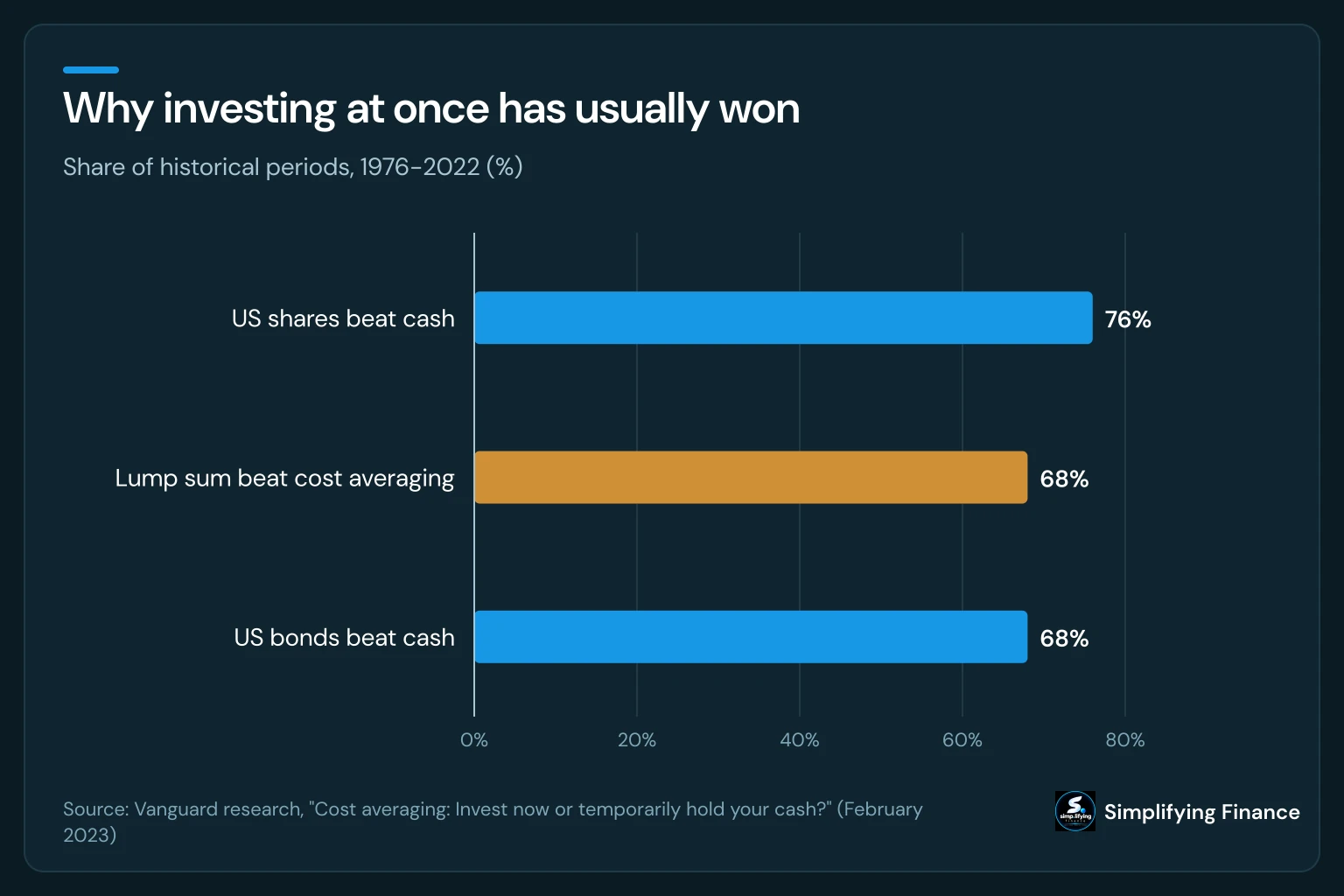
Vanguard research published in February 2023 compared the two approaches across several markets from 1976 to 2022. It found that investing a lump sum beat cost averaging roughly two-thirds of the time. Its UK summary reports a range of 61.6% to 73.7% across markets, and that the longer the money took to go in, the more often the lump sum won.
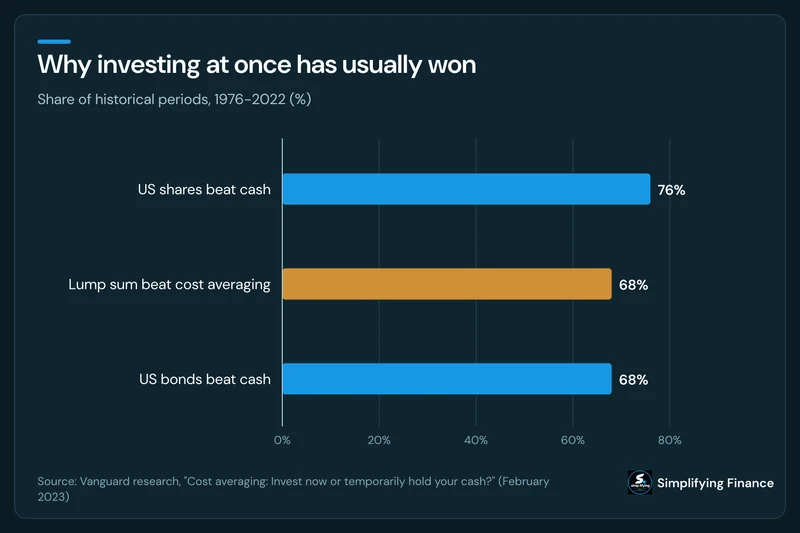
The reason is simple. Over 1976 to 2022, Vanguard notes, US shares beat cash 76% of the time and US bonds beat cash 68% of the time. Money waiting to be invested usually sits in cash, so on average it misses out.
Why cost averaging still has a role
The lump sum wins on average, but not every time. In the roughly one period in three when markets fall soon after investing, cost averaging does better. For someone who would be badly shaken by a large early loss, spreading the money over a few months can make it easier to stay invested.
Vanguard also notes that the lump-sum approach has a wider range of outcomes. Cost averaging narrows that range, at the price of a lower expected result. It is a trade between expected return and the risk of regret.
Diversification across time
Spreading entry points is a form of diversification: instead of spreading across assets, you spread across dates. Like any diversification, it reduces the chance of a single bad outcome. Unlike spreading across assets, it does not add a new source of return, which is why its average cost is positive.
If you do cost average, set a fixed plan in advance, such as equal amounts monthly over six or twelve months, and stick to it. Pausing whenever headlines are worrying turns a plan into market timing.
A short, fixed schedule, such as three to twelve months, keeps most of the benefit of investing early while softening the risk of the worst timing.
Behaviour matters more than maths
The two-in-three statistic describes the average outcome. Real decisions are made by people who feel losses sharply. A saver who invests everything just before a fall and then sells in panic does far worse than one who spread the money out and stayed calm.
Vanguard itself notes that investors with a strong aversion to losses may reasonably prefer cost averaging. The right method is the one that keeps you invested through the next downturn.
A middle path
Some people invest part of the sum at once and spread the rest. Others invest the whole sum at once but into a mix that already holds bonds and cash, which softens an early fall. Each approach trades some expected return for comfort. The best one is the one you can follow without second-guessing.
Taxes, fees and practical details
Practical points can tip the balance. In some countries, transaction fees are charged per purchase, which makes many small purchases more expensive. Tax rules on gains, allowances that reset each year, and the interest paid on cash while it waits all affect the result. It is worth checking these before choosing a schedule.
Whatever the method, the cash waiting to be invested should sit somewhere safe and easy to reach, so that the plan can be carried out on time.
Writing the plan down before starting helps you follow it.
All at once or over six months?
Take a saver in Oman who receives OMR 30,000 and plans to invest it for the long term. Option A: invest all OMR 30,000 today. Option B: invest OMR 5,000 a month for six months, keeping the rest in a deposit.
| Lump sum | OMR 30,000 on day one |
| Cost averaging | OMR 5,000 a month for 6 months |
| Early 20% fall, lump sum | about OMR 6,000 paper loss |
| Early 20% fall, first slice only | about OMR 1,000 paper loss |
If markets rise steadily, Option A ends ahead, because all the money was invested from the start. If markets fall 20% in the first month, Option A loses about OMR 6,000 on paper at once, while Option B loses only about OMR 1,000 on its first slice and buys the next slices cheaper. Historically, the first case has been more common. The choice depends on which outcome you could live with.
Where people go wrong
- Waiting for the "right moment". Leaving money in cash while waiting for a dip often means missing gains.
- Cost averaging with no end date. A plan that drags on indefinitely becomes market timing by another name.
- Confusing regular saving with cost averaging. Investing your salary monthly is just investing as you earn.
- Ignoring the mix. Investing a lump sum into a diversified mix already reduces the impact of an early fall.
- Overlooking per-purchase fees. Many small purchases can cost more than one large one.
Put it to work
- Ask the regret question. Decide which would hurt more: missing gains or an early loss.
- Choose and write it down. Pick lump sum, a fixed schedule, or a split, and note the dates.
- Check the destination. Make sure the money goes into a diversified mix that suits your goals.
- Check the costs. Compare trading fees and taxes for one purchase versus several.
- Read on. The next page looks at how a portfolio's mix quietly drifts over time.
Investing a lump sum at once has won about two times in three. Spreading it out buys peace of mind at an expected cost.
Facts checked against the sources above on 27 November 2026. Figures are as of the dates stated and will change. Worked examples use round illustrative numbers to show the arithmetic, not forecasts. Educational content only, not personal investment advice.