Why inflation changes the priorities
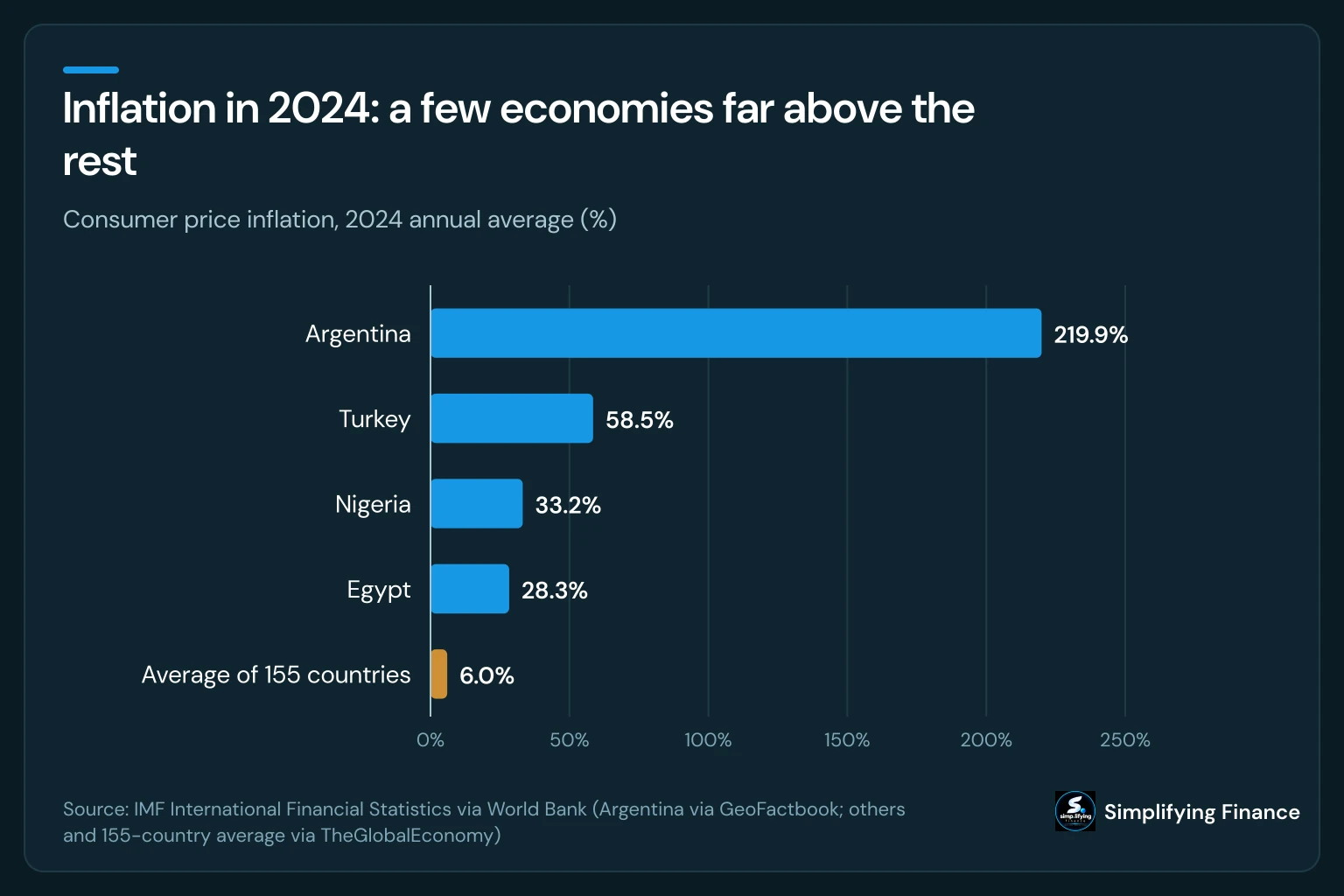
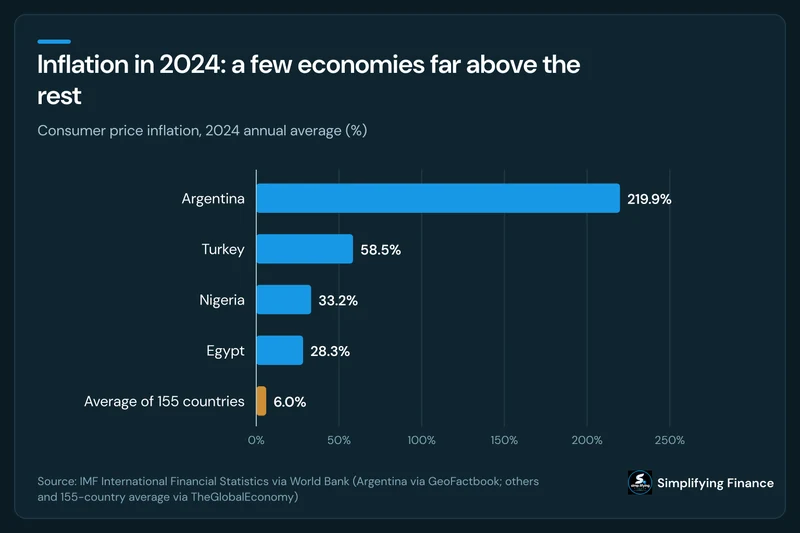
In most of this guide, the main risks are falls in asset prices. In an economy with very high inflation, a quieter risk can be larger: money held in local cash loses purchasing power month after month. According to IMF data published by the World Bank, average consumer prices rose about 220% in Argentina in 2024, about 59% in Turkey, about 33% in Nigeria and about 28% in Egypt, compared with an average of about 6% across 155 countries.
The library lessons on inflation and purchasing power and on real versus nominal returns explain why the rate earned on savings has to be compared with inflation, not with zero.
See the numbers behind the chart
| Economy | Inflation |
|---|---|
| Argentina | 219.9% |
| Turkey | 58.5% |
| Nigeria | 33.2% |
| Egypt | 28.3% |
| Average of 155 countries | 6.0% |
What high inflation does to cash
If prices rise 33% in a year, money that buys 100 things at the start buys only about 75 at the end. A savings account paying 20% leaves the saver poorer in real terms even though the balance grew. In such conditions, keeping long-term savings in local cash is often the riskiest choice, not the safest.
The effect compounds: two years at that pace leave money buying only about 57% of what it did at the start.
Inflation and the currency often move together
High inflation and a falling exchange rate usually go hand in hand. When a currency buys less at home, it often buys less abroad too. For savers, this means local cash loses value in two ways at once: against local prices and against other currencies. It also means that goods priced in foreign currencies, from fuel to phones, become more expensive.
This link is why savers in such economies often think about both inflation and currency when choosing where to keep their money, as the previous two pages discussed.
Tools people use
Savers in high-inflation economies have used a range of approaches, each with trade-offs. Inflation-linked government bonds, where available, adjust payments to prices. Local shares represent ownership of real businesses whose prices and revenues can rise with inflation, although they can be very volatile. Property and other real assets can hold value but are hard to sell quickly. Holdings in more stable foreign currencies, where legally allowed, protect against a falling local currency.
Gold has also long been used as a store of value in many of these countries, with the limits described on the earlier page about gold.
Thinking in real terms
A helpful habit is to measure every savings option in real terms: what it is likely to earn after inflation. A deposit at 20% with 33% inflation is roughly -10% in real terms; an inflation-linked bond with a small positive real yield keeps pace. Comparing options this way makes it easier to see which choices actually protect a household's future spending power, and which only look attractive because the numbers are large.
Respect the rules
Many high-inflation economies have rules on foreign currency, capital movements and which investments residents may hold. These rules change, sometimes quickly. Any plan to diversify outside local cash should start with what is legal and practical in your country, using regulated institutions.
Avoid high-return promises
Periods of high inflation are fertile ground for schemes that promise returns far above inflation with no risk. Genuine protection against inflation rarely comes with guarantees of very high returns. The library lesson on scams and fraud lists common warning signs. Using regulated banks, funds and government securities is the safest starting point.
Keeping an emergency buffer
Even with high inflation, households still need money they can reach quickly. The usual approach is to keep the emergency buffer as small as is safe and in the best-protected place available, then put longer-term money into assets more likely to keep pace with prices.
Inflation can fall too
High inflation does not last forever. When it falls sharply, local interest rates often fall too, and assets bought as inflation protection can behave differently. Spreading across several protective tools, rather than relying on one, helps a saver cope with both rising and falling inflation.
The same principles, different weights
The principles in the rest of this guide still apply: spread across assets, match money to its time horizon, keep costs low and avoid concentration. What changes in a high-inflation economy is the weighting. Protecting purchasing power moves to the top of the list, and holding large amounts of idle local cash becomes one of the main risks to manage.
A year of 33% inflation
Take a saver in Nigeria with ₦1,000,000 in a deposit paying 20% for a year, and assume prices rise 33%, close to the 2024 average. These are illustrative numbers.
| Starting deposit | ₦1,000,000 |
| After 20% interest | ₦1,200,000 |
| Cost of the same goods after 33% inflation | ₦1,330,000 |
| Real change in purchasing power | about -10% |
At the end of the year the deposit shows ₦1,200,000. But to buy what ₦1,000,000 bought a year earlier now costs ₦1,330,000. In real terms the saver has lost about 10% of their purchasing power, even though the balance grew by ₦200,000.
Where people go wrong
- Counting a rising balance as a gain. Compare growth with inflation, not with zero.
- Putting everything into one hedge. Each protective asset has its own risks; a mix is sturdier.
- Ignoring local rules. Foreign-currency and capital rules can change quickly; stay within them.
- Keeping too large a cash buffer. In high inflation, cash beyond what you need for emergencies loses value fast.
- Trusting guaranteed high returns. Promises of returns far above inflation with no risk are a common sign of fraud.
Put it to work
- Measure your real return. Subtract inflation from the interest or return you earn.
- Size your buffer. Keep only the cash you need for emergencies and near-term bills.
- List the legal options. Find out which inflation-protecting assets are available to residents.
- Use regulated providers. Keep savings with licensed banks, funds and government securities.
- Read on. Part 5 begins: your job as an asset, and why it matters for diversification.
In a high-inflation economy, the first risk to manage is not a market crash but the steady loss of what your money can buy.
Facts checked against the sources above on 27 November 2026. Figures are as of the dates stated and will change. Worked examples use round illustrative numbers to show the arithmetic, not forecasts. Educational content only, not personal investment advice.