Money meant to last forever
An endowment is a pool of money, usually built from gifts, that a university invests and never fully spends. Each year it pays out a small share of its value to support scholarships, professorships, research and buildings, while the rest stays invested to grow. Because donors often intend their gifts to support the institution permanently, endowments are designed to keep their purchasing power not just for years but for generations.
That goal creates two duties that pull against each other. The endowment must pay out enough each year to support today's students, yet grow fast enough after inflation to support tomorrow's just as well. Most of what is distinctive about how endowments invest flows from that tension.
See the numbers behind the chart
| Period | Average annualised return |
|---|---|
| 1 year | 10.9% |
| 3 years | 10.0% |
| 5 years | 10.2% |
| 10 years | 7.7% |
| 15 years | 8.5% |
| 20 years | 7.3% |
| 25 years | 6.6% |
How big they are
The NACUBO-Commonfund Study of Endowments, the main annual survey of US college endowments, covered 657 colleges, universities and education foundations in fiscal year 2025, with combined assets of about US$944.3 billion. The largest endowments are very large indeed: Harvard reported about US$68 billion at June 2026, and several others hold US$30 billion or more. Most, however, are far smaller, and the study reports results by size group.
What they own
On average, according to a summary of the 2025 NACUBO-Commonfund study, endowments held just over 31% in public equities, about 54% in alternative strategies, including private equity, venture capital, hedge funds and real assets, and about 11% in fixed income. Size makes a big difference. Endowments with less than US$50 million allocated on average about 12.5% to alternatives, while those with more than US$5 billion allocated about 62.5%.
Large endowments can do this because they have long horizons, specialist staff and the scale to commit money to private funds for ten years or more. Smaller ones tend to hold more listed shares and bonds, often through low-cost funds.
Why alternatives appeal to endowments
Endowments are unusual investors. They have no fixed end date, steady new gifts and predictable spending, so they rarely need to sell assets in a hurry. That lets them accept the main drawback of private equity, venture capital and private real estate: the money is locked up for many years. In return, they hope to earn a premium over listed markets and to own assets whose values move differently from the stock market.
Hedge funds and other absolute return strategies serve a different purpose. They aim to earn steady returns that depend less on the direction of markets, which helps when shares fall and an endowment still needs to pay out its annual budget.
How they have performed
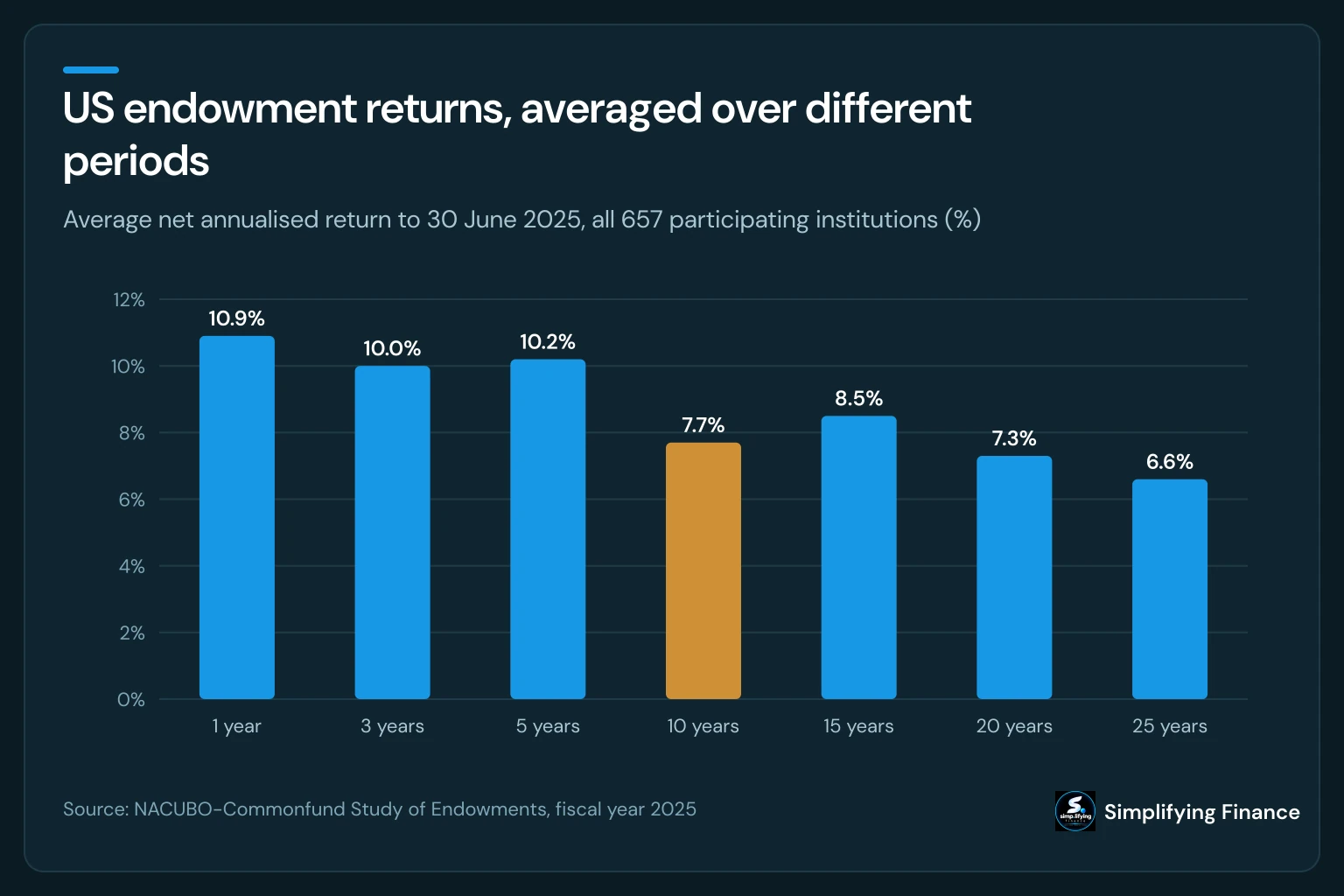
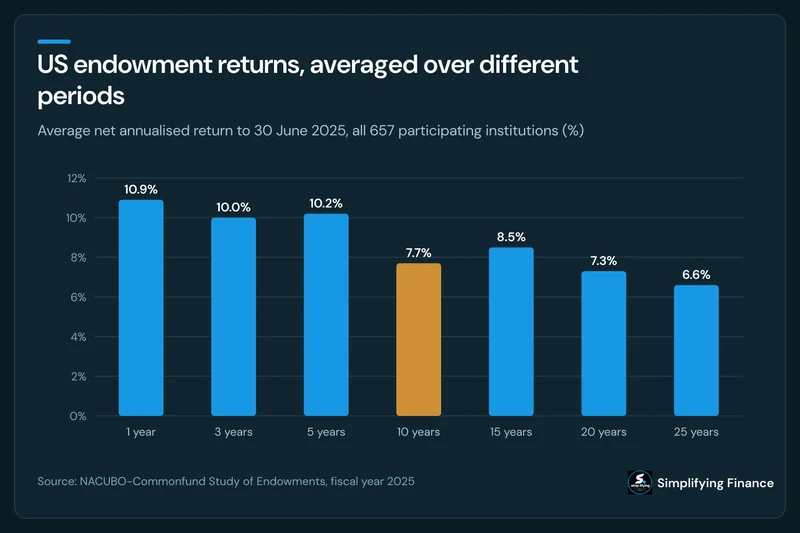
Participating institutions reported an average return of 10.9% for fiscal 2025 and an average of 7.7% a year over ten years. Over 25 years the average was 6.6% a year. Returns vary widely between institutions in any single year, which is why most endowments focus on long-run results against a target that covers their spending plus inflation.
The spending rule
Endowments typically spend a set percentage of their value each year, often around 4% to 5%, usually calculated on an average of past values to smooth the payout. The 2025 study reported that participating institutions withdrew a total of US$33.4 billion from their endowments in fiscal 2025, an increase of nearly 11% from the year before.
A spending rule is the core discipline of an endowment. Spend too much and the fund shrinks in real terms; spend too little and today's students lose out. The library lesson on the retirement number explains the same trade-off for a household living off savings.
What this section covers
The pages that follow look at individual endowments using each university's own announcements and reports: Harvard, Yale, Stanford, MIT, Princeton, Oxford and Cambridge, and Texas and Notre Dame. Then a page compares endowment results with a simple 60/40 portfolio of shares and bonds, and a final page draws out the lessons for ordinary investors.
Different measures, different results
Endowment surveys report averages, but institutions measure returns slightly differently, use different fiscal years and value private assets with different delays. When comparing one university with another, or with a simple portfolio, it helps to check the period, whether figures are before or after fees, and whether the comparison is with an average or a median.
How a 5% spending rule works
Imagine a small endowment worth US$1,000,000 that spends 5% of its value each year. It pays out US$50,000 this year. To keep its purchasing power, it needs to earn 5% plus inflation over time; with inflation at 3%, that is about 8% a year.
| Endowment value | US$1,000,000 |
| Spending at 5% | US$50,000 a year |
| Return needed (5% + 3% inflation) | about 8% a year |
| Real change if it earns 6% | about -2% a year |
If it earns only 6% a year while spending 5% and facing 3% inflation, its real value shrinks by about 2% a year, and future payouts fall in real terms. That is why endowments care so much about long-run returns after inflation.
Where people go wrong
- Judging an endowment on one year. Single-year results swing widely; the mission is measured over decades.
- Assuming all endowments invest alike. Small endowments hold far fewer alternatives than the largest ones.
- Ignoring the spending rule. Payouts are as important to an endowment's future as its returns.
- Copying private-market weights. Endowments can lock money away for a decade; most households cannot.
- Mistaking size for skill. The largest endowments have advantages of scale and access that small investors lack.
Put it to work
- Set your own spending rule. If you live off savings, decide what percentage you will draw each year.
- Target a real return. Work out what return after inflation your plan needs.
- Size alternatives to your situation. Smaller pots usually do better with simple, liquid funds.
- Compare with a simple benchmark. Measure any portfolio against a low-cost mix of shares and bonds.
- Read on. Next: Harvard's endowment.
Endowments are built to last forever, spend a few percent a year and ride out bad markets. That mission explains their heavy use of private and alternative assets, and why their returns are best judged over decades.
Facts checked against the sources above on 27 November 2026. Figures are as of the dates stated and will change. Worked examples use round illustrative numbers to show the arithmetic, not forecasts. Educational content only, not personal investment advice.