Lesson 1: give every pot a purpose
Each fund in this section has a written mandate. Norway's saves oil wealth for future generations; Australia's helps meet future pension costs; Kuwait's treasury fund pays today's bills while its future fund saves; Qatar's includes a stabilisation role. The mandate decides how much risk each fund can take and how easy to sell its assets must be.
A household can do the same. Name each pot of money and its job: an emergency fund, a home deposit, school fees, retirement. Each job has its own time horizon, and the horizon should decide the investments. The library lesson on financial goals shows how to set this up.
See the numbers behind the chart
| Fund | Years |
|---|---|
| ADIA | 30 years |
| GIC | 20 years |
| Temasek | 20 years |
| NZ Super Fund | 20 years |
| China Investment Corporation | 10 years |
| Australia's Future Fund | 10 years |
| Mubadala | 10 years |
Lesson 2: measure over decades
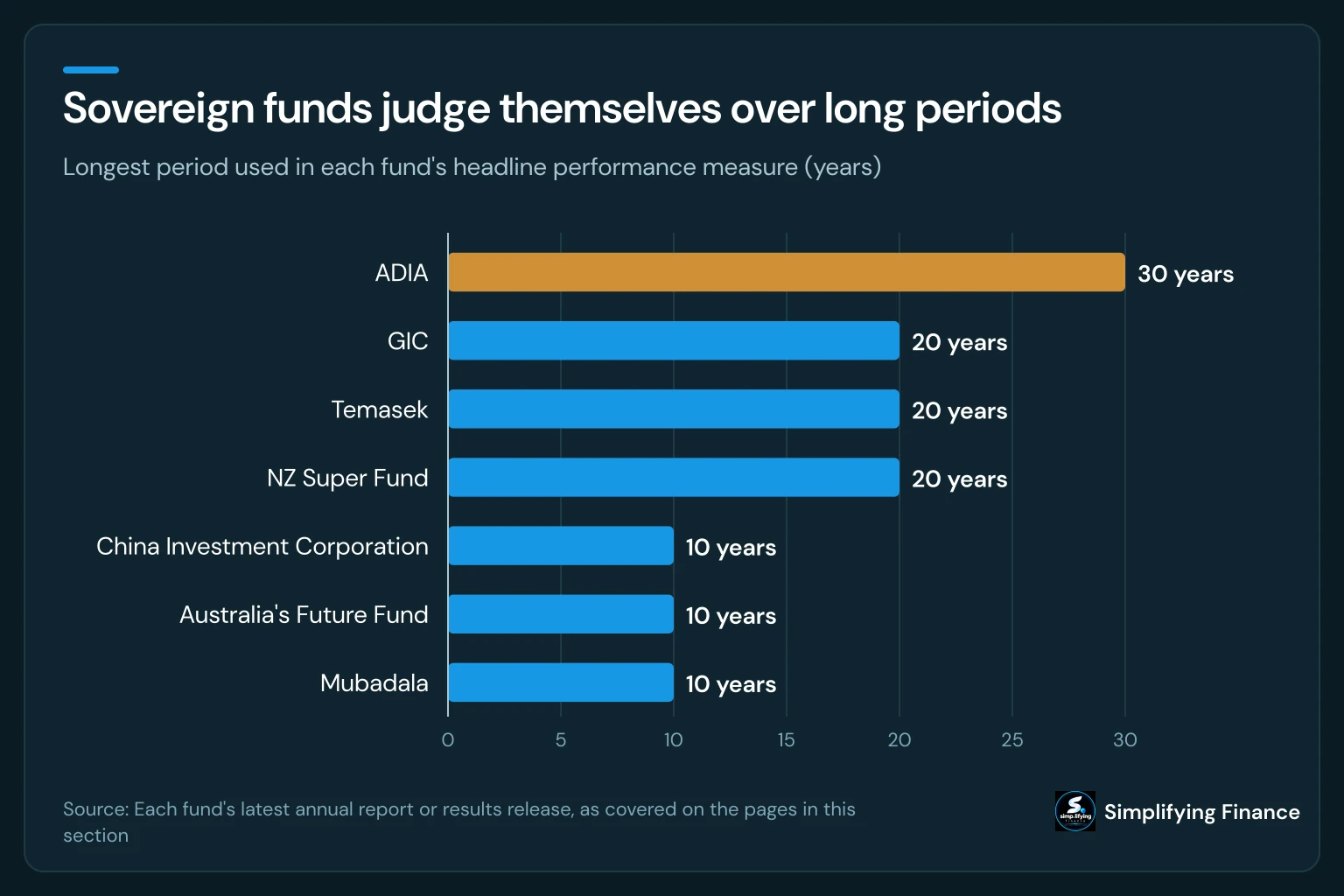
GIC's main measure is a 20-year real return; ADIA reports 20- and 30-year returns; Temasek reports 10- and 20-year returns; CIC reports a 10-year return against a target; Mubadala reports five- and ten-year returns. GIC explicitly does not publish one-year returns because a year is too short for its horizon.
For a saver, checking long-term money every day invites poor decisions. Reviewing once a year, against a long-term target, keeps the focus where it belongs.
Lesson 3: use ranges and rebalance
ADIA publishes a minimum and maximum for each asset class and region and adjusts them a few points at a time. Norway's fund follows a benchmark set by its owner. Both approaches mean the portfolio does not drift far from its plan.
Write your own ranges, for example shares 55% to 65% and bonds 25% to 35%, and rebalance only when a holding leaves its range. The library lesson on rebalancing explains the mechanics.
Lesson 4: diversify away from your income
Resource-rich countries invest abroad so that their savings do not depend on the same thing as their income. ADIA does not invest in the UAE as a matter of practice; Norway's fund invests only outside Norway; Kuwait looked abroad from its first office in London in 1953.
Most households already depend heavily on one economy and often one employer. Long-term savings spread across world markets reduce the chance that one local downturn hits both your job and your savings.
Lesson 5: keep costs low and use index funds
Norway's fund reports annual management costs of about 0.05% of assets from 2013 to 2025. ADIA reported that 46% of its portfolio was passive in its 2024 Review. Even the largest, most sophisticated investors use low-cost, index-tracking exposure as a core building block.
For individuals, broad index funds offer much of the same benefit at low cost. Every 1% a year saved in fees compounds into a large sum over decades.
Lesson 6: set a spending rule
Norway links spending from its fund to the expected long-term real return, about 3% a year. Alaska limits annual draws to 5% of the fund's average value over five years. Rules like these protect the capital from short-term pressures.
If you will one day live off savings, decide in advance how much you will draw each year and how you will smooth it. A written rule is far easier to follow in a bad year than a decision made under stress.
Lesson 7: keep a buffer so you never have to sell
Several funds carry explicit stabilisation roles or hold liquid assets for that purpose. Kuwait's General Reserve Fund pays for current spending so that the Future Generations Fund can stay invested. Qatar's mandate includes stabilising the local economy as necessary. The common idea is that money needed soon should not be invested in assets that might be down when it is needed.
For a household, this is the emergency fund. Several months of expenses in cash means a job loss or a large bill does not force the sale of shares during a market fall. The library lesson on emergency funds covers how much to hold and where.
What not to copy
Sovereign funds can hold large shares of private equity, infrastructure and real estate because they have decades-long horizons, steady funding and teams of specialists. For individuals, these assets often come with high fees, long lock-ups and limited information. The guide's page on private markets and alternatives sets out the trade-offs.
Copy the discipline, not the asset list. A simple, low-cost, globally diversified portfolio with a clear purpose, written ranges, a cash buffer and a spending rule captures most of what makes sovereign funds resilient.
A family "sovereign fund" in three pots
Suppose a family has US$50,000 in savings and monthly expenses of US$2,000. Following the lessons above, they keep US$12,000, six months of expenses, as a stabilisation pot in cash. The remaining US$38,000 becomes a long-term fund.
| Total savings | US$50,000 |
| Stabilisation pot (6 months of expenses) | US$12,000 |
| Long-term fund: global shares (70%) | about US$26,600 |
| Long-term fund: bonds (30%) | about US$11,400 |
They give the long-term fund a mandate (retirement in 25 years), a target mix of 70% global shares and 30% bonds, ranges of plus or minus 5 percentage points, and a once-a-year review. That puts about US$26,600 in shares and US$11,400 in bonds, rebalanced only when a range is crossed.
Where people go wrong
- Copying the exotic parts. Private equity and infrastructure stakes suit institutions with decades and no need for cash.
- Ignoring the boring parts. Mandates, ranges, low costs and spending rules do most of the work.
- Judging on one year. The funds in this section measure themselves over 10 to 30 years.
- Keeping everything at home. Savings that depend on your local economy double up your risk.
- Skipping the buffer. Without cash set aside, a surprise bill can force a sale at the worst time.
Put it to work
- Write your mandate. One sentence for each pot: what it is for and when you need it.
- Set ranges. Choose a target mix and a band around it.
- Build a buffer. Hold several months of expenses in cash before investing for the long term.
- Review once a year. Pick a date each year to check your ranges, costs and progress against your mandate.
- Explore further. Return to the Portfolios & Diversification hub for the next sections.
The biggest lessons from sovereign funds are not exotic assets. They are clear purposes, long horizons, written ranges, low costs, a spending rule and a cash buffer: habits anyone can copy.
Facts checked against the sources above on 27 November 2026. Figures are as of the dates stated and will change. Worked examples use round illustrative numbers to show the arithmetic, not forecasts. Educational content only, not personal investment advice.