The firm
Man Group is a long-established investment manager listed on the London Stock Exchange. It runs a range of strategies, from traditional long-only funds to hedge funds, and is particularly known for systematic investing through its Man AHL unit, a pioneer of computer-driven trend following. Because it is a listed company, Man publishes regular results, unlike most private hedge fund firms.
See the numbers behind the chart
| Position | Share of reported value |
|---|---|
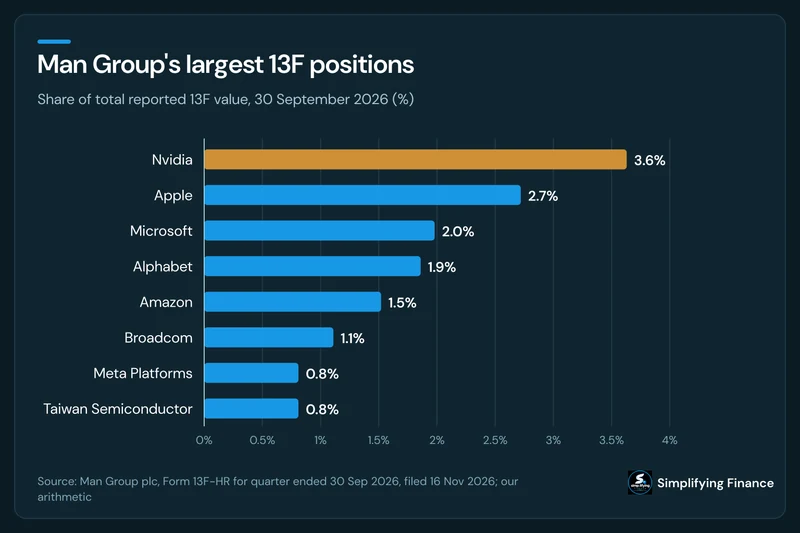
| Nvidia | 3.6% |
| Apple | 2.7% |
| Microsoft | 2.0% |
| Alphabet | 1.9% |
| Amazon | 1.5% |
| Broadcom | 1.1% |
| Meta Platforms | 0.8% |
| Taiwan Semiconductor | 0.8% |
What the 13F shows
Man Group's 13F for the quarter ended 30 September 2026, filed on 16 November 2026, listed 3,821 rows covering about 1,940 issuers. The total reported value was about US$67.8 billion, of which about US$59.4 billion was shares and ETFs and about US$8.4 billion options.
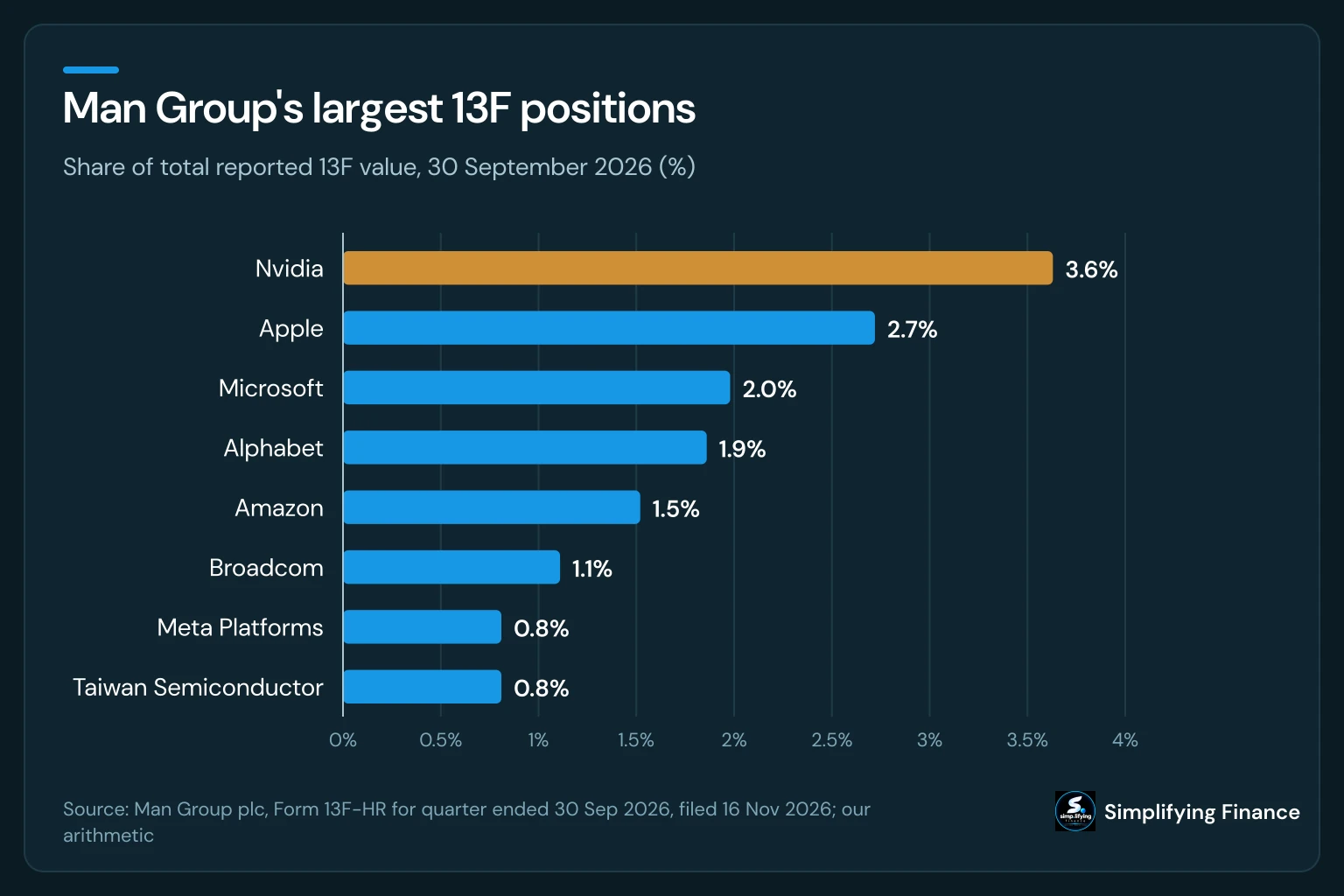
The largest positions were Nvidia (3.6% of total reported value), Apple (2.7%), Microsoft (2.0%), Alphabet (1.9%) and Amazon (1.5%). The ten largest issuers made up about 18% of the share value.
Trend following and the 13F
Trend-following strategies buy assets whose prices have been rising and sell those that have been falling, across many markets, usually through futures on stock indexes, bonds, currencies and commodities. Futures are not Section 13(f) securities, so these positions do not appear on a 13F. For Man Group, the filing mainly reflects its equity strategies and long-only funds, not its best-known systematic hedge funds.
Hedge funds inside a public company
Owning shares in a listed manager is different from investing in its funds. A shareholder in Man Group earns a share of the firm's profits from fees, not the returns of its funds. That makes such companies sensitive to flows of client money and to performance fees, which can vary greatly from year to year.
The lesson for individuals
Trend following has historically behaved differently from shares and bonds, which is why some large investors use it for diversification. The library lesson on momentum explains the underlying idea. Individuals should note, however, that trend-following funds can have long periods of poor results and often charge higher fees than index funds.
What the 13F does capture
Man Group's 13F reflects equity strategies that hold US-listed shares, including long-only funds and long-short equity. Its spread across about 1,940 issuers, with the largest US technology companies at the top, is typical of diversified equity portfolios. The roughly US$8.4 billion of options at underlying value may relate to hedging or specific strategies, but the filing does not say.
Comparing this broad equity book with the futures-based trend strategies for which Man is best known is a reminder that one firm can run very different strategies, and that a 13F may describe only some of them.
Diversifying across strategies
Large investors such as pension funds sometimes add trend-following or other systematic strategies to a portfolio of shares and bonds because these strategies have, at times, behaved differently in market crises. The aim is not to replace shares and bonds, but to add something with a different pattern of returns. Whether this works depends on the strategy, its costs and the period studied, so evidence should be examined carefully.
Reading a listed manager's 13F
Because Man Group is listed, it publishes far more about its business than most hedge fund firms, including regular updates on client assets and fund performance in its own results. A 13F adds a different view: what US-listed shares its funds held on one date. Combining the two, a firm's own reports for the overall picture and the 13F for one slice, gives a more complete understanding than either alone.
Costs and capacity
Systematic strategies can be limited by capacity: the more money that follows a signal, the less profit may remain. Managers therefore watch trading costs and market impact closely. For individual investors in any systematic fund, the total cost, including management fees, performance fees and trading costs inside the fund, has a large effect on what is left.
A long history
Man Group's history goes back more than two centuries, to its origins as a commodity trading business in London. Its move into managed futures and systematic investing came much later. That long history is unusual among hedge fund managers, most of which are far younger.
A note on this page
This page is educational only. Holdings come from the firm's SEC Form 13F-HR for the quarter ended 30 September 2026, as filed; values are as reported and percentages are our arithmetic on the filing. A 13F is a snapshot of certain long US-listed positions on one date. It does not show short positions, most non-US holdings, bonds, cash or private investments, and positions may have changed since. Nothing here is a recommendation to buy or sell any security.
How trend following works, simply
A simple trend rule might say: hold an asset when its price is above its average price over the past 12 months, and sell it when the price falls below. In a long decline, the rule moves to cash or goes short, limiting losses.
| Rule | hold when price is above its 12-month average |
| Long decline | moves out, limiting losses |
| Choppy market | repeated small losses |
| Where it shows up | futures, not on a 13F |
The cost is that in choppy markets the rule may buy and sell repeatedly, losing a little each time. Over long periods, trend following has tended to do best during big, sustained moves, which is what makes it a possible diversifier.
Where people go wrong
- Judging a futures-based fund by its 13F. Futures are not reported.
- Confusing the company with its funds. Shareholders earn fee profits, not fund returns.
- Expecting trend following to win every year. It can lag for long periods.
- Ignoring fees. Systematic hedge funds usually cost more than index funds.
- Assuming one firm runs one strategy. A large manager may run very different funds.
Put it to work
- Learn about momentum. Read how trend and momentum strategies work.
- Compare correlations. See how a strategy has behaved when shares fell.
- Check costs. Compare the full fees of any alternative fund with an index fund.
- Study behaviour in crashes. Look at how an alternative fund behaved in past market falls.
- Read on. Next: AQR.
Man Group shows that hedge fund strategies can sit inside a publicly listed company. Its 13F is broad and led by the largest US companies; its trend-following funds, which trade futures, do not appear at all.
Facts checked against the sources above on 27 November 2026. Figures are as of the dates stated and will change. Worked examples use round illustrative numbers to show the arithmetic, not forecasts. Educational content only, not personal investment advice.