The firm
Bridgewater Associates was founded by Ray Dalio and became one of the best-known hedge fund firms in the world. It is associated with global macro investing: forming views on economies, interest rates, inflation and currencies, and expressing them across many markets. Its "All Weather" approach aims to balance a portfolio so that it can cope with different economic environments, such as rising or falling growth and inflation.
Dalio has stepped back from running the firm, and it is now led by a team of executives and chief investment officers.
See the numbers behind the chart
| Position | Share of reported value |
|---|---|
| SPDR S&P 500 ETF | 11.3% |
| iShares ETFs (several funds) | 6.1% |
| Nvidia | 2.7% |
| iShares Inc. ETFs (several) | 2.1% |
| Broadcom | 2.0% |
| Lam Research | 1.5% |
| Advanced Micro Devices | 1.3% |
| Applied Materials | 1.2% |
What the 13F shows
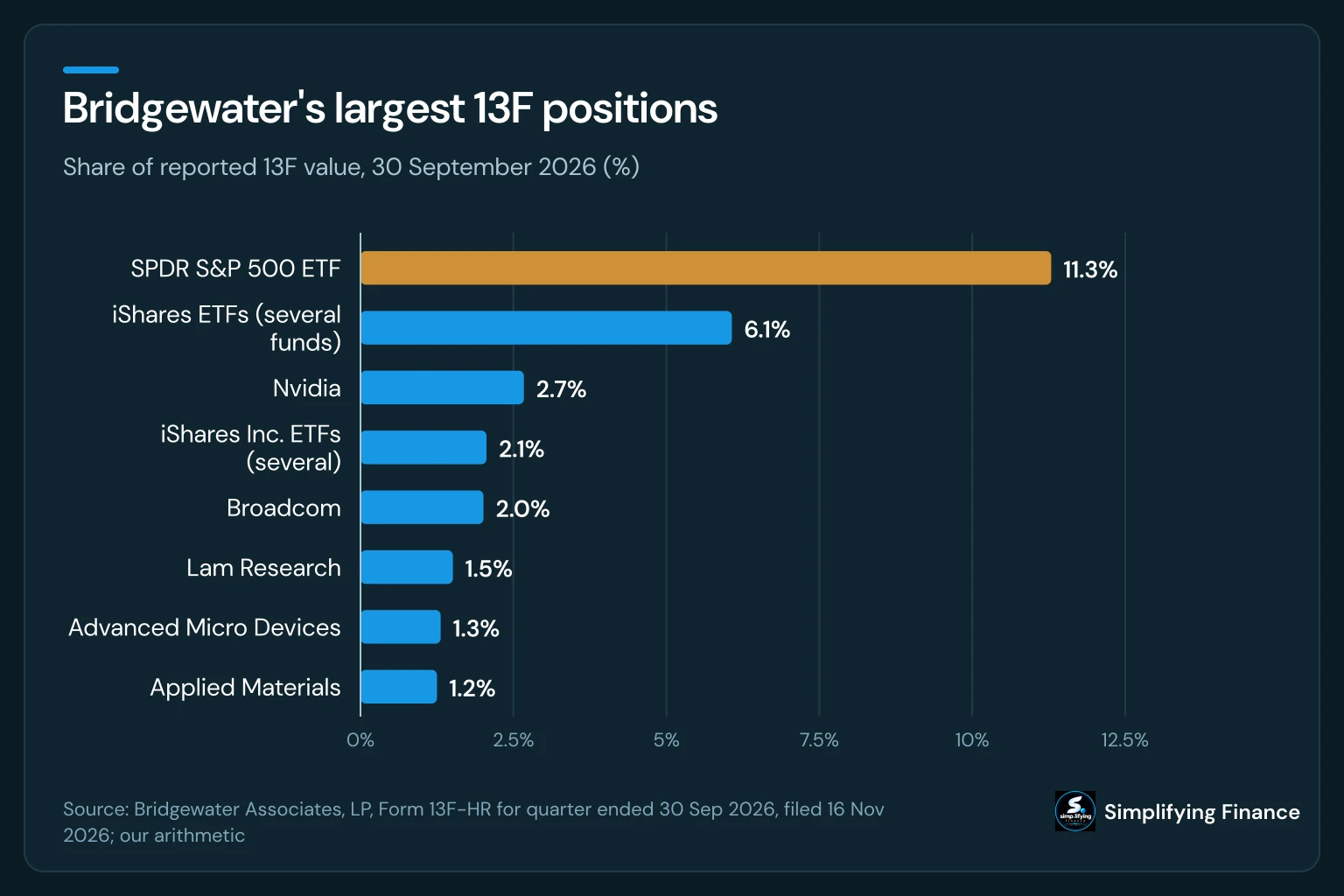
Bridgewater's 13F for the quarter ended 30 September 2026, filed on 16 November 2026, listed 974 rows covering about 967 issuers, with a total reported value of about US$22.99 billion. It reported no options.
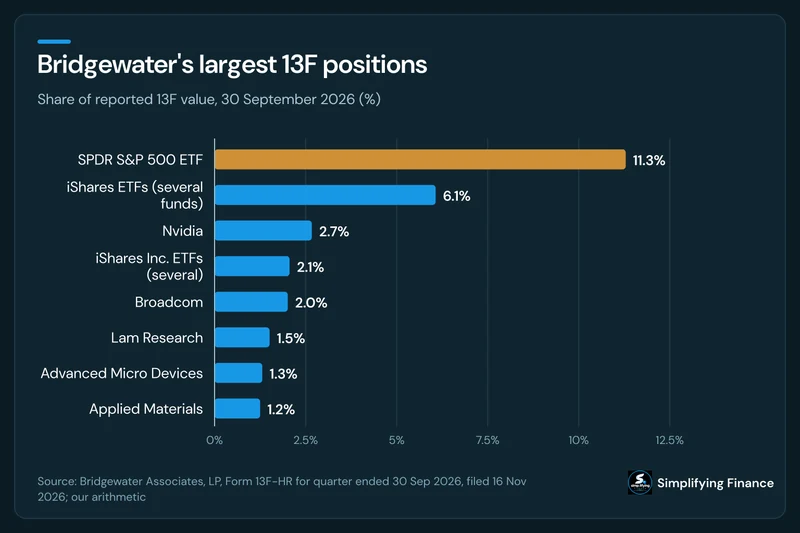
The largest single position was the SPDR S&P 500 ETF, at about US$2.6 billion or 11.3% of the reported value. Various iShares funds together accounted for a further 6.1%. Among individual companies, the largest were Nvidia (2.7%), Broadcom (2.0%), Lam Research (1.5%), Advanced Micro Devices (1.3%) and Applied Materials (1.3%). The ten largest issuers made up about 29% of the reported value.
Why so many index funds
For a large manager, an index fund can be a quick way to gain or adjust broad market exposure. A position in an S&P 500 fund tells us the firm held US shares in bulk on that date; it does not tell us why, or whether that exposure was offset elsewhere, for example by futures or short positions that a 13F does not report.
What the 13F misses
Bridgewater's best-known strategies trade government bonds, currencies, commodities and futures in many countries. None of these appear on a 13F. The US$23 billion of US-listed shares reported is therefore only one slice of what the firm manages. Reading its 13F as "Bridgewater's portfolio" would give a misleading picture.
The idea worth borrowing
The most useful lesson from Bridgewater for ordinary investors is not any particular holding but the principle behind All Weather: no one knows which economic environment comes next, so a portfolio should hold assets that do well in different conditions. The guide's earlier pages on bonds, inflation-linked bonds, gold and diversification across regions explain the building blocks.
Changes during the quarter
Comparing filings shows how the reported portfolio shifted. Bridgewater's reported value fell from about US$24.4 billion across 997 positions in June 2026 to about US$23.0 billion across 974 positions in September, according to reports of the two filings. Over the quarter it reduced some large technology holdings, such as Alphabet and Amazon, and added to others, including semiconductor companies such as Qualcomm and Micron, according to the same reports.
Changes like these reflect many decisions across Bridgewater's strategies, as well as market moves. The filing gives no reasons, so treating any single change as a forecast would be speculation.
Risk balance in plain terms
The idea of risk balance is that a portfolio's risk often comes mostly from shares, even when shares are only half of its money, because shares are more volatile than high-quality bonds. Balancing risk means giving more weight to steadier assets so that no single asset class dominates the ups and downs. Some versions use borrowing to raise the return of the steadier assets, which adds its own risks. Individuals can apply the simple version without borrowing: check that shares are not the only thing driving their portfolio.
What the filing cannot tell you
The 13F cannot say whether Bridgewater's share positions were part of a strategy that was, overall, betting on rising or falling markets, because futures and short positions are absent. It cannot show the firm's bond and currency positions, which are central to its approach, and it gives no information about performance, fees or client assets. It is also a single date: positions on 30 September 2026 may have changed substantially by the time the filing was published on 16 November.
Used carefully, the filing is a useful record of one part of the firm's activity. Used carelessly, as a model to copy, it can give a misleading idea of how one of the world's best-known macro investors actually invests.
A note on this page
This page is educational only. Holdings come from the firm's SEC Form 13F-HR for the quarter ended 30 September 2026, as filed; values are as reported and percentages are our arithmetic on the filing. A 13F is a snapshot of certain long US-listed positions on one date. It does not show short positions, most non-US holdings, bonds, cash or private investments, and positions may have changed since. Nothing here is a recommendation to buy or sell any security.
Balancing for different environments
A simple investor version of balancing across environments might hold shares (which tend to do well when growth is strong), high-quality government bonds (which often help when growth weakens), inflation-linked bonds and a little gold (which can help when inflation surprises).
| Global shares | US$16,000 (40%) |
| Government bonds | US$12,000 (30%) |
| Inflation-linked bonds | US$8,000 (20%) |
| Gold | US$4,000 (10%) |
With US$40,000, that could be US$16,000 in a global share fund, US$12,000 in government bonds, US$8,000 in inflation-linked bonds and US$4,000 in gold. This is an illustration of the principle, not Bridgewater's actual mix or a recommendation.
Where people go wrong
- Copying a macro fund's 13F. The filing omits the bonds, currencies and futures that drive its results.
- Reading index holdings as a forecast. They may be offset by positions the 13F does not show.
- Assuming one environment. Portfolios built for a single scenario can fail when conditions change.
- Ignoring the date. Positions shown are as of 30 September 2026.
- Reading changes as forecasts. Quarterly changes reflect many strategies and market moves.
Put it to work
- Test your mix. Ask how your portfolio would fare in high inflation and in a recession.
- Add a stabiliser. Consider whether high-quality bonds play a role in your mix.
- Look up the filing. Open Bridgewater's 13F on SEC EDGAR to see the full list.
- Check where your risk comes from. Estimate how much of your portfolio's swings come from shares.
- Read on. Next: Renaissance Technologies.
Bridgewater's 13F shows a broad, index-heavy portfolio of US shares. But the firm is best known for global macro strategies in bonds, currencies and commodities, which a 13F does not capture.
Facts checked against the sources above on 27 November 2026. Figures are as of the dates stated and will change. Worked examples use round illustrative numbers to show the arithmetic, not forecasts. Educational content only, not personal investment advice.