The firm
Renaissance Technologies was founded by Jim Simons, a mathematician and former codebreaker, and is famous for hiring scientists, mathematicians and engineers rather than traditional investors. Its approach is quantitative: computer models search large amounts of data for small, repeatable patterns in prices and trade on them, usually holding positions for short periods.
See the numbers behind the chart
| Position | Share of reported value |
|---|---|
| Micron Technology | 2.21% |
| Alphabet | 1.87% |
| Advanced Micro Devices | 1.64% |
| United Therapeutics | 1.24% |
| Intel | 1.14% |
| iShares ETFs (several) | 1.14% |
| UnitedHealth Group | 1.11% |
| Exelixis | 1.02% |
What the 13F shows
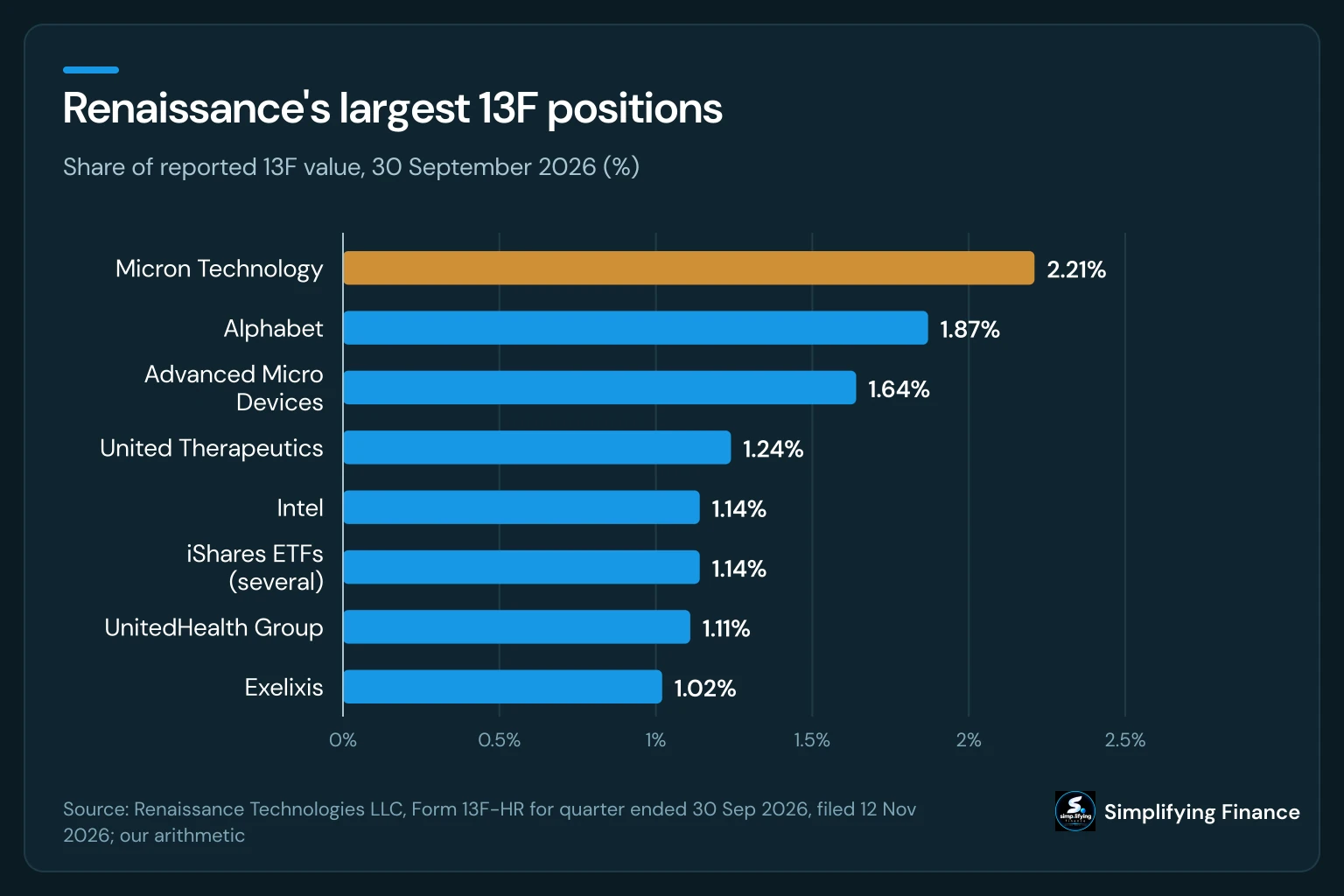
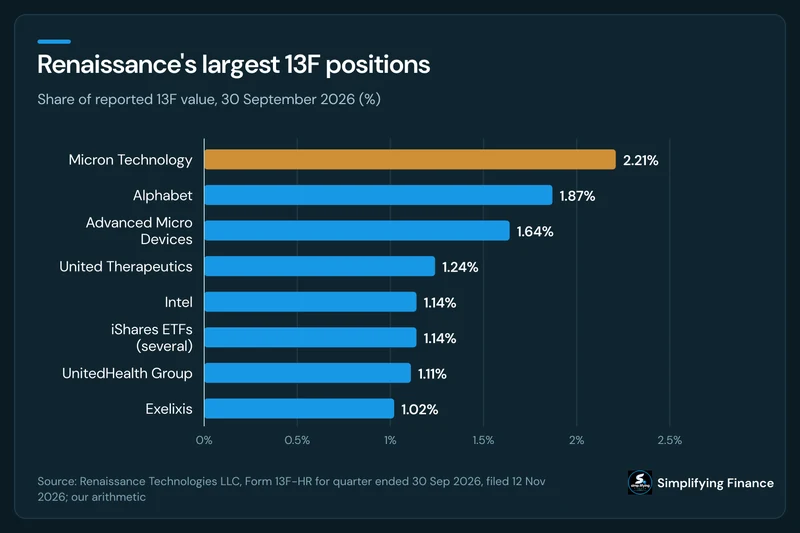
Renaissance's 13F for the quarter ended 30 September 2026, filed on 12 November 2026, listed 3,151 rows covering about 2,900 issuers, with a total reported value of about US$73.4 billion. It reported no options. The largest position, Micron Technology, was about US$1.62 billion, or 2.2% of the reported value. Next came Alphabet (1.9%, across two share classes), Advanced Micro Devices (1.6%) and United Therapeutics (1.2%). The ten largest issuers together made up only about 13% of the reported value.
Very high turnover
The filing shows how quickly a quantitative portfolio changes. Compared with June 2026, Renaissance held 7,091,256 Nvidia shares on 30 June and 23,170 on 30 September, a reduction of 99.7%. Its Micron holding rose from 211,580 shares to 1,520,639. A tally of the filings counted 591 new positions and 580 complete exits in a single quarter.
A 13F does not explain why a fund traded. For a model-driven firm, a large change may reflect statistical signals rather than a view on a company's prospects.
What the 13F misses
Quantitative funds typically run both long and short positions, often balanced so that the overall market direction matters little. The 13F shows only the long side in US-listed shares. It also cannot show positions opened and closed between quarter-ends, which for a fast-trading fund may be most of its activity.
The lesson for individuals
Renaissance's 13F illustrates two ideas. First, wide diversification: no single company dominates. Second, the limits of imitation: a strategy that depends on speed, data and constant adjustment cannot be copied from a list published six weeks later. Individuals can borrow the first idea cheaply through a broad index fund.
New positions and exits
Beyond Nvidia, Renaissance's September 2026 filing showed sharply higher holdings in companies such as Micron, Charles Schwab and UnitedHealth Group, according to a tally of the filings. Many smaller positions came and went. Across the portfolio, the turnover is so high that the ranking of top holdings can change completely from one quarter to the next.
For readers, the main lesson is about the nature of the strategy rather than the companies: a model-driven fund rebalances constantly, so any list of its holdings is a moving target.
Data, speed and cost
Quantitative strategies depend on three things individuals rarely have: large amounts of clean data, the ability to trade quickly and cheaply, and the research capacity to test ideas without fooling themselves. Small statistical edges can disappear once trading costs are included. That is why the advantages of firms like Renaissance are hard to replicate even for other professionals, let alone private investors.
Spreading risk across thousands of positions
With about 2,900 issuers and the largest at just over 2%, Renaissance's long book is more diversified than most mutual funds. Each position contributes only a little, positive or negative, and the result depends on the overall accuracy of the models across all of them. If the models are slightly right on average, many small gains add up; if they are wrong, the losses are spread thinly too. This statistical approach is very different from a traditional manager who backs a few strong convictions, and it is one reason the firm's methods attract so much interest.
The broader point
The deeper lesson is humility about information. By the time any public list of holdings appears, professional traders have long since acted on whatever it contains. Individuals gain far more from controlling what they can, such as costs, diversification, saving rates and behaviour in downturns, than from trying to follow the trades of a firm whose methods are secret and whose positions change every few days.
A note on this page
This page is educational only. Holdings come from the firm's SEC Form 13F-HR for the quarter ended 30 September 2026, as filed; values are as reported and percentages are our arithmetic on the filing. A 13F is a snapshot of certain long US-listed positions on one date. It does not show short positions, most non-US holdings, bonds, cash or private investments, and positions may have changed since. Nothing here is a recommendation to buy or sell any security.
Copying a fast-moving fund
Suppose an investor read Renaissance's June 2026 13F in August and bought its largest position, Nvidia, expecting to follow the fund. By 30 September, the fund had sold almost all of its Nvidia shares, as the next filing in November revealed.
| June 2026 Nvidia shares | 7,091,256 |
| September 2026 Nvidia shares | 23,170 |
| Change | about -99.7% |
| When the change became public | 12 November 2026 |
The investor would have been holding a position the fund had already exited, and would only have found out months later. With a portfolio this active, a 13F is a historical record, not a guide to current holdings.
Where people go wrong
- Copying a quantitative fund's holdings. Its positions change constantly and the 13F is weeks old.
- Assuming big changes are big views. Model-driven trades may not reflect opinions about companies.
- Ignoring the short side. Long positions may be balanced by shorts that are not reported.
- Mistaking many holdings for safety. Diversification works best when combined with low cost and patience.
- Underestimating trading costs. Frequent trading can erase small statistical edges.
- Following famous names blindly. Reputation does not make a delayed snapshot useful.
Put it to work
- Diversify cheaply. A broad index fund gives exposure to thousands of companies.
- Avoid chasing filings. Treat 13Fs as history, not trade signals.
- Learn about factors. Read how systematic strategies use factors such as momentum and value.
- Trade less. Keep your own portfolio changes infrequent and deliberate.
- Focus on what you control. Costs, diversification, saving and behaviour matter most.
- Read on. Next: Citadel.
Renaissance's 13F shows extreme diversification and very high turnover: thousands of small positions chosen by computer models. Its filings change so much each quarter that copying them is close to meaningless.
Facts checked against the sources above on 27 November 2026. Figures are as of the dates stated and will change. Worked examples use round illustrative numbers to show the arithmetic, not forecasts. Educational content only, not personal investment advice.