The firm
Citadel was founded by Ken Griffin and has become one of the largest hedge fund firms. It is a multi-strategy manager: many separate investment teams run their own strategies in equities, fixed income, commodities, credit and quantitative trading, under central risk limits. Citadel the hedge fund firm is separate from Citadel Securities, a market-making business that Griffin also founded.
See the numbers behind the chart
| Type | US$ billion |
|---|---|
| Shares and ETFs | 182 |
| Call options | 382 |
| Put options | 335 |
What the 13F shows
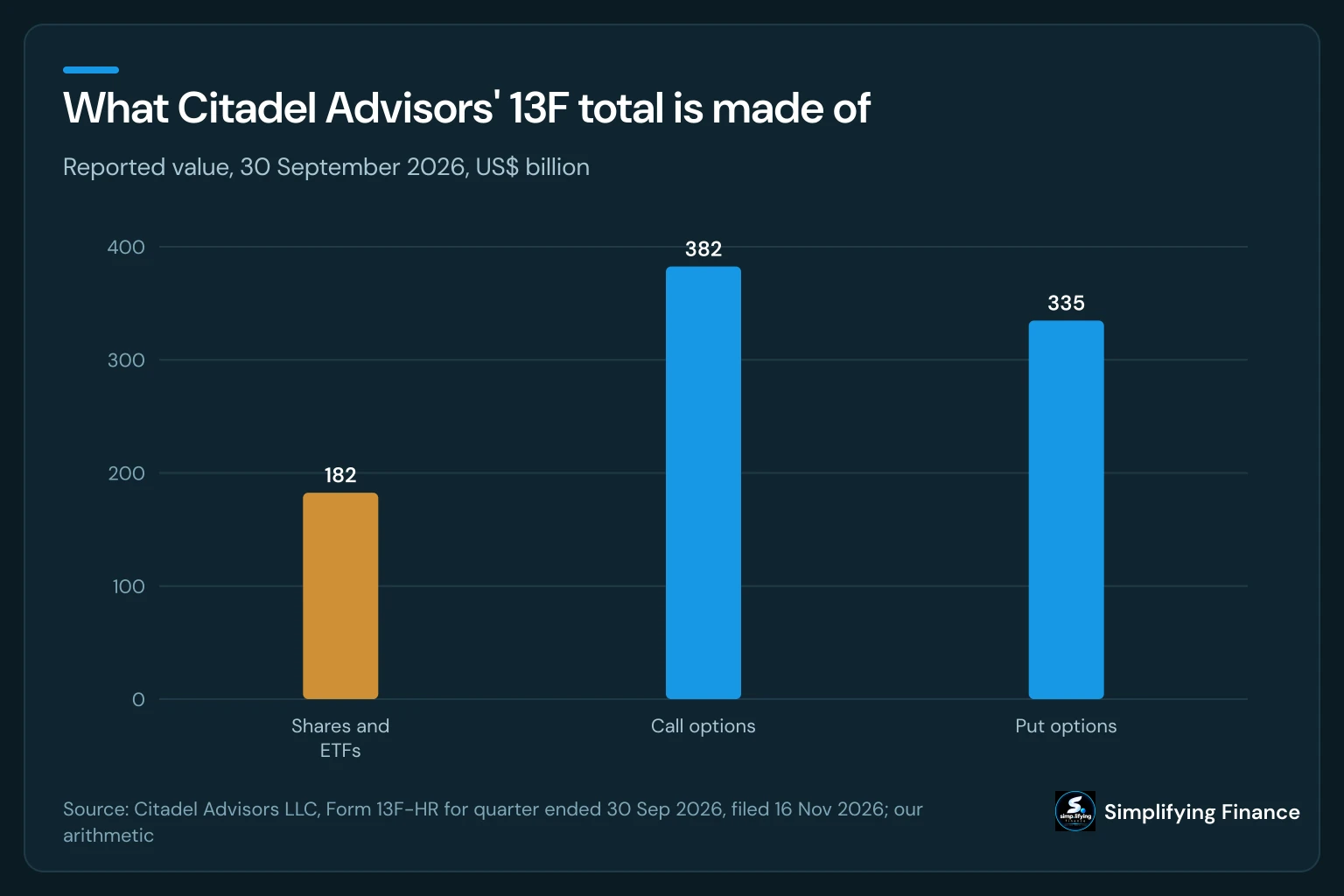
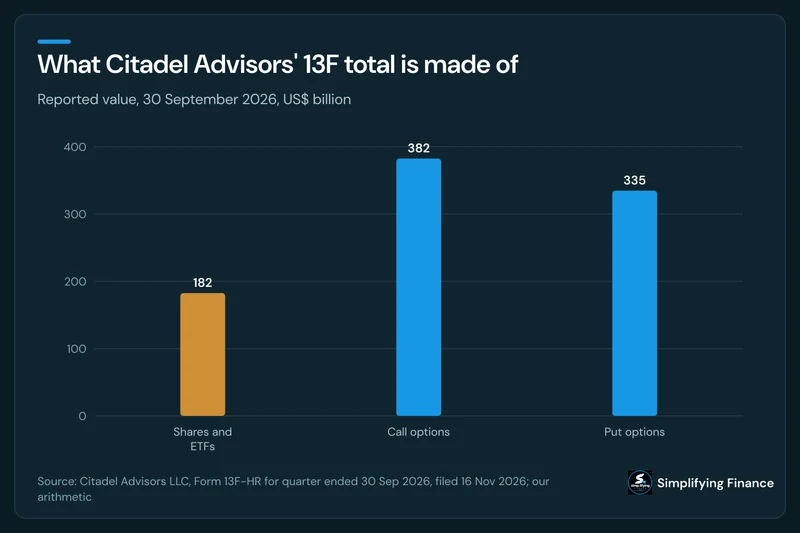
Citadel Advisors' 13F for the quarter ended 30 September 2026, filed on 16 November 2026, is enormous: 16,527 rows covering more than 4,600 issuers, with a total reported value of about US$899.6 billion. But only about US$182.5 billion of that was shares and ETFs. About US$382.5 billion was call options and US$334.7 billion put options, each measured by the value of the shares they relate to.
Among shares, the largest holdings were various iShares funds (about 7% of the share value), then Microsoft, Nvidia, the SPDR S&P 500 ETF and Mastercard, each between about 1% and 2%. The ten largest issuers made up about 16% of share value.
Why so many options
A multi-strategy fund uses options for many purposes: to hedge positions, to express views on volatility, or to adjust exposure quickly. A put option on an index fund, for example, gains when the market falls and can offset losses elsewhere. The 13F shows that these positions existed, but not their cost, their exact terms or how they combine with other positions.
What the 13F misses
Short positions, bonds, futures, commodities and non-US positions are all absent. For a firm whose teams trade across many asset classes, the 13F is a partial view of one part of its activity on one day.
The lesson for individuals
Citadel's model, many independent teams under strict risk control, is a form of diversification across strategies and managers. Individuals cannot replicate it, but they can apply its core discipline: limit how much any single idea can hurt the whole portfolio, and keep track of total risk rather than individual bets.
Multi-strategy in brief
Multi-strategy firms such as Citadel and Millennium allocate capital to many teams and move it between them based on results and opportunities. Central risk teams monitor total exposure to markets, sectors and factors, and may hedge at the firm level. The goal is a smoother return stream than any single strategy could produce alone.
This is diversification across strategies and people rather than across assets alone. It is expensive to run, because it requires large numbers of skilled staff, technology and data, and investors in such funds have often paid substantial fees, including pass-through of costs.
The largest share holdings in context
Citadel Advisors' largest share positions, iShares funds, Microsoft, Nvidia, an S&P 500 fund and Mastercard, together made up only a small fraction of its reported share value of about US$182.5 billion. With more than 4,600 issuers, the long book is spread very widely. Combined with heavy option use, this suggests a portfolio designed around many small, controlled positions rather than a few big ideas.
Questions to ask of any large 13F
When a filing runs to thousands of rows, a few questions help. How much of the total is options rather than shares? Are the largest positions index funds, which may be used for hedging or quick exposure, or individual companies? How concentrated are the top ten? How much did the total change from the previous quarter, and was that from trading or from prices? For Citadel Advisors in September 2026, the answers point to a widely spread share book with very large option positions, a profile typical of a multi-strategy firm rather than a stock picker.
Where to find the filing
Citadel Advisors' filing, like every 13F, is available free on SEC EDGAR, linked in the sources below. Because it runs to more than 16,000 rows, it is best read as a downloaded table, sorted by value, with option rows separated from share rows before any totals are calculated. Doing that yourself is the best protection against misleading headline numbers.
A note on this page
This page is educational only. Holdings come from the firm's SEC Form 13F-HR for the quarter ended 30 September 2026, as filed; values are as reported and percentages are our arithmetic on the filing. A 13F is a snapshot of certain long US-listed positions on one date. It does not show short positions, most non-US holdings, bonds, cash or private investments, and positions may have changed since. Nothing here is a recommendation to buy or sell any security.
How an option is reported
Suppose a fund buys put options on 1 million shares of an index ETF trading at US$500. The options might cost, say, US$10 million. On the 13F, the position is reported as about US$500 million, the value of the underlying shares.
| Underlying shares | 1 million at US$500 |
| Reported on 13F | about US$500 million |
| Actual cost (illustrative) | about US$10 million |
| Gains when | the market falls (put) |
A reader adding up the 13F would count US$500 million, fifty times what the fund actually spent, and might even read it as a large bullish bet when it is a hedge that gains if the market falls.
Where people go wrong
- Adding options to share values. Options are reported at underlying value, which inflates totals.
- Reading puts as bullish. A put rises in value when prices fall.
- Confusing related firms. Citadel the hedge fund and Citadel Securities are separate businesses.
- Expecting a full picture. Shorts and non-equity trades are missing.
- Assuming more holdings means more risk. Wide spreading usually reduces single-company risk.
Put it to work
- Check the put/call column. Separate options from shares when reading any 13F.
- Limit single-idea risk. Decide a maximum share for any one holding in your portfolio.
- Track total risk. Review how much of your portfolio is in shares overall.
- Diversify across approaches. Consider whether your portfolio relies on a single strategy.
- Read on. Next: Millennium.
Citadel's 13F shows why headline 13F totals can be misleading. Most of the reported value is call and put options, often used to hedge or to fine-tune risk, not straightforward bets.
Facts checked against the sources above on 27 November 2026. Figures are as of the dates stated and will change. Worked examples use round illustrative numbers to show the arithmetic, not forecasts. Educational content only, not personal investment advice.