The firm
Millennium Management was founded by Israel Englander. It runs a multi-strategy platform made up of many separate investment teams, often called pods, each focused on a particular strategy, sector or market. Each team has its own capital and strict loss limits; teams that breach their limits can have their capital cut. The aim is steady returns with little dependence on the direction of the overall market.
See the numbers behind the chart
| Type | US$ billion |
|---|---|
| Shares and ETFs | 137 |
| Call options | 58 |
| Put options | 107 |
What the 13F shows
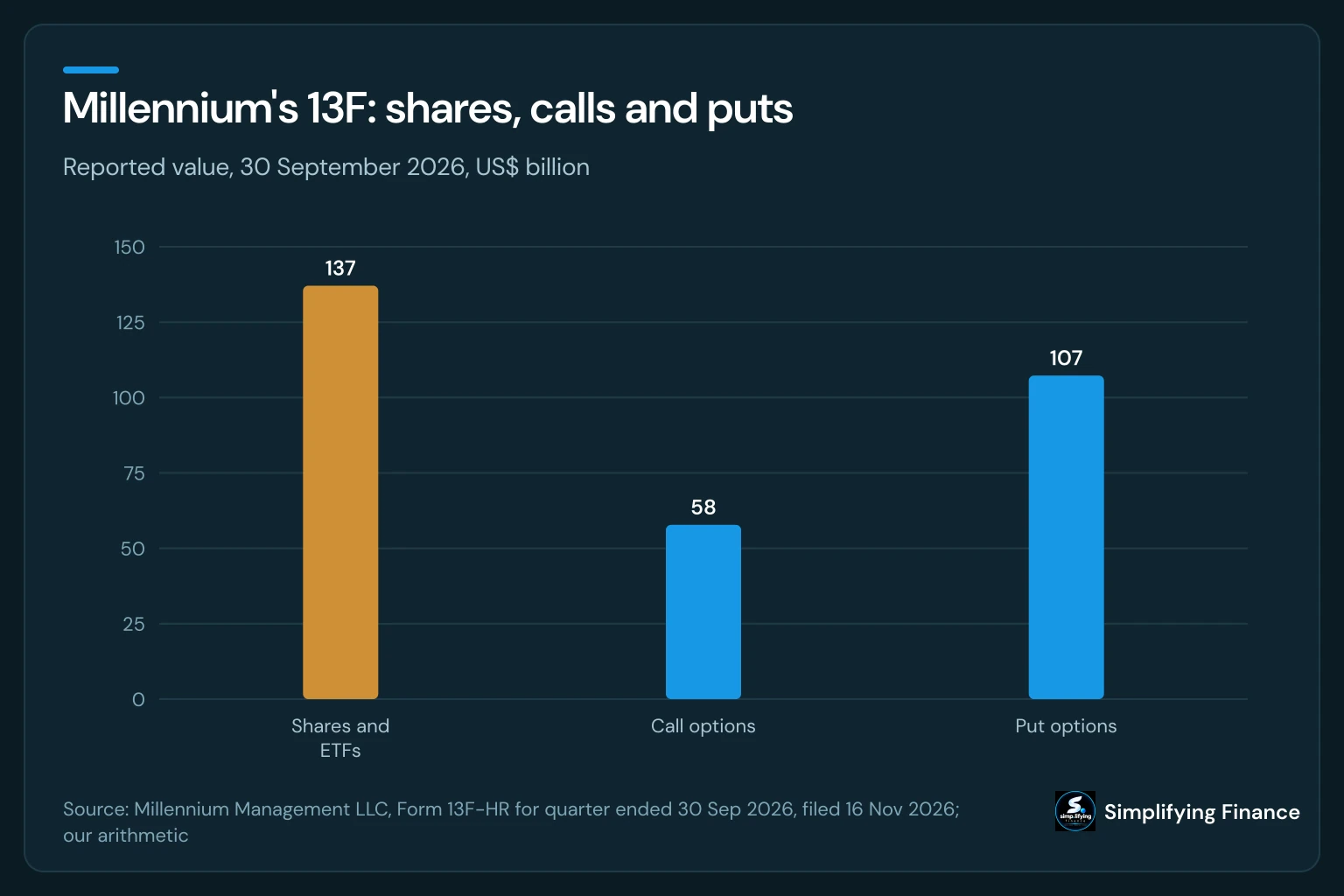
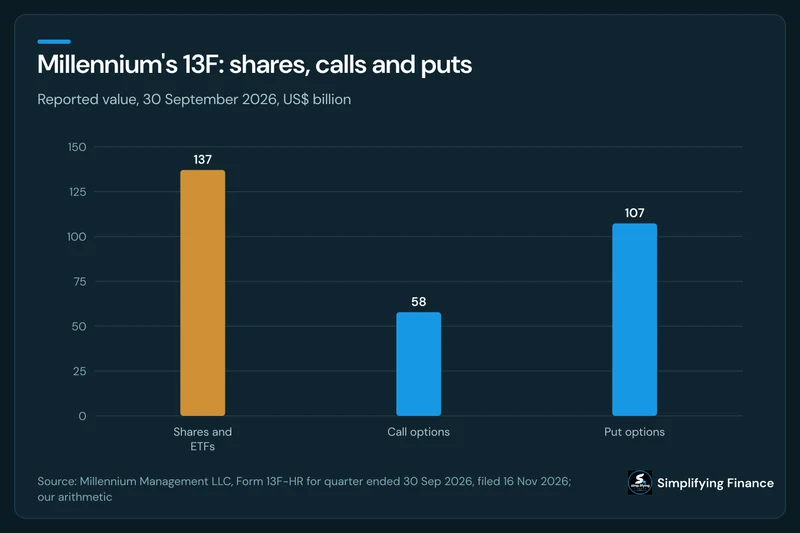
Millennium's 13F for the quarter ended 30 September 2026, filed on 16 November 2026, listed 6,103 rows covering about 3,700 issuers. The total reported value was about US$302 billion, of which about US$137 billion was shares and ETFs, US$58 billion call options and US$107 billion put options, measured by underlying value.
Among shares, the largest positions were various iShares funds (about 7% of share value), Nvidia (2.2%), Vanguard index funds (1.4%), the SPDR S&P 500 ETF (1.3%) and Warner Bros. Discovery (1.1%). The largest option positions were puts on iShares funds and on the Nasdaq-100 trust.
Reading the hedges
Large index puts and ETF positions are consistent with a firm that hedges market risk so that results depend on its teams' stock selection rather than on the market's direction. Many teams may buy shares they like and protect against a broad fall with index puts or short positions. The 13F confirms the puts but not the short positions, so it cannot show how fully the market risk was offset.
What the 13F misses
Many Millennium teams trade bonds, interest rates, commodities and currencies, none of which appear on a 13F. Positions are also adjusted frequently, so the quarter-end snapshot may differ greatly from typical holdings.
The lesson for individuals
The pod model shows the value of strict loss limits and of not letting any single bet dominate. Individuals can apply simplified versions: set a maximum size for any one holding, and decide in advance what you will do if an investment falls sharply, rather than deciding under pressure.
Why put options outweigh calls
In Millennium's filing, put options at about US$107 billion of underlying value outweighed calls at about US$58 billion. Puts are commonly used to protect against falls, either in single shares or in whole markets. A pod-based firm may encourage teams to neutralise market exposure so that their results reflect stock-picking skill. Index puts are one tool for that, alongside short selling and futures, which are not reported.
Because options are reported at the value of the shares underneath, these figures say nothing about how much the firm paid for them or how much they could gain or lose.
Discipline as a strategy
A key feature of the pod model is that teams are cut back quickly after losses. This keeps any single team's mistakes from damaging the whole firm. For individuals, the equivalent is having rules decided in advance, such as rebalancing when a holding grows too large, rather than reacting emotionally. The guide's page on portfolio drift explains how simple rebalancing rules work.
Index funds as building blocks
Millennium's largest share positions were index funds: various iShares funds, Vanguard funds, an S&P 500 ETF and the Nasdaq-100 trust. Professional investors often use such funds to gain or reduce exposure to a market or sector quickly, sometimes as one leg of a hedged trade. The same funds that individuals use for long-term diversification also serve as precise tools for hedge funds, which shows how central low-cost index products have become to the whole investment system.
The numbers in proportion
Taken together, Millennium's 13F showed about US$137 billion in shares spread across thousands of issuers, with no single company dominating. Its largest single-company holding, Nvidia, was just over 2% of share value. That pattern, many small positions plus large index protection, is the visible footprint of a strategy designed to keep any one bet, or the market as a whole, from deciding results.
A note on this page
This page is educational only. Holdings come from the firm's SEC Form 13F-HR for the quarter ended 30 September 2026, as filed; values are as reported and percentages are our arithmetic on the filing. A 13F is a snapshot of certain long US-listed positions on one date. It does not show short positions, most non-US holdings, bonds, cash or private investments, and positions may have changed since. Nothing here is a recommendation to buy or sell any security.
A hedged position in practice
Suppose a team buys US$10 million of shares in a company it expects to beat its rivals, and sells short, or buys protection on, US$10 million of an index fund covering the same sector. If the whole sector falls 10% and the company falls 8%, the team loses about US$800,000 on the shares but gains about US$1 million on the hedge.
| Long shares | US$10m, fall 8%: -US$0.8m |
| Sector hedge | US$10m, sector falls 10%: +US$1.0m |
| Net result | about +US$0.2m |
| Visible on 13F | the long shares and listed options only |
The result, about US$200,000 profit, comes from the company doing better than its sector, not from the market's direction. On a 13F, only the US$10 million long position would appear, plus any listed put options.
Where people go wrong
- Ignoring hedges. Large put positions often mean market risk is being reduced.
- Treating a pod firm as one view. Hundreds of teams may hold opposing positions.
- Copying quarter-end snapshots. Holdings change frequently between filings.
- No loss limits of your own. Decide in advance how you will respond to big falls.
- Letting winners grow unchecked. A holding that doubles can come to dominate your risk.
Put it to work
- Set position limits. Choose a maximum percentage for any single share or theme.
- Plan for falls. Write down what you will do if a holding drops 30%.
- Look at your hedges. Ask whether anything in your portfolio tends to rise when shares fall.
- Rebalance on a schedule. Review your mix once or twice a year and trim large positions.
- Read on. Next: D. E. Shaw.
Millennium's 13F reflects a "pod" model: many small, independent teams each running tightly limited risk. Its large put option positions point to extensive hedging, which is typical of market-neutral strategies.
Facts checked against the sources above on 27 November 2026. Figures are as of the dates stated and will change. Worked examples use round illustrative numbers to show the arithmetic, not forecasts. Educational content only, not personal investment advice.