The firm
D. E. Shaw was founded by David E. Shaw, a computer scientist, and was one of the early firms to apply computing power and quantitative methods to investing. Today it runs both systematic strategies, driven by models, and discretionary ones, driven by people, across many markets. Several well-known technology and finance figures began their careers there.
See the numbers behind the chart
| Position | Share of share value |
|---|---|
| SPDR S&P 500 ETF | 5.6% |
| Alphabet | 2.9% |
| Nvidia | 2.7% |
| Intel | 1.4% |
| Microsoft | 1.3% |
| Amazon | 1.1% |
| Apple | 1.1% |
| Warner Bros. Discovery | 1.0% |
What the 13F shows
D. E. Shaw's 13F for the quarter ended 30 September 2026, filed on 16 November 2026, listed 6,478 rows covering about 3,100 issuers. The total reported value was about US$209 billion: about US$159 billion in shares and ETFs, US$23 billion in call options and US$27 billion in put options, measured by underlying value.
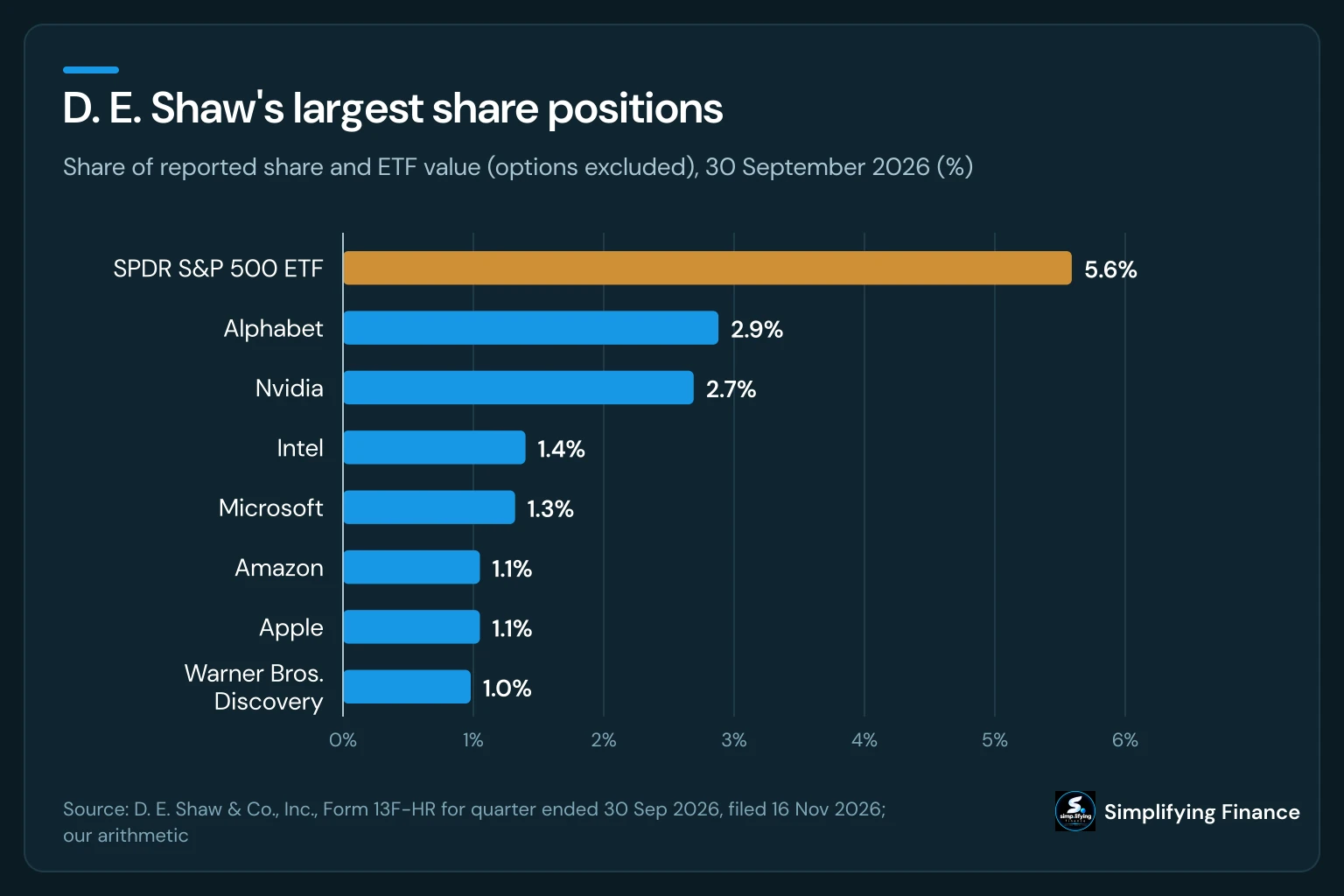
The largest share position was the SPDR S&P 500 ETF, at about US$8.9 billion or 5.6% of share value. Next came Alphabet (2.9%), Nvidia (2.7%), Intel (1.4%) and Microsoft (1.3%). The ten largest issuers made up about 19% of the reported value.
Balanced options
Unlike Citadel and Millennium, D. E. Shaw's calls and puts were roughly balanced in reported value. That is consistent with a mix of strategies that use options in both directions, though the filing does not reveal the strategies themselves. As always with a 13F, reported option values reflect the underlying shares, not the money at risk.
What the 13F misses
D. E. Shaw trades credit, interest rates, currencies and other assets, and runs short positions in shares. None of these appear on a 13F. Its private investments and non-US listed holdings are also excluded.
The lesson for individuals
D. E. Shaw's long book looks, at the top, much like a large-company index: an S&P 500 fund plus the biggest US technology companies. This is common among large managers and shows how much the largest companies dominate US market value. Individuals who hold a broad index fund already own these companies in proportion to their size.
Systematic and discretionary together
D. E. Shaw combines model-driven strategies with judgement-based investing by experienced teams. Using both allows a firm to diversify its sources of return: models may excel at processing large amounts of data quickly, while people may be better at complex situations such as restructurings or unusual events. When one approach struggles, the other may hold up.
Individuals can apply a simple version of this idea by not relying on a single method. A low-cost index core reflects the market's collective judgement; any personal research can then be limited to a small part of the portfolio.
Why the largest companies appear everywhere
Alphabet, Nvidia, Microsoft, Amazon and Apple appear near the top of many hedge fund 13Fs in this section. This is partly because these companies are among the largest in the world by market value, so any broad portfolio holds a lot of them. Their presence in a 13F is not necessarily a sign of special conviction; it can simply reflect their size in the market.
What changed and what did not
A single 13F is a snapshot, so changes between filings are often more informative than levels. Even then, a change in reported value mixes trading with price moves: a holding can rise in value simply because its share price went up. For a firm with thousands of positions and active options use, quarter-to-quarter differences can reflect many strategies at once. Readers should therefore treat changes as descriptive facts, not as signals of what the firm expects next.
A note on scale
D. E. Shaw's reported share value of about US$159 billion is large, but it should not be read as the firm's size. Like the other firms here, its true capital, borrowing and short positions are not disclosed on a 13F. Any comparison of firms based on 13F totals compares only their long US-listed holdings on one date.
A note on this page
This page is educational only. Holdings come from the firm's SEC Form 13F-HR for the quarter ended 30 September 2026, as filed; values are as reported and percentages are our arithmetic on the filing. A 13F is a snapshot of certain long US-listed positions on one date. It does not show short positions, most non-US holdings, bonds, cash or private investments, and positions may have changed since. Nothing here is a recommendation to buy or sell any security.
Overlap with an index fund
An investor holding US$20,000 in an S&P 500 index fund already owns small stakes in Alphabet, Nvidia, Microsoft, Amazon and Apple, which are among the largest companies in the index.
| S&P 500 fund | already holds the largest US companies |
| Extra direct holdings | the same companies again |
| Result | higher concentration |
| Check | compare top holdings across all your accounts |
If the same investor then buys those five companies separately to "follow" a hedge fund's 13F, they increase their concentration in the same few businesses. The overlap is easy to miss because the holdings sit in different accounts or funds.
Where people go wrong
- Doubling up on the largest companies. Index funds already hold them.
- Assuming balanced options mean no risk. Option values on a 13F do not show money at risk.
- Ignoring missing asset classes. Credit and rates trading are absent from 13Fs.
- Treating a 13F as a model portfolio. It is a partial snapshot, not a recommendation.
- Reading popularity as conviction. Large companies appear in many portfolios because of their size.
- Comparing firms by 13F totals. Totals show long US-listed holdings only, not firm size.
Put it to work
- Map your overlap. List your top ten exposures across every fund and account.
- Prefer breadth. Use broad funds rather than stacking the same large companies.
- Check the filing date. This page reflects 30 September 2026.
- Use one core method. Let a broad index fund carry most of your exposure.
- Read the full table. Download the filing and sort it by value to see the whole long book.
- Read on. Next: Two Sigma.
D. E. Shaw's 13F shows a broad, diversified long book, led by index funds and the largest US companies, with balanced option positions. Like other multi-strategy firms, much of its activity is invisible in the filing.
Facts checked against the sources above on 27 November 2026. Figures are as of the dates stated and will change. Worked examples use round illustrative numbers to show the arithmetic, not forecasts. Educational content only, not personal investment advice.