The firm
Two Sigma was founded by John Overdeck and David Siegel, who came from backgrounds in mathematics and computer science. It describes its approach as applying scientific methods, data and technology to investing. Its teams build models that analyse large amounts of information, from prices to company data, to find patterns that may predict returns.
See the numbers behind the chart
| Position | Share of reported value |
|---|---|
| Nvidia | 1.69% |
| Microsoft | 1.25% |
| iShares ETFs (several) | 1.24% |
| Apple | 0.95% |
| Select Sector SPDR ETFs | 0.93% |
| Alphabet | 0.83% |
| JPMorgan Chase | 0.78% |
| Costco | 0.76% |
What the 13F shows
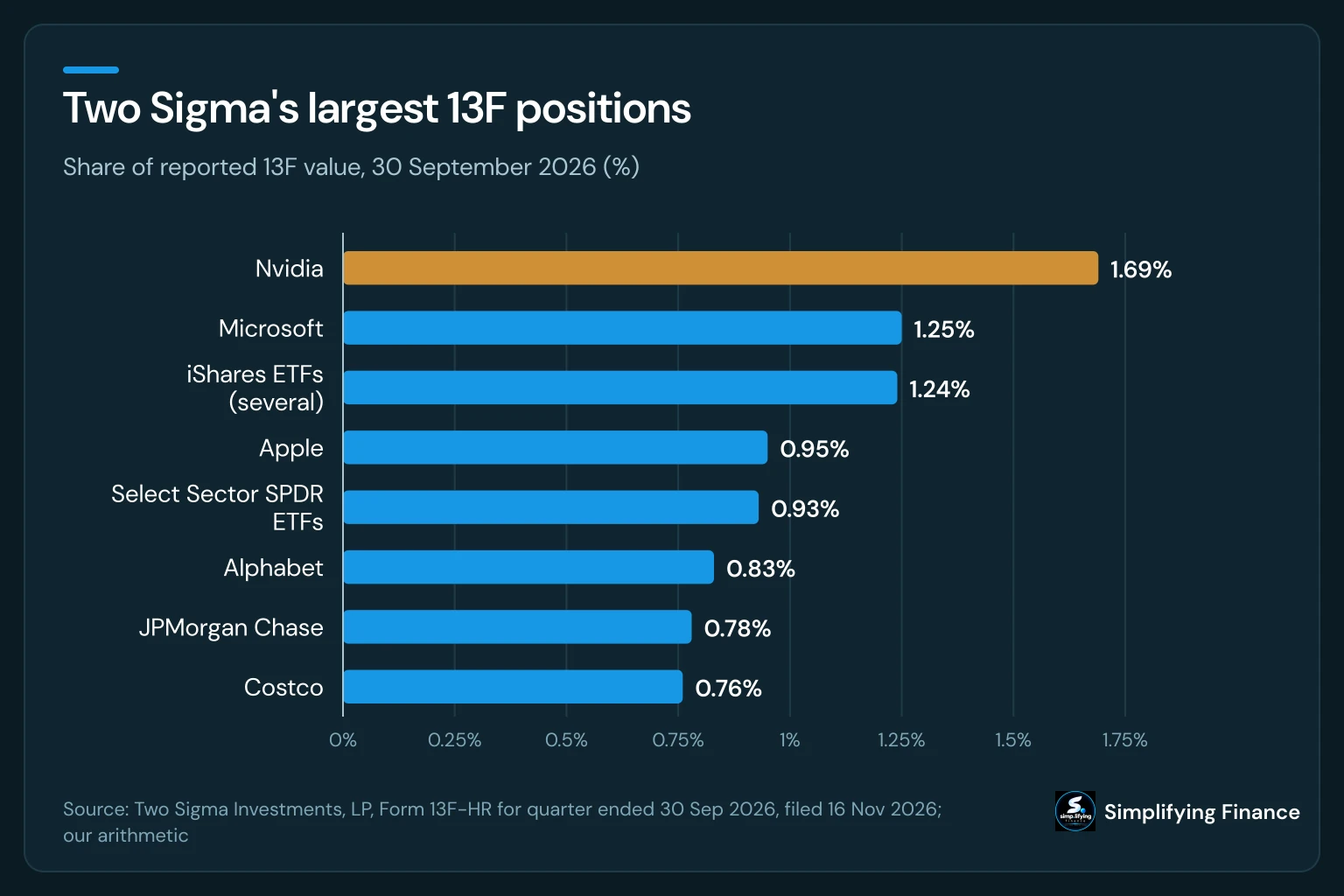
Two Sigma Investments' 13F for the quarter ended 30 September 2026, filed on 16 November 2026, listed 4,830 rows covering about 3,600 issuers. The total reported value was about US$141.9 billion, of which about US$137.7 billion was shares and ETFs and about US$4.2 billion options.
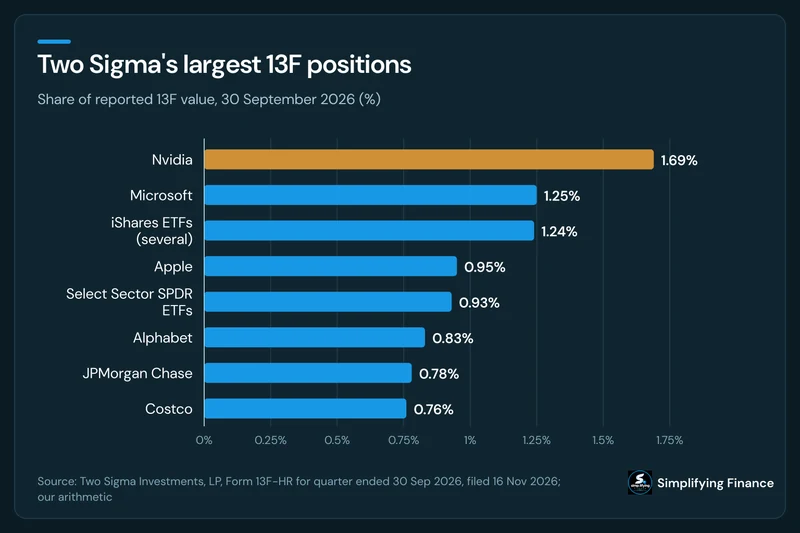
The largest position, Nvidia, was only about 1.7% of the reported value. Next came Microsoft (1.3%), various iShares funds (1.2%), Apple (1.0%) and Select Sector SPDR funds (0.9%). The ten largest issuers together made up under 10% of the share value, one of the lowest concentrations among the firms in this section.
Why so spread out
Quantitative strategies often take many small positions, each expected to add a little to returns, rather than a few large bets. Spreading capital thinly means that any single mistake has a small effect, and that results depend on the average quality of thousands of decisions. This is diversification taken to an extreme, and it relies on low trading costs and careful risk control.
What the 13F misses
As with other quantitative firms, Two Sigma's long positions are likely to be matched by short positions that a 13F does not report, and its holdings change frequently. Positions in futures, currencies and non-US markets are also excluded.
The lesson for individuals
The individual equivalent of thousands of small positions is a broad, low-cost index fund. It provides very wide diversification without the trading costs or data needed for active quantitative investing. What individuals cannot copy is the edge: the models, data and speed that a firm like Two Sigma uses.
Science applied to markets
Two Sigma describes investing as a scientific problem: form hypotheses, test them on data, and keep only those that hold up. The risk in this approach is overfitting, finding patterns in past data that are just coincidence. Careful firms guard against this by testing ideas on data not used to develop them and by requiring a sensible economic reason for each signal.
The same caution applies to individual investors reading backtests or performance charts. A strategy that looks brilliant on past data may simply have been tuned to the past.
The limits of a long-only view
With options worth only about US$4.2 billion at underlying value, Two Sigma's 13F is mostly shares. But a firm running market-neutral strategies would usually hold short positions of similar size to its longs, so the long book alone may greatly overstate its exposure to rising markets. A 13F therefore cannot tell you whether a quantitative fund is betting on the market or deliberately avoiding it.
Ten largest, under ten percent
Two Sigma's ten largest issuers accounted for under 10% of its reported share value on 30 September 2026, the lowest concentration of the ten firms in this section. By comparison, the ten largest companies in the S&P 500 index have in recent years made up a much larger share of that index. In other words, Two Sigma's long book was more evenly spread than a typical market-value-weighted index fund, a reminder that index funds themselves can be quite concentrated in their largest holdings.
Where to look next
Readers interested in how quantitative investing works can start with the library's lessons on factor investing and diversification, linked below. They explain, without mathematics, the ideas that systematic firms build on, and how individuals can apply the useful parts through simple, low-cost funds.
That is the practical takeaway from Two Sigma's filing for most readers.
A note on this page
This page is educational only. Holdings come from the firm's SEC Form 13F-HR for the quarter ended 30 September 2026, as filed; values are as reported and percentages are our arithmetic on the filing. A 13F is a snapshot of certain long US-listed positions on one date. It does not show short positions, most non-US holdings, bonds, cash or private investments, and positions may have changed since. Nothing here is a recommendation to buy or sell any security.
Many small bets versus a few large ones
Compare two US$100,000 portfolios. One holds 10 shares at US$10,000 each; the other holds 1,000 at US$100 each. If one company in each portfolio goes to zero, the first loses US$10,000 (10%) and the second loses US$100 (0.1%).
| 10 holdings | one failure costs 10% |
| 1,000 holdings | one failure costs 0.1% |
| What remains | market-wide risk |
| Cheapest route to breadth | a broad index fund |
The second portfolio's result depends on the average of many companies, not on any one. That is why broad diversification reduces company-specific risk, though it does not remove the risk of the whole market falling.
Where people go wrong
- Thinking quant funds pick a few winners. They usually take thousands of small positions.
- Copying the long side only. Shorts that balance the portfolio are not shown.
- Ignoring trading costs. Many small trades are only worthwhile with very low costs.
- Expecting diversification to stop market falls. It reduces company risk, not market risk.
- Trusting a backtest at face value. Past patterns may be coincidence.
- Assuming an index fund is evenly spread. Market-value weighting concentrates index funds in the largest companies.
Put it to work
- Count your holdings. See how many companies you own through all your funds.
- Keep costs low. Use low-cost funds rather than trading many single shares.
- Understand factors. Learn how value, momentum and quality are used by systematic investors.
- Ask why a strategy should work. Look for a sensible economic reason, not just a good chart.
- Check your fund's top ten. See what share of your index fund sits in its ten largest holdings.
- Read on. Next: Elliott Management.
Two Sigma's 13F is among the most widely spread of any large firm: the ten largest issuers were under 10% of reported value. Like other quantitative firms, its edge lies in models and data, not in any list of holdings.
Facts checked against the sources above on 27 November 2026. Figures are as of the dates stated and will change. Worked examples use round illustrative numbers to show the arithmetic, not forecasts. Educational content only, not personal investment advice.