The firm
Elliott was founded by Paul Singer and is known for activist investing: buying significant stakes in companies and pressing for changes, such as new strategies, asset sales, board changes or cost cuts, that it believes will raise value. It also invests in distressed debt, credit, and many other areas. Its activist campaigns are often public and can involve some of the world's largest companies.
See the numbers behind the chart
| Position | Share of share value |
|---|---|
| Phillips 66 | 30.6% |
| Triple Flag Precious Metals | 25.5% |
| Suncor Energy | 12.4% |
| Hewlett Packard Enterprise | 10.7% |
| Southwest Airlines | 6.3% |
| 3.3% | |
| Uniti Group | 3.1% |
| Etsy | 2.2% |
What the 13F shows
Elliott Investment Management's 13F for the quarter ended 30 September 2026, filed on 16 November 2026, listed 39 rows covering just 17 issuers. The total reported value was about US$28.6 billion: about US$16.1 billion in shares, US$1.1 billion in call options and US$11.4 billion in put options, measured by underlying value.
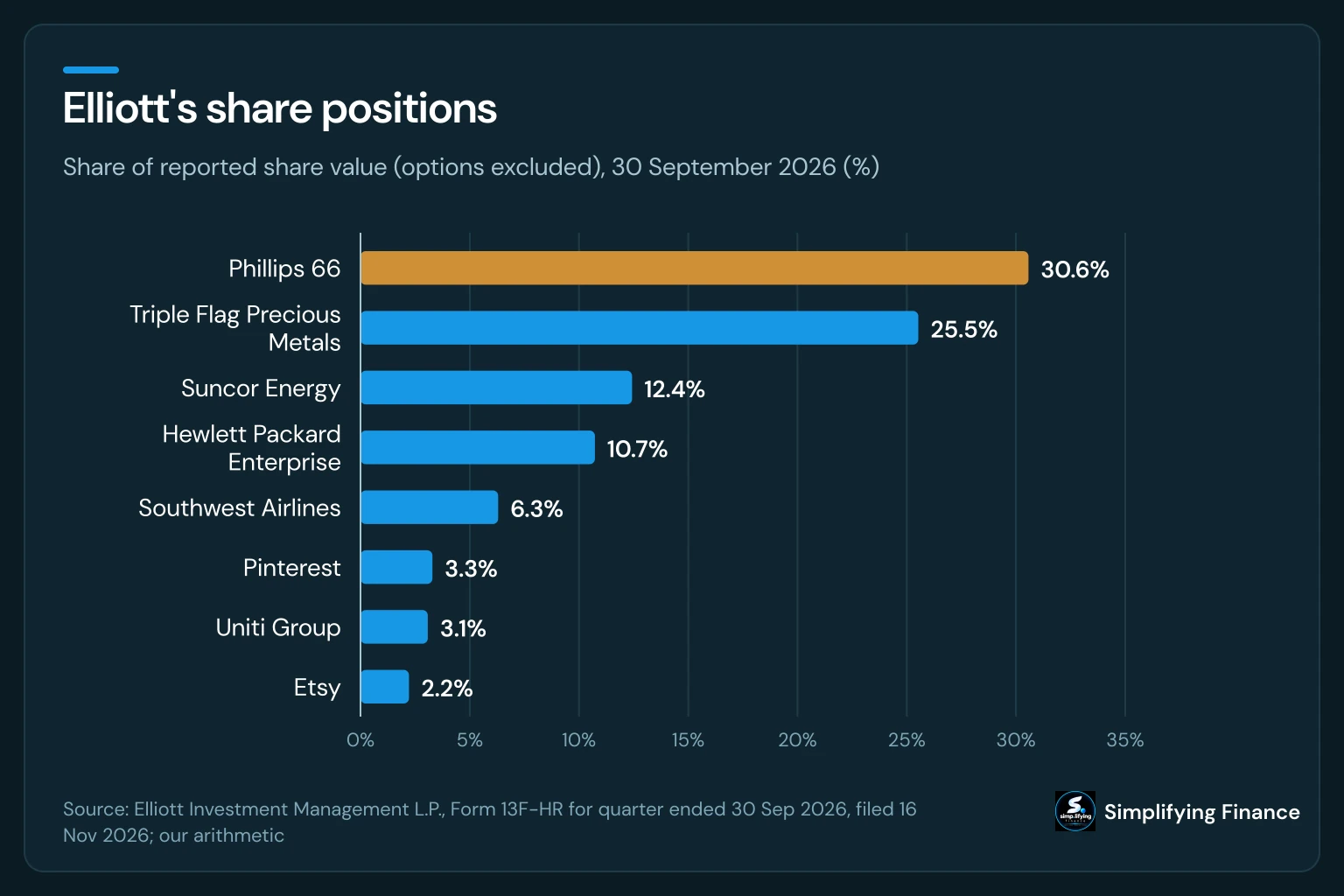
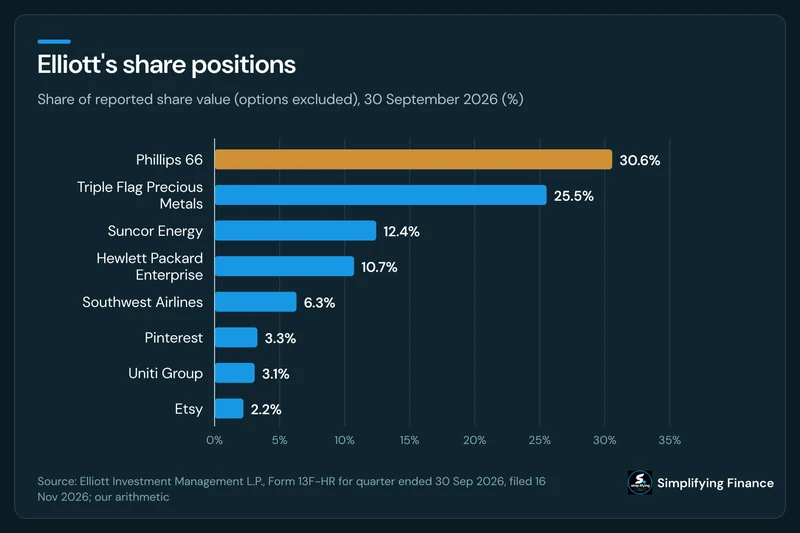
Among shares, Phillips 66 was by far the largest, at about US$4.9 billion or 31% of share value, followed by Triple Flag Precious Metals (26%), Suncor Energy (12%), Hewlett Packard Enterprise (11%) and Southwest Airlines (6%). The ten largest issuers made up about 97% of the share value.
Large index puts
The filing also lists large put options on broad funds: the Nasdaq-100 trust, Select Sector SPDR funds, iShares funds and VanEck and SPDR funds. Put options gain value when prices fall. Large index puts alongside a concentrated long book are consistent with protecting the portfolio against a broad market decline, though the 13F does not state their purpose, cost or terms.
What the 13F misses
Much of Elliott's activity, including distressed debt, credit, private investments and positions in non-US companies, does not appear on a 13F. Its activist campaigns in Europe and Asia, for example, would be invisible here unless the companies are also listed in the United States.
The lesson for individuals
Concentration works for an activist because it has the resources, access and influence to try to change how a company is run. Individual investors have none of those. A portfolio with half its value in two companies carries risks that a small investor cannot manage the way an activist can. The guide's page on famous concentration losses shows what can happen.
How activism works
An activist usually starts by building a stake large enough to be taken seriously, then presents its case to the company's board and management, often privately at first. If talks fail, it may publish letters or presentations, nominate directors or seek support from other shareholders at the annual meeting. Many campaigns end with a settlement, such as new directors or a strategic review.
For other shareholders, an activist's arrival can lead to changes that raise value, but it can also create uncertainty. Whether a campaign succeeds depends on the merits of the case and on other investors' votes.
Concentrated longs, broad protection
The structure visible in Elliott's 13F, a few large stakes plus big put positions on index funds, shows one way professionals combine concentration with risk control. The concentrated stakes carry the firm's specific views; the index puts may limit damage if the whole market falls. Individuals rarely use options this way, and doing so has costs, but the principle of thinking about what protects a portfolio in a crash applies to everyone.
For a household, the more practical forms of protection are holding high-quality bonds and cash, and keeping any single company to a modest share of the total.
Energy and materials focus
In September 2026, Elliott's largest share holdings were in energy (Phillips 66 and Suncor Energy) and precious-metal royalties (Triple Flag Precious Metals), alongside technology and consumer companies such as Hewlett Packard Enterprise, Pinterest and Etsy, and Southwest Airlines. Several of these have been the subject of public engagement by Elliott in recent years. The filing confirms the size of the positions on that date but does not describe any campaign.
Reading activist filings
Activists that cross ownership thresholds in a US company must also file other SEC disclosures, which can state their intentions more directly than a 13F. For anyone interested in a specific campaign, those filings and the company's own statements are more informative than the quarterly 13F list.
A note on this page
This page is educational only. Holdings come from the firm's SEC Form 13F-HR for the quarter ended 30 September 2026, as filed; values are as reported and percentages are our arithmetic on the filing. A 13F is a snapshot of certain long US-listed positions on one date. It does not show short positions, most non-US holdings, bonds, cash or private investments, and positions may have changed since. Nothing here is a recommendation to buy or sell any security.
Concentration with and without protection
Suppose a portfolio of US$100,000 has US$50,000 in two companies. If both fall 40%, the portfolio loses US$20,000 from those two alone, 20% of its value.
| Two holdings | US$50,000 (50%) |
| Both fall 40% | loss of US$20,000 |
| Effect on portfolio | -20% |
| Activist's tools | influence, hedges, resources |
An activist may hold protection, such as index puts, and can work to change the companies. An individual with the same concentration and no protection simply bears the loss. That difference is why concentration that makes sense for an activist rarely makes sense for a household.
Where people go wrong
- Copying an activist's concentration. Individuals lack the influence that justifies it.
- Ignoring the hedges. Large index puts change the risk picture.
- Assuming campaigns always succeed. Activist outcomes vary and take time.
- Missing non-US activity. Many campaigns involve companies not on a 13F.
- Ignoring the cost of protection. Options and other hedges cost money, even when unused.
Put it to work
- Check your concentration. Note the share of your portfolio in your two largest holdings.
- Set a cap. Decide a sensible maximum for any one company.
- Read about governance. Learn how shareholders influence companies through voting.
- Hold a buffer. Keep high-quality bonds or cash as a cushion against falls.
- Read on. Next: Pershing Square.
Elliott's 13F is the opposite of a quant fund's: a few large, concentrated positions where it often seeks change at the company, protected by sizeable put options on broad market funds.
Facts checked against the sources above on 27 November 2026. Figures are as of the dates stated and will change. Worked examples use round illustrative numbers to show the arithmetic, not forecasts. Educational content only, not personal investment advice.