The firm
Pershing Square Capital Management was founded by William A. (Bill) Ackman on 1 January 2004, according to the annual report of Pershing Square Holdings, its London-listed fund. It describes its approach as investing in high-quality, growing businesses and typically allocating the substantial majority of its portfolio to 8 to 12 core holdings, usually large, liquid North American companies. It is also known for activist campaigns.
See the numbers behind the chart
| Position | Share of reported value |
|---|---|
| Pershing Square Inc. | 33.5% |
| Uber | 7.6% |
| Amazon | 6.9% |
| Microsoft | 6.8% |
| Meta Platforms | 6.7% |
| Howard Hughes | 6.7% |
| Brookfield | 6.1% |
| Restaurant Brands Intl | 5.1% |
| Netflix | 3.5% |
| Mastercard | 3.4% |
What the 13F shows
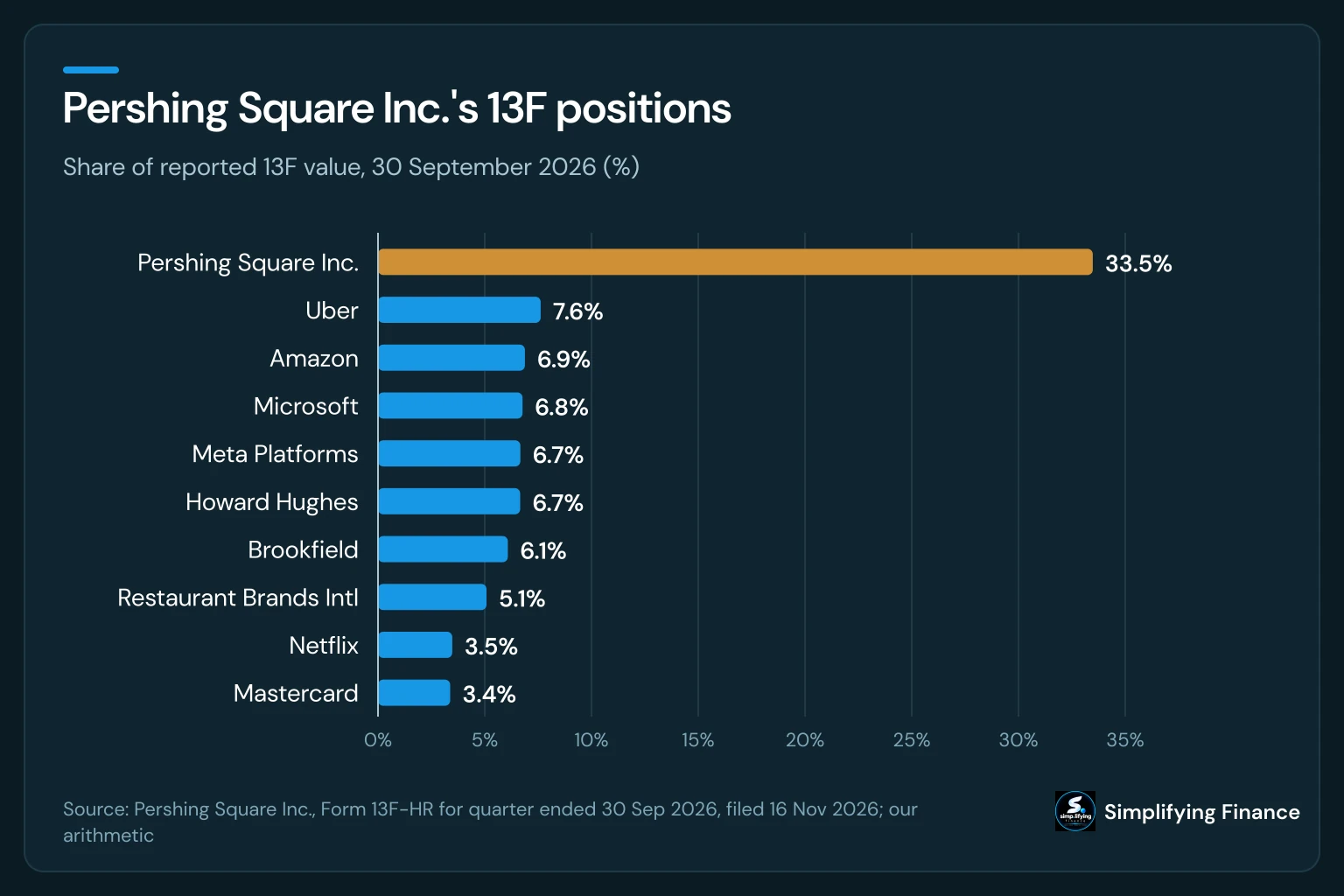
For the quarter ended 30 September 2026, the 13F was filed on 16 November 2026 by Pershing Square Inc., a different filer from the one used for earlier quarters (Pershing Square Capital Management, L.P., whose most recent 13F covered 31 March 2026). The new filing listed 17 rows covering 16 issuers, with a total reported value of about US$30.8 billion and no options.
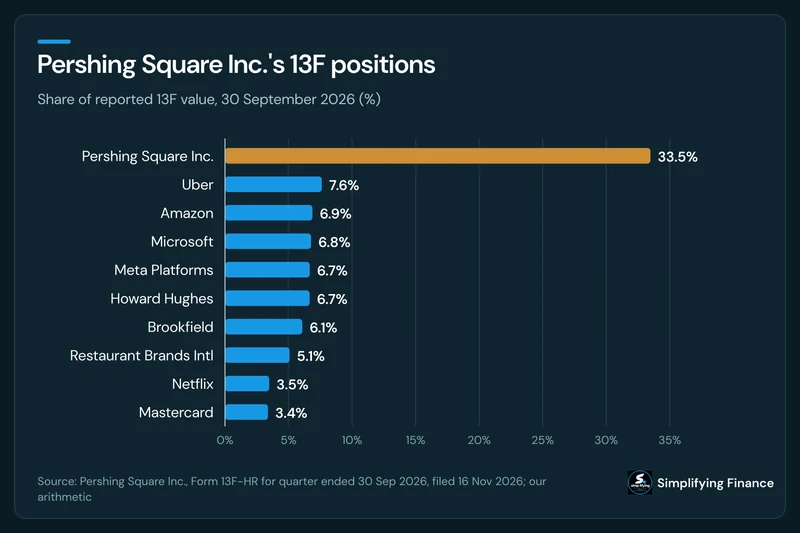
The largest row, about US$10.3 billion or 33.5% of the reported value, was shares listed under the issuer name Pershing Square Inc. The next largest were Uber (7.6%), Amazon (6.9%), Microsoft (6.8%), Meta Platforms (6.7%), Howard Hughes (6.7%) and Brookfield (6.1%). The ten largest issuers made up about 86% of the reported value.
Changes from earlier filings
Comparisons are complicated by the change of filer, but the March 2026 filing from Pershing Square Capital Management listed about US$13.7 billion across ten issuers, led by Brookfield, Amazon, Uber and Microsoft. The September filing included new positions, such as Netflix and Mastercard, alongside many of the same core companies. A 13F does not explain the reasons for changes.
What the 13F misses
Pershing Square has at times used derivatives such as interest-rate hedges and has held positions in companies listed outside the United States. Those would not appear on a 13F. The filing also gives no information about performance or fees.
The lesson for individuals
A concentrated portfolio of good businesses can do very well, and very badly. With a third of reported value in one position and the rest in a handful, results depend heavily on a few outcomes. For most individuals, owning great businesses is better done through a diversified fund, with any concentrated positions kept to a modest share.
Why so few holdings
A concentrated investor argues that its best ideas deserve large positions, and that holding many companies dilutes them. It also allows deep research and, where useful, engagement with company boards. The trade-off is volatility: the portfolio's results can differ sharply from the market for long periods, both above and below. Pershing Square Holdings' June 2026 report, for example, showed a negative return for the first half of 2026, illustrating that even well-known concentrated managers have difficult periods.
Listed funds and their discounts
Pershing Square Holdings, the firm's fund listed in London, is a closed-ended fund: investors buy and sell its shares on the stock exchange rather than with the fund. Such shares can trade at a discount or premium to the value of the fund's holdings. For investors, this adds another layer of price movement beyond the underlying portfolio, which is worth understanding before investing in any listed fund.
The guide's endowment and sovereign fund pages describe how long-term institutions think about such structures; the key questions are always cost, liquidity and diversification.
Reading the top position
The largest row in the September 2026 filing, about a third of the reported value, is listed under the issuer name Pershing Square Inc. The 13F itself records the issuer, class, value and number of shares but does not explain the position. Readers who want to understand it should consult Pershing Square's own published reports rather than relying on interpretations. This is a good general rule: when a 13F entry is unusual, go to the firm's or the issuer's own documents.
Comparing quarters carefully
Because the 13F filer changed during 2026, the jump in reported value from about US$13.7 billion in March to about US$30.8 billion in September should not be read as growth in a single portfolio. The two filings come from different entities and may cover different holdings and accounts. Comparing like with like is essential before drawing any conclusion.
A note on this page
This page is educational only. Holdings come from the firm's SEC Form 13F-HR for the quarter ended 30 September 2026, as filed; values are as reported and percentages are our arithmetic on the filing. A 13F is a snapshot of certain long US-listed positions on one date. It does not show short positions, most non-US holdings, bonds, cash or private investments, and positions may have changed since. Nothing here is a recommendation to buy or sell any security.
How concentration magnifies results
Suppose a portfolio holds ten companies equally, so each is 10%. If one doubles, the portfolio gains 10%. If one goes to zero, the portfolio loses 10%. In an index of 500 companies, the same events would move the portfolio by about 0.2%.
| Ten equal holdings | one doubling: +10% |
| Ten equal holdings | one failure: -10% |
| 500-company index | same events: about ±0.2% |
| Takeaway | concentration magnifies both |
Concentration can therefore produce results very different from the market, in either direction. Managers like Pershing Square accept that risk deliberately; an individual should choose it consciously, not by accident.
Where people go wrong
- Copying a concentrated manager. You take the concentration risk without the research team.
- Comparing filings without noting the filer. Pershing's 13F filer changed in 2026.
- Assuming quality means safety. Even great businesses can fall sharply.
- Ignoring position size. A single holding at a third of a portfolio dominates results.
- Ignoring discounts on listed funds. A closed-ended fund's share price can differ from its asset value.
Put it to work
- Size your conviction. Keep individual high-conviction shares to a limited share of your portfolio.
- Use a diversified core. Hold most long-term money in broad funds.
- Verify the filer. On EDGAR, check which entity filed each 13F you compare.
- Read the fund's own reports. Check its stated strategy, holdings and fees.
- Read on. Next: Man Group.
Pershing Square says it usually holds 8 to 12 core positions in large, high-quality businesses. Its 13F shows that concentration plainly, and it shows why such a portfolio can swing far more than an index.
Facts checked against the sources above on 27 November 2026. Figures are as of the dates stated and will change. Worked examples use round illustrative numbers to show the arithmetic, not forecasts. Educational content only, not personal investment advice.