A sovereign investor with two roles
Mubadala was established in 2002 and took its current form in 2017. It invests on behalf of its shareholder, the Government of Abu Dhabi. Its stated mandate is to deliver sustainable, risk-adjusted returns for its shareholder.
Alongside its global investing, Mubadala has a UAE investments platform that supports the country's economic diversification, investing in sectors such as life sciences, renewable energy, real estate, digital health and technology.
Its headquarters are in Abu Dhabi.
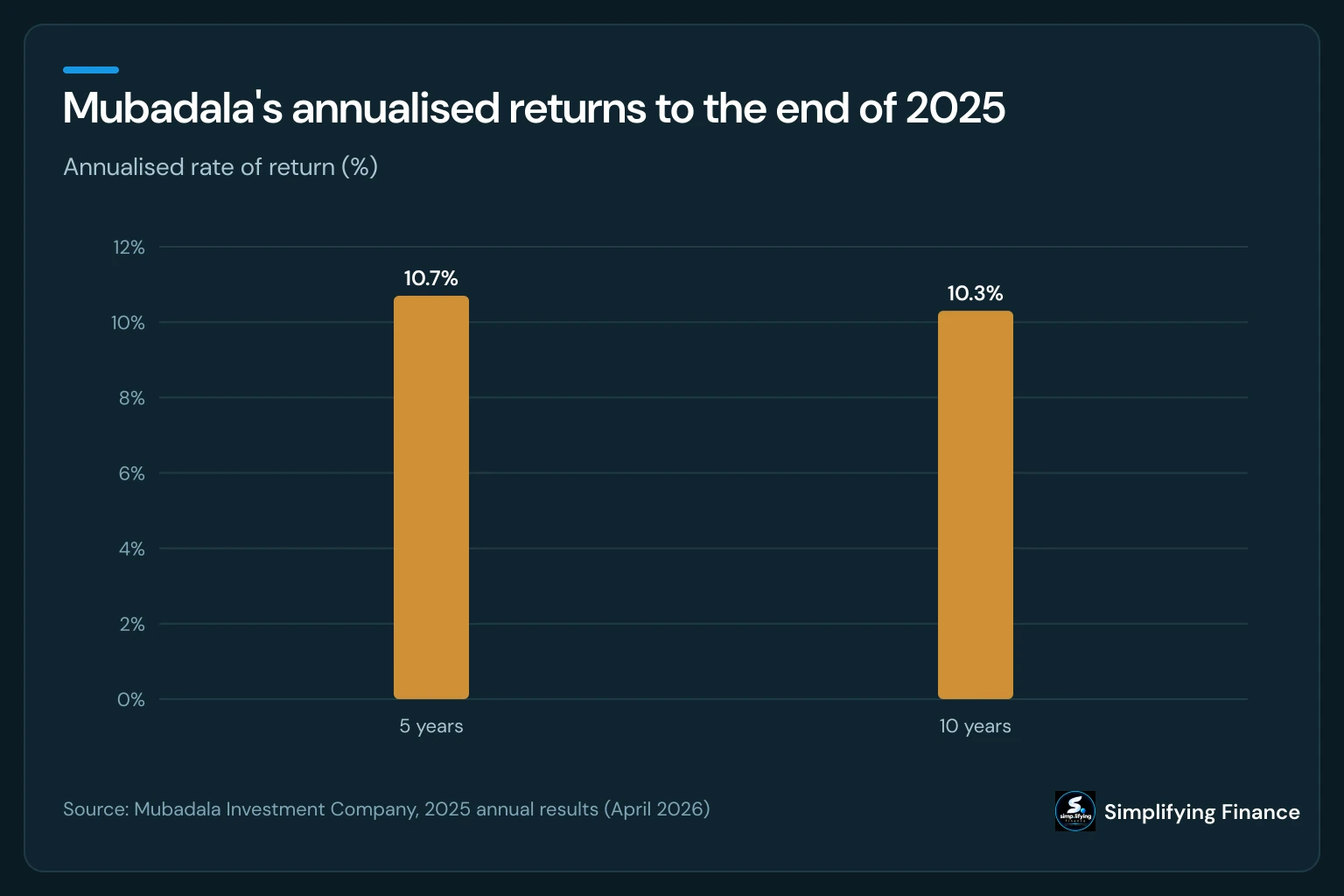
See the numbers behind the chart
| Period | Annualised return |
|---|---|
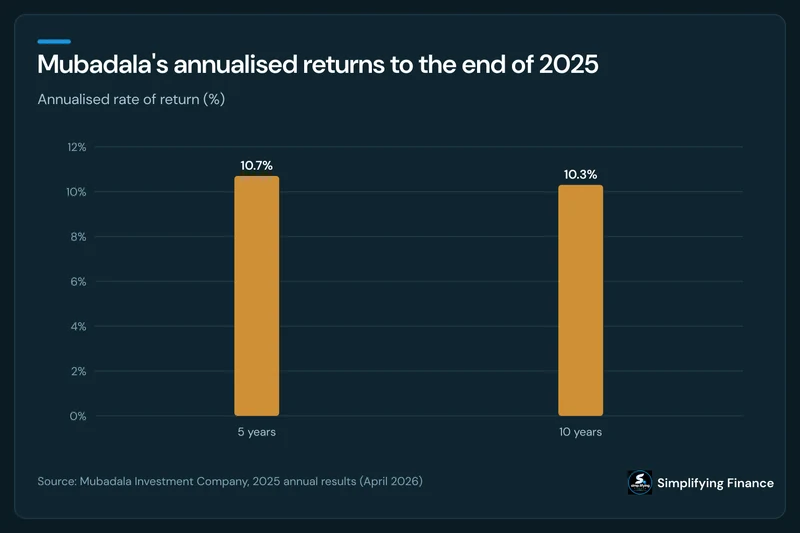
| 5 years | 10.7% |
| 10 years | 10.3% |
The size of it
In its 2025 annual results, published in April 2026, Mubadala reported assets under management of AED 1.4 trillion (US$385 billion), up 17% from a year earlier. Capital deployed during the year grew 20% to AED 143 billion (US$39 billion), while proceeds grew 27% to AED 138 billion (US$38 billion).
Deploying new capital while also realising proceeds from earlier investments is part of how a large investor keeps its portfolio balanced: money is recycled from mature holdings into new opportunities.
Proceeds of AED 138 billion against deployment of AED 143 billion meant that most of the year's new investment was matched by money returned from earlier investments, a sign of an active portfolio that is continually renewing itself over time.
How Mubadala reports
Since 2021, Mubadala has reported rolling multi-year returns rather than annual profit figures, and in 2024 it began publishing ten-year returns alongside five-year returns. Its Annual Review sets out assets under management, capital deployed and proceeds, together with highlights from across its platforms.
Its returns are expressed as an internal rate of return, a measure that takes account of the timing of money going into and coming out of investments. That suits an investor that is constantly deploying new capital and receiving proceeds, because a simple year-end comparison of values would not capture the effect of those flows.
Measured over five and ten years
Mubadala reported five- and ten-year annualised rates of return of 10.7% and 10.3% respectively. The company explains that, in line with its sovereign investment mandate, it focuses on long-term value creation and reports multi-year performance metrics rather than single-year figures.
For an investor with a long horizon, this is the right lens. A single year's result says more about markets in that year than about the quality of a long-term strategy, as the library lesson on investment horizon explains.
Global and local together
Mubadala invests across many asset classes, including private equity, private credit, real estate, infrastructure and listed markets, and across many countries. Reporting on its 2025 results noted that the United States was its largest market, at about 44% of the portfolio, while almost a quarter was invested in the UAE.
Its UAE platform contributed AED 45 billion in GDP impact, equivalent to 5.7% of Abu Dhabi's non-oil GDP, and supported around 98,000 jobs in Abu Dhabi directly and indirectly, a 51% increase since 2021, according to the company.
Partnerships as a way to diversify
Much of Mubadala's activity involves partnerships: co-investing alongside global asset managers, building platforms with partners and taking minority stakes next to other institutions. In 2025, for example, it invested US$600 million in a minority stake in an international schools operator alongside other global investors.
Partnering spreads risk across many deals and draws on specialist expertise. For individual investors, the closest equivalent is using diversified funds run by specialists rather than concentrating savings in a handful of single positions.
A purpose alongside returns
Mubadala's approach shows that a portfolio can serve more than one goal: earning long-term returns while also supporting a country's economic development. Households have multiple goals too, such as a home, education and retirement. Giving each goal its own pot and time horizon, as the library lesson on financial goals suggests, can make a plan clearer.
Lessons for ordinary investors
Three ideas from Mubadala translate well to household finance. First, judge a strategy over many years. Second, keep money working by moving gains from holdings that have grown large into areas that are underweight. Third, be clear about purpose: a pot with a defined job is easier to manage than a general pile of savings.
None of this requires private deals or large sums. A small set of diversified funds, a written goal for each pot and an annual review can apply the same discipline at any scale.
What returns above 10% compound to
Take AED 100,000. At Mubadala's reported ten-year annualised return of 10.3%, it would grow to about AED 266,500 over ten years, more than two and a half times the starting amount.
| Starting amount | AED 100,000 |
| 10 years at 10.3% a year | about AED 266,500 |
| 5 years at 10.7% a year | about AED 166,200 |
| US dollar equivalent of AED 100,000 | about US$27,200 |
At the five-year rate of 10.7%, AED 100,000 would grow to about AED 166,200 over five years. These figures illustrate compounding at the reported rates; they are not forecasts of future returns.
Where people go wrong
- Comparing a single year with multi-year returns. Mubadala reports five- and ten-year figures to reflect its long horizon.
- Ignoring how capital is recycled. Proceeds from mature investments fund new ones and keep the portfolio balanced.
- Copying institutional private deals. Large partnerships and private stakes are not available or suitable for most households.
- Mixing goals in one pot. Separate pots for separate goals make each one easier to plan.
- Measuring return without timing. When you add and withdraw money, a simple before-and-after comparison can mislead.
Put it to work
- Name your goals. List what your savings are for and give each a time horizon.
- Judge results over years. Look at five- and ten-year results, not just the latest year.
- Recycle gains deliberately. When a holding grows large, consider moving some gains into areas you hold less of.
- Track money in and out. Record contributions and withdrawals so you can measure your real return.
- Read on. Next: ADQ.
Mubadala combines global investing with a role in developing the UAE economy, and it reports multi-year returns rather than single-year results. Both reflect a long-term, purpose-driven mandate.
Facts checked against the sources above on 27 November 2026. Figures are as of the dates stated and will change. Worked examples use round illustrative numbers to show the arithmetic, not forecasts. Educational content only, not personal investment advice.