An active investor and holding company
ADQ was established in 2018 as an Abu Dhabi-based investment and holding company with a broad portfolio of major enterprises. It describes its mandate as building economic clusters aligned with strategic government priorities, supporting the continued diversification of Abu Dhabi's economy.
Unlike a fund that mainly buys listed shares and bonds around the world, ADQ owns and develops operating companies. Many of them provide essential services, such as power, water, transport, food and healthcare.
See the numbers behind the chart
| Year end | AED billion |
|---|---|
| End 2024 | 921.7 |
| End 2025 | 996.8 |
The size of it
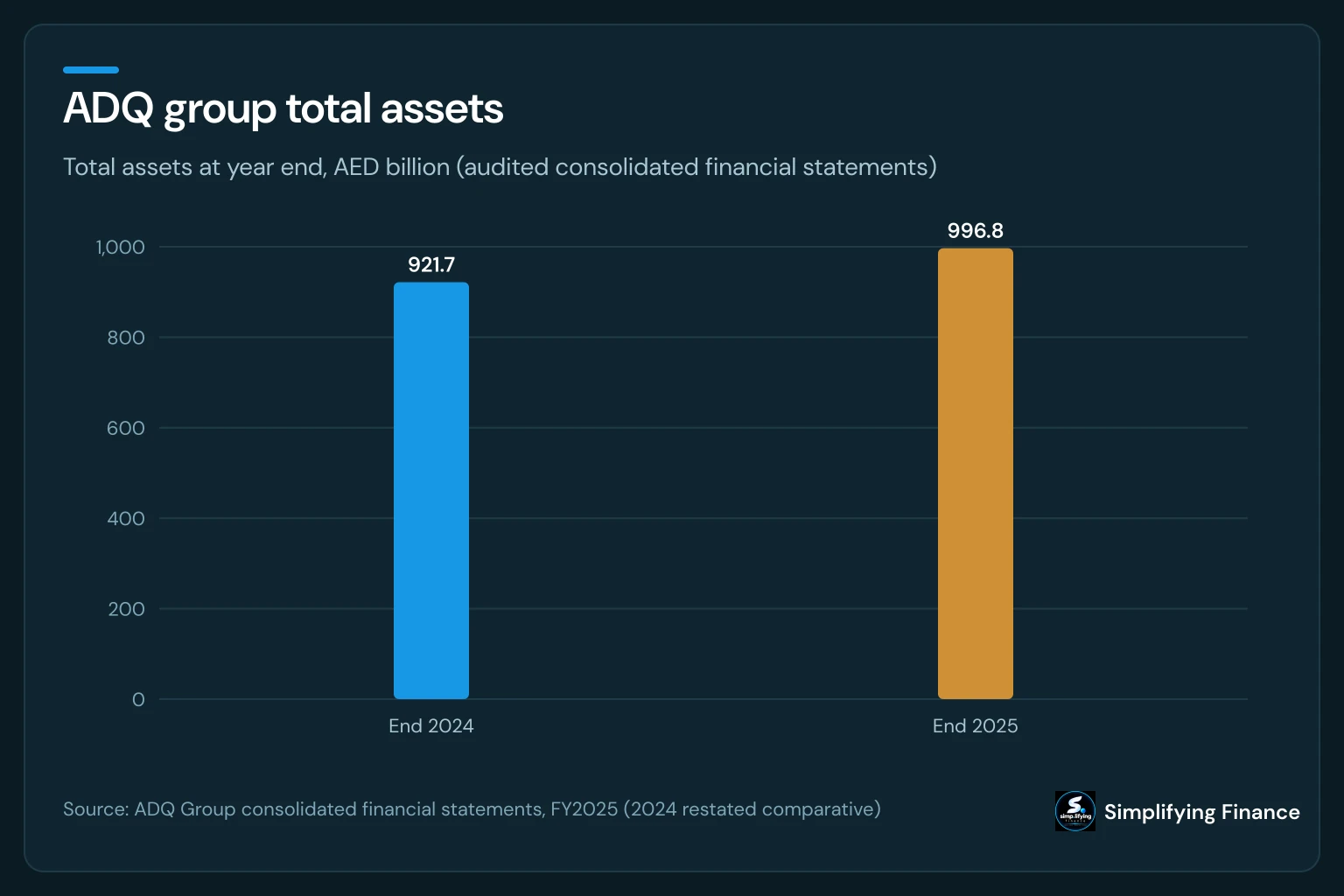
According to ADQ's audited consolidated financial statements, group total assets were about AED 996.8 billion at 31 December 2025, up from about AED 921.7 billion a year earlier. ADQ's own communications put its total assets at US$251 billion at the end of 2024.
Because ADQ is a holding company that consolidates the businesses it controls, its size is reported as total assets in its financial statements rather than as assets under management.
ADQ's 2025 accounts, as summarised by the rating agency Fitch, show total equity of about AED 521.4 billion at the end of 2025, compared with about AED 482.6 billion a year earlier, so the growth in assets was accompanied by growth in equity.
Clusters, not just holdings
ADQ organises its portfolio into economic clusters. These include energy and utilities, transport and logistics, food and agriculture, healthcare and life sciences, financial services, real estate, sustainable manufacturing and, since January 2025, infrastructure and critical minerals.
The idea is that companies within a cluster can work together, sharing supply chains, customers and know-how, so that the whole is stronger than the parts. ADQ reports that it has more than 25 portfolio companies employing more than 86,000 people, with operations spanning more than 130 markets.
What the clusters do
Each cluster focuses on a part of the economy that matters for daily life and long-term resilience. ADQ describes its food and agriculture cluster as building national champions and investing in regional and international businesses that together establish a foundation for food security in the UAE and the wider region. Through its transport and logistics investments, in assets from ports to airlines, ADQ says it is deepening Abu Dhabi's connectivity with the rest of the world.
ADQ also highlights operating results from its portfolio companies in its board updates. For example, it reported that Abu Dhabi Airports welcomed more than 15.8 million passengers in the first half of 2025, 13.1% more than in the same period of 2024.
Contribution to the economy
ADQ reports that its portfolio contributed 22% of Abu Dhabi's non-hydrocarbon GDP in 2024. It also reports that, since 2019, its portfolio has grown EBITDA, a measure of operating earnings, by 2.3 times, while maintaining a strong Abu Dhabi focus and widening its global footprint.
Now consolidated under L'IMAD
On 30 January 2026, the Supreme Council for Financial and Economic Affairs (SCFEA) issued a resolution to consolidate the assets and investments of L'IMAD Holding Company and the Abu Dhabi Developmental Holding Group (ADQ) under the umbrella of L'IMAD, as announced by the Abu Dhabi Media Office and the Emirates News Agency (WAM) and reported by Khaleej Times. The resolution aims to create a sovereign investment powerhouse with a diversified asset base, supporting the Government of Abu Dhabi's policy on sustainable investment and contributing to economic development for Abu Dhabi and the UAE.
L'IMAD is chaired by His Highness Sheikh Khaled bin Mohamed bin Zayed Al Nahyan, Crown Prince of Abu Dhabi and Chairman of the Abu Dhabi Executive Council. Following the consolidation, ADQ's portfolio companies form part of L'IMAD's wider portfolio of about 25 investment companies and platforms and more than 250 group subsidiaries. The figures on this page describe ADQ as reported in its own 2025 financial statements and publications; the next page looks at L'IMAD itself.
A different kind of diversification
Most of this section has looked at funds that diversify by spreading money across many countries and markets. ADQ shows another dimension: diversifying an economy across many essential sectors, so that growth does not depend on a single industry.
The same thinking can help households. A family whose income depends on one sector can strengthen its position by building skills, savings and investments that do not all depend on that sector, a point the library lesson on diversification covers.
Building value, not just holding it
ADQ describes an active approach to ownership. Its value creation framework combines organic and inorganic growth, operational excellence, digital transformation, innovation and disciplined governance. It runs programmes to develop leaders across its portfolio companies and has been building a common data platform and AI capabilities for the portfolio.
This hands-on ownership is very different from buying an index fund, but it rests on a familiar principle: returns come from the earnings of real businesses. Whether you own a whole company or a tiny slice of thousands through a fund, the long-term value of your investments depends on how well those businesses are run.
ADQ's Sustainable Investing Report also sets out its approach to environmental, social and governance factors across the portfolio, including year-on-year improvement in its own ESG maturity score.
Reading growth in total assets
ADQ's total assets rose from about AED 921.7 billion to about AED 996.8 billion during 2025, an increase of about AED 75.1 billion, or about 8.1%.
| Total assets, end 2024 | about AED 921.7 billion |
| Total assets, end 2025 | about AED 996.8 billion |
| Increase | about AED 75.1 billion |
| Percentage change | about 8.1% |
For a household, the equivalent check is simple: compare your total assets this year with last year and ask what drove the change, whether new savings, investment growth or a change in the value of a home or business. Knowing the source of growth tells you more than the headline number.
Where people go wrong
- Comparing total assets with assets under management. Holding companies report consolidated total assets; funds often report assets under management.
- Assuming all sovereign investors buy the same things. ADQ owns operating companies; other funds mainly hold global securities.
- Looking only at the headline. Ask what drove the change: new money, earnings or valuations.
- Relying on one sector. Income and savings that all depend on one industry carry concentrated risk.
- Forgetting what drives value. Over time, investment returns follow the earnings of the underlying businesses.
Put it to work
- Map your sectors. List the industries your job, business and investments depend on.
- Check your yearly change. Compare your total assets with last year and identify the drivers.
- Add what is missing. Consider broad funds that cover sectors you have little exposure to.
- Look through to the businesses. Check what the companies in your funds actually do and how they earn money.
- Read on. Next: L'IMAD, which now holds ADQ's assets and investments.
ADQ builds connected groups of businesses, or clusters, that support each other and the wider economy. It shows a different way to think about diversification: across sectors that together strengthen a whole system.
Facts checked against the sources above on 27 November 2026. Figures are as of the dates stated and will change. Worked examples use round illustrative numbers to show the arithmetic, not forecasts. Educational content only, not personal investment advice.