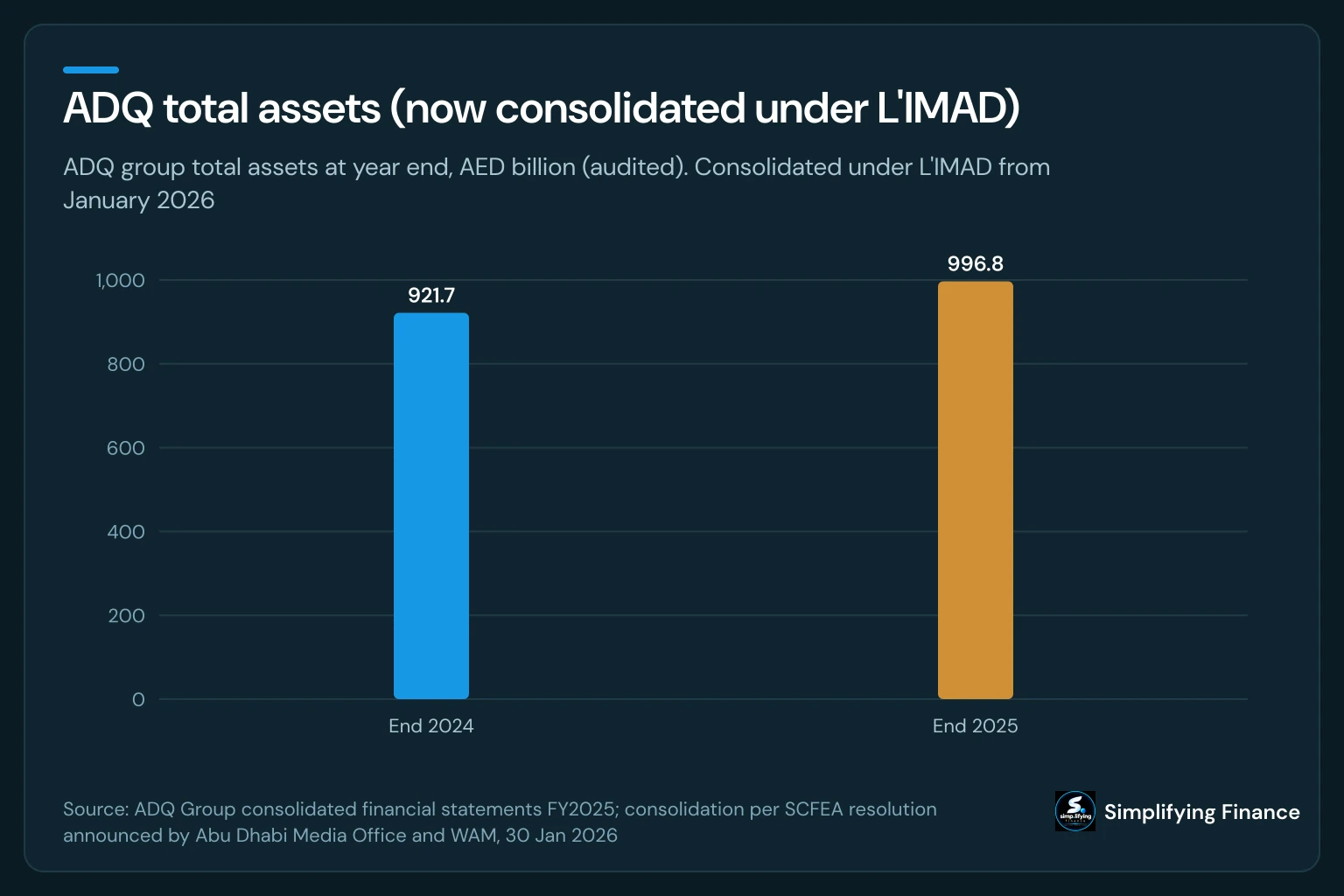
A sovereign investment platform
L'IMAD Holding Company was established as a sovereign investment platform of the Government of Abu Dhabi, mandated to support sustainable economic growth, diversify revenue sources and achieve optimal investment returns for the emirate, according to the announcement of its board published by WAM in January 2026.
On 12 January 2026, the Supreme Council for Financial and Economic Affairs (SCFEA) issued a resolution forming L'IMAD's Board of Directors, chaired by His Highness Sheikh Khaled bin Mohamed bin Zayed Al Nahyan, Crown Prince of Abu Dhabi and Chairman of the Abu Dhabi Executive Council. L'IMAD is led by Jassem Mohamed Bu Ataba Al Zaabi, its Managing Director and Chief Executive Officer.
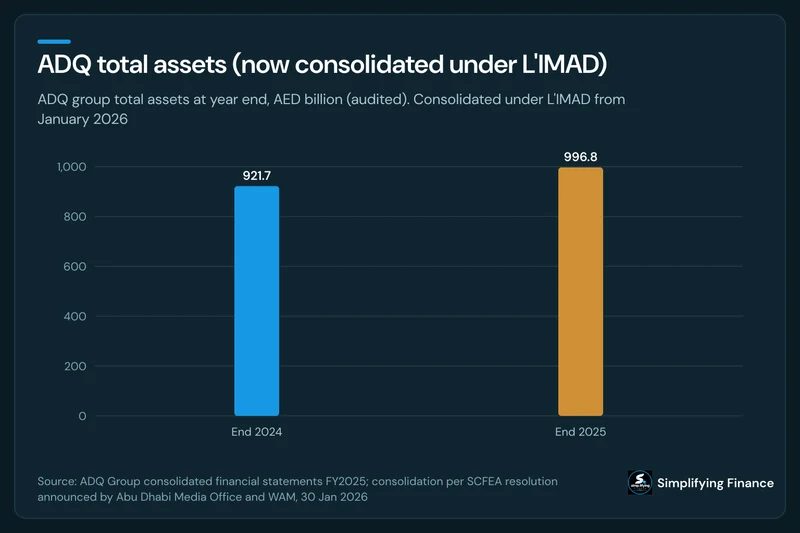
See the numbers behind the chart
| Year end | AED billion |
|---|---|
| End 2024 | 921.7 |
| End 2025 | 996.8 |
The January 2026 consolidation
On 30 January 2026, the SCFEA issued a resolution to consolidate the assets and investments of L'IMAD and the Abu Dhabi Developmental Holding Group (ADQ) under the umbrella of L'IMAD, as announced by the Abu Dhabi Media Office and WAM and reported by Khaleej Times.
The resolution aims to create a sovereign investment powerhouse with a diversified asset base, supporting the Government of Abu Dhabi's policy on sustainable investment and contributing to economic development for Abu Dhabi and the UAE. The announcement describes it as growing sovereign investment locally and globally while preserving an investment policy built over more than fifty years.
What the group holds
According to the announcement, L'IMAD's diversified portfolio includes about 25 investment companies and platforms and more than 250 group subsidiaries. Companies named in the announcement include TAQA, Modon Properties, Etihad Airways, PureHealth, Etihad Rail, Wio Bank, Abu Dhabi Ports, McLaren and Louis Dreyfus.
Its target sectors span energy, real estate and infrastructure, healthcare including pharmaceuticals, food, aviation, ports, financial services and banking, and a range of industrial and technology sectors. Many of these businesses previously formed ADQ's economic clusters, described on the previous page.
ADQ within L'IMAD
Since the consolidation, ADQ's assets and investments are consolidated under L'IMAD, in the words of the official announcement. In August 2026, L'IMAD announced a voluntary conditional cash offer, made through ADQ, to acquire the shares of AD Ports Group that ADQ did not already own, at AED 6.25 per share; ADQ held 75.42% of AD Ports Group at the time, as reported by Khaleej Times and Gulf News. Bringing a listed company fully into the group is one way a holding company can simplify ownership of a core strategic asset.
How it invests
L'IMAD aims to build globally competitive investment platforms and national champions in sectors of strategic importance. It combines operational, developmental, industrial and financial capabilities, and plans to invest both directly and indirectly, through funds, in public and private markets. It also aims to expand its global footprint through private investment funds, on its own or with strategic partners.
This combination is a form of diversification in itself: owning and running operating companies across many sectors, while also investing through funds and markets at home and abroad.
Abu Dhabi's sovereign investment structure
The announcement sets out that the SCFEA oversees Abu Dhabi's principal sovereign investment institutions: the Abu Dhabi Investment Authority (ADIA), Mubadala Investment Company and L'IMAD Holding Company, as well as the Abu Dhabi National Oil Company (ADNOC).
Each has a distinct role. As the earlier pages describe, ADIA invests a highly diversified portfolio globally and, as a matter of practice, does not invest in the UAE. Mubadala invests worldwide and through a UAE investments platform. L'IMAD focuses on building national champions and investment platforms, with a growing international footprint. Taken together, the structure spreads the emirate's wealth across global markets, strategic sectors and operating businesses.
Why structure matters for diversification
Giving each institution a clear role reduces overlap and makes it easier to see how the whole is diversified. A global savings portfolio, a strategic investor and a group of operating companies each respond differently to economic conditions, so together they spread risk across different drivers of value.
The same principle helps households. Savings scattered across many accounts and products are hard to oversee: it is easy to hold the same investments twice or to lose track of costs. Bringing them into a small number of pots, each with a clear job, makes it far easier to see whether the overall mix is genuinely diversified. The library lesson on fund overlap explains how duplicated holdings creep in.
Following an evolving structure
Sovereign investment structures change over time as governments refine roles and bring related assets together. For readers, the reliable approach is to follow official announcements, such as SCFEA resolutions published by the Abu Dhabi Media Office and WAM, and each institution's own reports. Figures published before a consolidation, such as ADQ's 2025 financial statements, remain an accurate record of that entity at that date, while later reports will reflect the combined group.
This page will be updated as L'IMAD publishes its own reports on the consolidated portfolio.
Consolidating scattered savings into clear pots
Suppose a family in Abu Dhabi has AED 240,000 spread across six accounts and funds opened over the years, each with its own fees and paperwork. They decide to consolidate into three pots with distinct roles: AED 40,000 as an emergency fund, AED 80,000 for a home deposit in three years and AED 120,000 as a long-term, globally diversified portfolio.
| Total savings | AED 240,000 |
| Emergency fund | AED 40,000 |
| Home deposit (3 years) | AED 80,000 |
| Long-term global portfolio | AED 120,000 |
If each account charged an administration fee of AED 150 a year, going from six accounts to three saves about AED 450 a year, before any savings from removing overlapping funds. More importantly, the family can now see at a glance what each pot is for and how it is invested.
Where people go wrong
- Confusing consolidation with concentration. Bringing holdings under one structure can still leave the portfolio spread across many sectors.
- Keeping overlapping accounts. Several funds holding the same shares add cost without adding diversification.
- Giving every pot the same job. Each pot works best with one clear purpose and time horizon.
- Losing track of costs. Many small fees across many accounts add up over time.
Put it to work
- List every account. Write down each savings account, fund and policy you hold, with its fees.
- Assign a role to each. Decide which pot each one belongs to, or whether it should be closed.
- Check for overlap. Compare the top holdings of your funds before consolidating.
- Read on. Next: the Public Investment Fund of Saudi Arabia.
L'IMAD brings many of Abu Dhabi's major operating companies under one roof, with a mandate to build national champions and invest locally and globally. It shows how a clear structure, with distinct roles for each institution, supports long-term diversification.
Facts checked against the sources above on 27 November 2026. Figures are as of the dates stated and will change. Worked examples use round illustrative numbers to show the arithmetic, not forecasts. Educational content only, not personal investment advice.