Established to diversify
QIA was established by Amiri Decision No. 22 of 2005, which set out its objectives and governance framework, and began investment operations in 2006. The International Forum of Sovereign Wealth Funds describes it as the sovereign wealth fund of the State of Qatar, established to protect and grow Qatar's financial assets and to diversify the economy.
In 2023, Amiri Decision No. 34 updated QIA's founding framework and reiterated its mandate and its primary roles and responsibilities as the sovereign wealth fund for Qatar's future generations.
See the numbers behind the chart
| Fund | US$ billion |
|---|---|
| Mubadala | US$12.9bn |
| Kuwait Investment Authority | US$6.0bn |
| Qatar Investment Authority | US$4.0bn |
A three-fold mandate
QIA describes a three-fold mandate that guides its strategy: to create long-term value for the State and future generations, to support the development of a competitive Qatari economy, and to stabilise the local economy as necessary.
The third element is worth noticing. Many sovereign funds act partly as a national safety net, able to support the economy in difficult times. That role requires some assets that can be turned into cash without heavy losses, which shapes how much of a fund can sit in long-term, hard-to-sell investments.
What QIA invests in
According to QIA and the IFSWF, its portfolio spans technology, media and telecommunications, healthcare, retail and consumer, real estate, infrastructure, financial institutions, industrials and materials, liquid securities and funds. By asset class it invests in credit and fixed income, real estate, infrastructure, private equity, public equity and alternative investments.
QIA says that diversification is key to its approach, with investments spanning many markets, asset classes, sectors and geographies. Over the years it has built internal investment teams and co-invested with partners around the world.
From expansion to direct investing
QIA's history describes a period of expansion from 2009 to 2015, when it grew its internal investment teams and continued to diversify, collaborating and co-investing with partners worldwide. Its timeline also notes a shift in focus towards direct investments, and the introduction of a new asset allocation approach and long-term investment plan to guide how the portfolio evolves.
QIA took part in drafting the Santiago Principles in 2008, the voluntary standards for sovereign wealth funds described on this section's first page. It has also set up a graduate training scheme for Qatari nationals, building investment skills at home.
Moving from external managers towards in-house teams and direct deals is a common path for large funds. It can lower costs and give more control, but it also requires deep expertise. For individuals, the low-cost equivalent is not picking single companies but choosing broad, inexpensive funds.
Active in technology
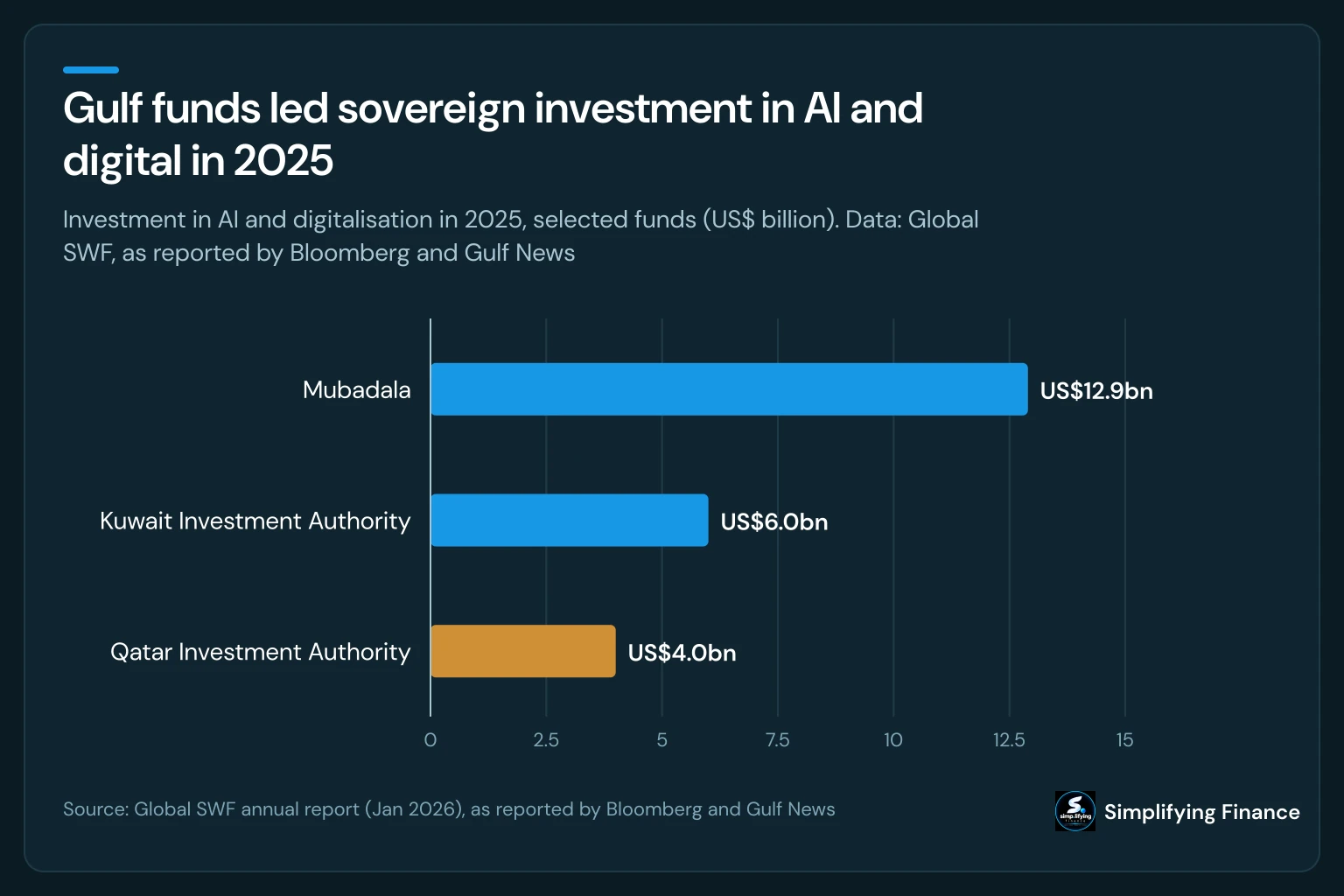
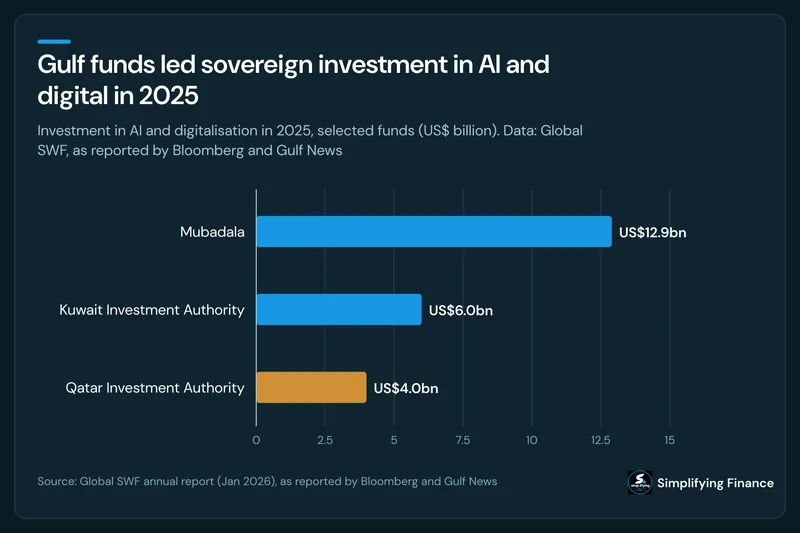
In 2025, sovereign investors put about US$66 billion into artificial intelligence and digitalisation, according to the data firm Global SWF, as reported by Bloomberg and by Gulf News in the UAE. Gulf funds led this activity: according to Global SWF's figures, Mubadala invested the most, about US$12.9 billion, the Kuwait Investment Authority about US$6 billion and QIA about US$4 billion.
Technology investment of this kind adds a growth-oriented slice to a portfolio that also holds real estate, infrastructure and financial assets. Balancing growth themes with steadier, income-producing assets is a form of diversification across economic drivers.
Disclosure
QIA does not publish the total value of its portfolio. In its Santiago Principles self-assessment, it explains that its Board submits reports to Qatar's Supreme Council for Economic Affairs and Investment, including full disclosure of total assets and aggregated information by asset class. This page therefore uses only figures that are publicly reported.
Sustainability in the portfolio
QIA states that it aims to embed sustainability principles across its portfolio rather than treat them as a standalone part of it, and that it believes investing sustainably enhances the performance and resilience of the portfolio. It links this to its mandate to create value for future generations and to the goals of the Qatar National Vision 2030.
One mandate, many tools
Taken together, QIA's mandate, its spread of asset classes and its stabilisation role show how a single institution can serve several goals. Long-term growth comes from equities, private equity and technology; steadier returns come from real estate, infrastructure and credit; and flexibility comes from liquid securities. A household plan can follow the same pattern on a far smaller scale: growth assets for the long term, steadier assets for the medium term and cash for the unexpected.
Keeping a stabilisation slice
A household can copy the idea of a mandate with a stabilisation role. Suppose a family in Qatar has QAR 500,000 in savings. They might keep QAR 75,000 (15%) in cash and short-term deposits as a stabilisation pot, and invest QAR 425,000 for the long term.
| Total savings | QAR 500,000 |
| Stabilisation pot (15%) | QAR 75,000 |
| Long-term investments (85%) | QAR 425,000 |
| Purpose of the cash pot | Cover expenses without forced selling |
If income falls for a while, the stabilisation pot covers expenses, so the long-term investments do not have to be sold during a market fall. The exact split depends on the family's income security and needs.
Where people go wrong
- Assuming undisclosed means unknown to everyone. QIA reports its total assets to its oversight body even though it does not publish them.
- Forgetting the stabilisation role. Funds that may need to support the economy keep some assets easy to sell.
- Chasing one theme. Technology is one part of a diversified portfolio, not all of it.
- Investing without a mandate. Write down what your money is for before choosing what to buy.
- Copying direct investing. Large funds build expert teams first; individuals usually do better with broad funds.
Put it to work
- Write a three-part mandate. Growth, support for your goals and a safety buffer: give each a share.
- Size your buffer. Decide how many months of expenses you want in cash.
- Balance themes. Pair growth themes with steadier holdings.
- Know what you own. Read the factsheet of each fund you hold so you understand its sectors and regions.
- Read on. Next: the Kuwait Investment Authority.
QIA has a three-part mandate: build long-term value, support a competitive Qatari economy and help stabilise it when needed. Like many funds, it pairs a long-term savings role with flexibility.
Facts checked against the sources above on 27 November 2026. Figures are as of the dates stated and will change. Worked examples use round illustrative numbers to show the arithmetic, not forecasts. Educational content only, not personal investment advice.