A fund with a transformation mandate
The Public Investment Fund was set up in 1971 and today describes itself as a long-term investor with a unique mandate to drive the economic transformation of Saudi Arabia and deliver sustainable financial returns. It sits at the centre of the country's Vision 2030 programme to reduce reliance on hydrocarbon revenues.
That mandate makes PIF different from savings funds such as Norway's, which invest only abroad. PIF builds and owns companies at home, in sectors such as tourism, logistics, advanced manufacturing, energy transition and sports and entertainment, while also investing internationally.
See the numbers behind the chart
| Year | US$ billion |
|---|---|
| 2015 | 150 |
| 2021 | 530 |
| 2025 | 900 |
The size of it
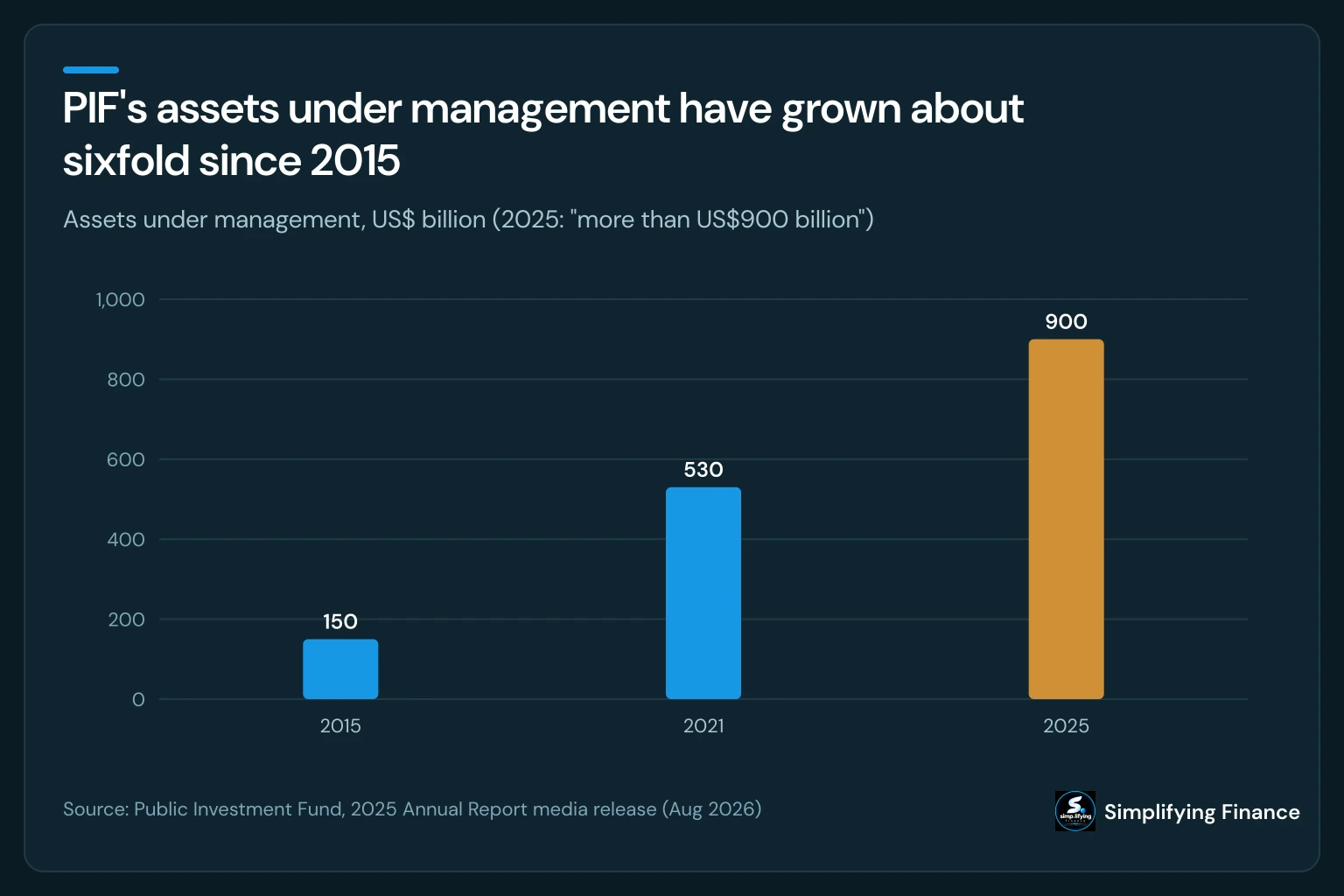
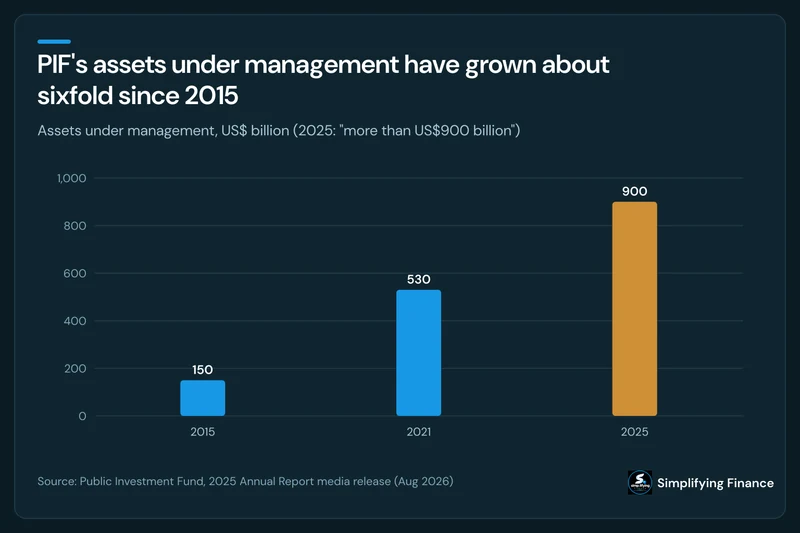
In its 2025 Annual Report, published in August 2026, PIF reported assets under management of more than US$900 billion, about SAR 3.4 trillion, up from around US$530 billion in 2021 and US$150 billion in 2015. Revenue rose 9% to US$120 billion, and net profit more than doubled to US$17 billion.
Growth on this scale has come from a mix of investment returns, new capital and transfers of state assets into the fund.
Mostly invested at home
According to PIF's statement on its 2025 results, local investments made up 76% of assets under management, international investments 20% and treasury 4%. PIF reports that it has invested US$199 billion in domestic priorities since 2021 and that it contributed 11% of Saudi Arabia's total non-oil GDP in 2025.
A large home allocation is a deliberate choice for a development fund. Its purpose is not only to earn returns but to help build new industries in its own economy.
How PIF measures returns
PIF reports a total shareholder return. Its annualised total shareholder return since the start of the Vision Realization Program in September 2017 was 5.8% at the end of 2025, compared with 7.2% reported a year earlier. For 2025 alone, the total shareholder return was negative, at about -4.2%.
PIF said the 2025 result was supported by higher dividends from portfolio companies and returns from financial investments, and was affected by lower valuations of some assets amid wider market conditions, as it continued to make long-term local investments. This is a useful reminder that even a very large fund has down years, and that a long-term number moves when a weaker year is added.
A new strategy period
2025 was the final year of PIF's 2021-2025 strategy. Its 2026-2030 strategy focuses on developing competitive domestic economic ecosystems that connect sectors, unlocking the full potential of strategic assets and maximising long-term returns. Strategy periods of several years give a fund a clear framework and a fixed point at which to review results.
Development funds and diversification
This section has shown savings funds that diversify away from their home economy, such as Norway's and ADIA. PIF shows the other model: a fund whose job is to change the home economy itself. The two models carry different risks. A development fund's results are tied closely to how its home economy and its own projects perform, while a global savings fund's results follow world markets.
For a household, the lesson is to match the mix to the purpose. Money meant to build something specific, such as a business, is concentrated by design. Money meant to secure the future, such as retirement savings, benefits from broad diversification, as the library lesson on portfolio concentration explains.
Reading a fund that is also a builder
Because PIF creates and grows companies, many of its investments are young businesses and large projects that take years to mature. Their value can change as projects progress, as market conditions shift or as accounting valuations are updated. That is why PIF's annual return can swing more than a fund holding mainly listed shares and bonds, and why it reports a long-run annualised figure alongside each year's result.
PIF also reports wider measures of its impact, such as its contribution to non-oil GDP. A household cannot measure itself that way, but it can measure progress against its own goals, which matters more than any single year's return.
Turning assets into income
PIF reported that higher dividends from its portfolio companies helped its 2025 result. Dividends are cash paid out of company profits, and they provide a return even in years when valuations fall. For any long-term investor, a portfolio that produces a steady stream of income can make it easier to stay invested through weaker markets.
What 5.8% a year compounds to
Take US$100,000 growing at PIF's reported annualised total shareholder return of 5.8% for eight years, roughly the period from late 2017 to the end of 2025. It would grow to about US$157,000.
| Starting amount | US$100,000 |
| 8 years at 5.8% a year | about US$157,000 |
| PIF annualised TSR, end 2024 | 7.2% |
| PIF annualised TSR, end 2025 | 5.8% |
The same example shows why one weak year matters. If a portfolio has grown at 5.8% a year and then has a year of about -4%, the long-run average falls, just as PIF's did from 7.2% to 5.8%. Long-run averages are built from uneven years.
Where people go wrong
- Treating all sovereign funds alike. A development fund and a savings fund have different jobs and risks.
- Ignoring a fund's home share. About 76% of PIF's assets were local in 2025.
- Expecting long-run averages to stay fixed. A weaker year pulls the annualised figure down.
- Confusing growth in size with returns. Assets can grow through new capital and transfers, not only through investment gains.
- Comparing a builder with a saver on returns alone. A development fund also aims for economic impact, which a return figure does not capture.
Put it to work
- Label each pot by purpose. Decide which money is for building and which is for securing your future.
- Check your home exposure. Work out how much of your wealth depends on one economy.
- Separate growth from contributions. Track how much of your savings growth came from new money versus returns.
- Give big projects time. If you invest in a business or property project, judge it over its full life, not one year.
- Read on. Next: the Qatar Investment Authority.
PIF is a development-focused fund: about three-quarters of its assets are local. Its story shows how a fund's mandate shapes what it owns, and why the same diversification rules do not apply to every pot of money.
Facts checked against the sources above on 27 November 2026. Figures are as of the dates stated and will change. Worked examples use round illustrative numbers to show the arithmetic, not forecasts. Educational content only, not personal investment advice.