What happened
JICA’s third-phase loan agreement dates to December 2023 and amounted to approximately ¥76.6 billion. It was one financing tranche, distinct from the estimated cost of the wider expansion. Loan signing also differs from passenger operation. A terminal can be physically complete while systems integration, operational staffing or transfers between facilities are still being organised. An airline schedules flights around the service it can depend on, not the date at which a building is photographed.
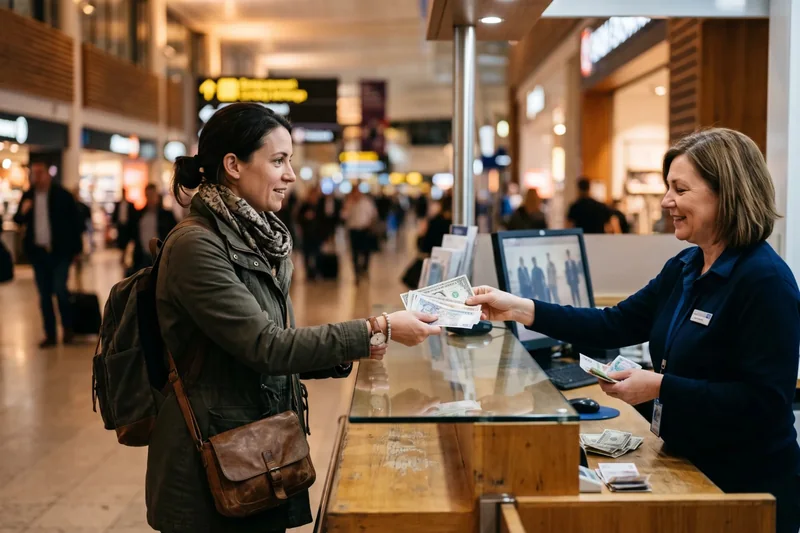
At peak hours, queue lengths depend on how arrivals bunch as well as how many desks are open. Expanding the hall can make a long queue more comfortable without helping people make their flights. Adding desks can shorten the queue but transfer it to baggage screening. Track a passenger and a checked bag all the way from entrance to aircraft. An operations trial should include late arrivals, equipment failures and connections between facilities, with explicit responsibility at each handoff.
The financial case combines passenger charges, concession income and the cost of maintaining space and equipment. Shops need footfall, yet commercial space that increases the distance to a gate may reduce the value of the passenger experience. A staged opening can build operational reliability at the cost of temporarily duplicating staff and equipment. Set the stage gates around completed passenger journeys, bags delivered and peak-hour service. Annual design capacity alone makes an inadequate acceptance test.
JICA says Hazrat Shahjalal International Airport handled 7.92 million international passengers in 2022, close to the 8 million annual capacity of its existing terminals. Construction of the third terminal began in December 2019, and the terminal had a soft opening in October 2023.
On 24 December 2023 JICA signed a loan agreement with the Government of Bangladesh for up to ¥76,635 million, about US$540 million, for the third phase of the airport expansion project. The money covers the third international passenger terminal, a cargo terminal and related facilities. The implementing agency is the Civil Aviation Authority of Bangladesh.
Local reports put the total project cost at about Tk 21,399 crore, most of it financed by JICA and the rest by the government. Japanese loans across the three phases were reported at about US$2.21 billion in total.
Airports worldwide face the same planning puzzle: build too early and the asset sits underused; build too late and congestion drives airlines and passengers elsewhere. Large terminals are usually financed with long-term debt, and when that debt is in a foreign currency, the cost of repayment depends on exchange rates over decades. Good planning therefore looks at traffic forecasts, the timing of capacity, and the currency mix of revenues and debts together, rather than one at a time.
Key moments
Earlier terminals were assessed against their annual passenger capacity.
The phase III loan agreement provided a separate tranche for the expansion.
Source: World Bank, World Development Indicators (IS.AIR.PSGR).
The trade-offs at the heart of the case
Do a trial with a late bag
Run a complete departure bank using test passengers and tracked bags with realistic check-in times. Include a late bag, a missed connection and a passenger needing assistance. Record elapsed time and who authorised each exception. A successful average can hide a small group of expensive failures, especially when multiple airlines close flights at similar times. I would stage opening around a defined flight bank and expand after operators consistently meet end-to-end standards. The extra cost of overlap with the previous terminal should appear in the ramp-up budget rather than being discovered only after the operator has promised a low opening cost. A rehearsal earns its keep when it reveals an exception before the first paying passenger has to discover who is responsible for resolving it.
A queue that moves can masquerade as a success
At a container terminal, a faster crane can move the wait from the ship to the yard. At an airport, a faster check-in desk can move passengers into a slower security lane. Both operators need a system-wide measure and a way to allocate responsibility locally. At Dhaka airport that means agreeing flight-level service measures with airlines, ground handlers and public agencies, each of which controls only part of a departure. If individual incentives pay out for faster handoff even when the receiving stage is full, each department may rationally make the passenger’s journey worse. A rehearsal that deliberately bunches departures tests precisely this risk and can identify inexpensive changes to rosters before new equipment is purchased.
For your seminar, paper or interview
- Q1
Why can a terminal below annual capacity still have extreme queues?
- Q2
Which costs arise from running old and new systems together?
- Q3
How should a lender distinguish a tranche from total project cost?
- Capacity planning
- Foreign-currency debt
- Demand forecasting
- Asset utilisation
How we would approach it
Simplifying Finance’s opinion, offered as a starting point for debate, not as fact or investment advice.
We think the decision to build Terminal 3 was justified by demand, but its financial success depends on how fast it fills and how the yen-denominated debt is repaid. The airport earns mostly in taka, so currency movements can change the real cost of the project as much as passenger numbers can.
Phase opening to demand
Open gates and counters in stages as traffic grows to control running costs.
Grow non-aviation income
Develop retail, parking and cargo revenue that is less tied to ticket prices.
Plan for currency risk
Set aside reserves or charges to cover the cost of repaying yen loans if the taka weakens.
What this plan gives up
Opening in stages saves money but may disappoint airlines and passengers who expect the full new terminal at once.
The strongest counter-argument
Concessional Japanese loans carry very low interest rates and long terms, so even with currency swings the debt may be far cheaper than any commercial alternative, making currency risk a secondary concern.
Metrics to watch
- International passengers per year
- Share of revenue from non-aviation sources
Propose your solution
Pick a discussion question and set out what you would do, why, and what it would cost. Strong, well-argued answers are reviewed and published below with your first name and programme.
Published solutions
Loading published solutions…
- JICA: Hazrat Shahjalal airport expansion, phase III ↗
- JICA: Phase III ex-ante evaluation and financing scope ↗
- World Bank: World Development Indicators, Air passengers carried by nationally registered airlines ↗
- JICA: Loan agreement for Hazrat Shahjalal International Airport Expansion Project (III) ↗
- JICA: Project outline (PDF) ↗
- BSS: Japan to provide 76,635m yen to Bangladesh ↗
- The Daily Star: Bangladesh gets $540m in third tranche ↗
- Photo: HSIA Terminal 3.jpg by Dunhill1410, CC0 (cropped and resized) ↗
Figures are as reported by the companies or cited outlets as of 22 November 2026. Check the source before quoting. Corrections: let us know through the solution form.