What happened
Ford announced its five-dollar day in 1914. Eligibility and a profit-sharing component make the programme more complicated than an immediate universal doubling of wages. The factory faced a practical problem, replacing people interrupted production and consumed recruitment and training effort. Higher compensation could partly pay for itself if employees stayed longer.
On 5 January 1914 Ford announced that it would pay five dollars for an eight-hour day. The Henry Ford says the previous rate was $2.34 for a nine-hour day.
The background was a turnover problem. The Henry Ford reports that monotonous assembly work led many workers to quit, leaving Ford with a labour turnover rate of 370 percent. Another note from The Henry Ford puts the late-1913 figure at 380 percent.
The announcement drew huge crowds. Within days, thousands of applicants came to Detroit from across the Midwest, and Ford said it would hire only people who had lived in Detroit for at least six months.
The five dollars was not a simple raise. The Henry Ford explains that it was a profit-sharing plan: a worker who earned about $2.30 under the old schedule still earned that wage, with the rest paid as profit share.
Eligibility came with conditions. Ford’s Sociological Department investigated workers’ home lives to check how the money was spent, according to The Henry Ford.
Economists have studied the plan closely. Daniel Raff and Lawrence Summers concluded in an NBER paper that the Ford experience is consistent with efficiency wage theories, which say higher pay can raise productivity and reduce turnover.
Raff and Summers also found vivid evidence of long queues for Ford jobs, and significant increases in productivity and profits at Ford after the five-dollar day was introduced.
Ford tied the move to the assembly line. The Henry Ford notes that the line had cut the time to build a Model T from 12½ hours to 93 minutes, which lowered costs but made the work more repetitive.
The exhibit shows that Ford roughly doubled daily pay while shortening the working day by one hour.
The decision makes more sense when turnover is counted as a cost. Every worker who quit had to be replaced, trained and brought up to speed.
With turnover in the hundreds of percent, Ford was effectively hiring its whole workforce several times a year.
Efficiency wage theory says paying above the market rate can be profitable if it raises effort, loyalty and productivity.
Opportunity cost also matters. The money spent on higher wages could have gone elsewhere, so it had to save more than it cost.
The plan’s conditions, enforced by home visits, show how employers once tried to control workers’ private lives in ways that would be unacceptable today.
Modern companies use similar thinking when they pay above market rates to keep skilled staff in tight labour markets.
Students can debate whether higher pay or better working conditions is the more effective way to reduce turnover.
Key concept: unit economics. Unit economics looks at the revenue and costs linked to a single unit, such as one car or one customer. If each unit earns more than it costs to make and sell, growth adds profit; if not, growth adds losses.
Fixed costs such as development and tooling are spread across all units, so the cost per unit falls as volume rises. That is why low-volume products need high prices, and why volume matters so much in the car industry.
Key concept: opportunity cost. Opportunity cost is the value of the best alternative given up when making a choice. Money and time spent on one project cannot be spent on another.
Good decisions compare options against each other, not just against doing nothing.
Key concept: risk and return. In business and investing, higher potential returns usually come with higher risk. Entering a new market or launching a new kind of product can bring large rewards, but the chance of failure is also greater.
Managers weigh the size of the possible gain against the likelihood and cost of failure, and they often reduce risk by testing ideas on a small scale before committing large sums.
Key moments
Workforce turnover disrupts production
Five-dollar-day programme announced
Eligibility and profit-sharing conditions shape who qualifies
Source: The Henry Ford.
The trade-offs at the heart of the case
A closer look
Recruiting the same position repeatedly consumes supervisor time and exposes beginners to a job they are still learning. To evaluate the five-dollar day, compare jobs with similar training demands and distinguish employees who qualified for the scheme from those who did not. The resulting change in retention is only part of the history. Eligibility also affected which workers shared in the headline payment.
The alternative on the table
For comparison, consider the option to manage turnover through continuous recruitment. The related case “Where did the time go on the moving assembly line?” supplies a useful reference point. At Highland Park, Ford broke assembly into shorter tasks and moved the work past the workers. A moving line magnifies the disruption of an unfilled station. A pay premium can protect the entire sequence. Test that claim using absence and replacement data as well as wage records.
For your seminar, paper or interview
- Q1
Which hiring and training costs fall when an experienced worker stays?
- Q2
Which finding in the records on retention, qualifying payments and induction costs by job would persuade you to manage turnover through continuous recruitment?
- Q3
Compare this decision with “Where did the time go on the moving assembly line”. Which difference between the cases would change your recommendation?
- Efficiency wages
- Labour turnover
- Human capital
- Profit sharing
How we would approach it
Simplifying Finance’s opinion, offered as a starting point for debate, not as fact or investment advice.
We think the five-dollar day was a sound business decision, not just generosity. Turnover was so high that Ford was paying again and again to hire and train people for a line that depended on steady crews. Paying more to keep workers stable fits the idea of efficiency wages, though the strings attached to the plan were intrusive.
Count turnover costs
Add hiring, training and lost output.
Tie pay to stability
Reward people who stay and learn the job.
Avoid intrusive conditions
Keep eligibility rules fair and simple.
What this plan gives up
Higher pay raises the wage bill but can cut hiring and training costs.
The strongest counter-argument
Some argue the plan was mainly publicity or a way to justify faster lines.
Metrics to watch
- Staff turnover rate
- Output per worker
Propose your solution
Pick a discussion question and set out what you would do, why, and what it would cost. Strong, well-argued answers are reviewed and published below with your first name and programme.
Published solutions
Loading published solutions…
- The Henry Ford • Ford Motor Company Publication: "Helpful Hints and Advice to Ford Employes," 1915 ↗
- The Henry Ford • Unimproved Kitchen of Employee’s Home, Ford Sociological Department, circa 1914 ↗
- The Henry Ford • Source document — Could higher pay buy a more stable workforce ↗
- The Henry Ford • Ford’s Five-Dollar Day ↗
- The Henry Ford • Henry Ford: $5 Day (expert set) ↗
- NBER • Raff and Summers, Did Henry Ford Pay Efficiency Wages? (Working Paper 2101) ↗
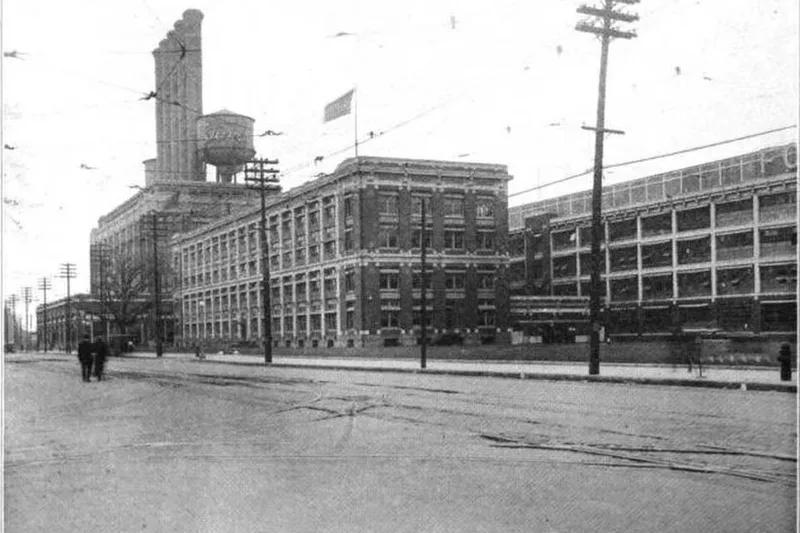
- Photo: Highland park plant 2 by Clarence Monroe Burton, William Stocking, Gordon K. Miller, Public domain (cropped and resized) ↗
Figures are as reported by the companies or cited outlets as of 22 November 2026. Check the source before quoting. Corrections: let us know through the solution form.