What happened
Ford’s 1948 F-Series organised a range of trucks around different work requirements. The light F-1 and heavier models served buyers whose purchases depended on the load and duty expected of the vehicle. A truck family could share a name and some components while requiring different engineering and selling skills across the range.
Ford introduced the F-Series with the 1948 F-1, its first all-new truck since World War II, according to The Henry Ford. The public first saw the trucks on 16 January 1948.
Ford marketed the range as Bonus Built, suggesting extra value for the money. The Henry Ford notes that farmers and businesses were still the main target markets.
The range ran from the half-ton F-1 pickup to the heavy-duty F-8, with capacities from half a ton to three tons. The Henry Ford says the F-7 and F-8 were the largest trucks Ford had ever built at the time.
Unlike Ford’s earlier pickups, the F-Series used a dedicated truck platform. Wikipedia reports that Ford developed a purpose-built truck frame rather than sharing a platform with its cars.
Ford invested in comfort. Wikipedia says Ford spent $1 million on research and tooling for the new cab, which was nicknamed the Million-Dollar Cab.
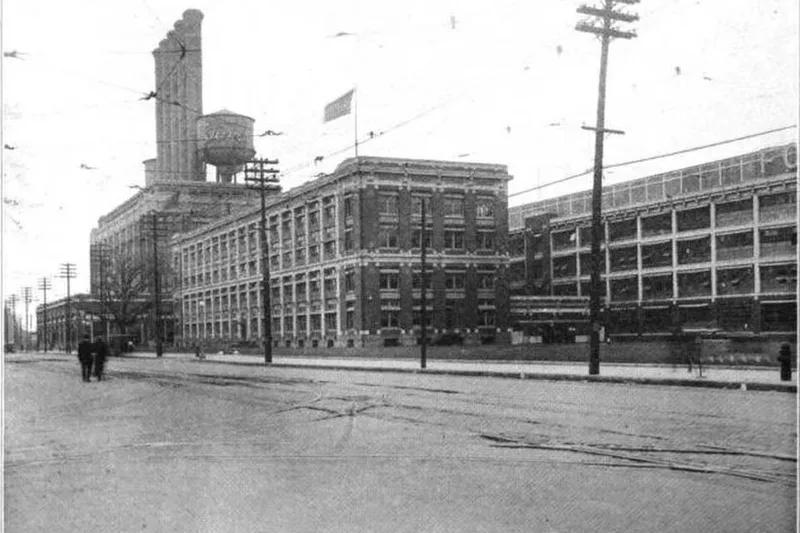
The trucks were built widely. Just Cars reports that F-Series production took place at 16 Ford factories across the United States and Canada.
Sales grew quickly. Ford Performance says F-Series production reached a then-record of nearly 346,000 in 1950, and HowStuffWorks reports that buyers took 148,956 F-1 pickups alone that year.
The F-Series name continues today and has become the best-selling light vehicle line in North America, according to Mac’s Motor City Garage.
The exhibit shows the scale of F-Series production in its record year of 1950.
Designing a truck from scratch costs more than adapting a car, but it can fit working buyers much better.
Offering a full range from light to heavy trucks let Ford serve farmers, tradespeople and fleets under one name.
Shared cabs and design across the range helped control costs while meeting different load needs.
Unit economics improve when one family name supports many models and a large dealer network.
The F-Series name became one of the strongest brands in the industry, a clear economic moat.
Pickups later moved from pure work tools to family and lifestyle vehicles, a shift the F-1 already hinted at.
Students can ask how a company decides when a product deserves its own platform.
Key concept: economic moats. An economic moat is a lasting advantage that protects a company’s profits from competitors, much as a moat protects a castle. Sources include strong brands, patents, cost advantages, networks and high switching costs for customers.
Brands with deep heritage and loyal customers can charge higher prices for many years, but moats must be maintained: a brand that disappoints customers can lose its advantage.
Key concept: unit economics. Unit economics looks at the revenue and costs linked to a single unit, such as one car or one customer. If each unit earns more than it costs to make and sell, growth adds profit; if not, growth adds losses.
Fixed costs such as development and tooling are spread across all units, so the cost per unit falls as volume rises. That is why low-volume products need high prices, and why volume matters so much in the car industry.
Key concept: opportunity cost. Opportunity cost is the value of the best alternative given up when making a choice. Money and time spent on one project cannot be spent on another.
Good decisions compare options against each other, not just against doing nothing.
Key concept: risk and return. In business and investing, higher potential returns usually come with higher risk. Entering a new market or launching a new kind of product can bring large rewards, but the chance of failure is also greater.
Managers weigh the size of the possible gain against the likelihood and cost of failure, and they often reduce risk by testing ideas on a small scale before committing large sums.
Key moments
Ford already sells commercial vehicles
Dedicated F-Series range introduced
The series spans light and heavy work
Sources: Ford Performance; HowStuffWorks.
The trade-offs at the heart of the case
A closer look
An operator buying a truck for work can value a different load rating even when the cab looks very similar. Follow the customer’s heaviest regular load and measure what happens when the lower-rated vehicle cannot carry it in one trip. The larger truck may avoid a second journey. This gives a dealer a practical way to sell the F-Series distinction and a factory a reason to support the extra variant.
The alternative on the table
For comparison, consider the option to adapt existing passenger vehicles for commercial duties. The related case “How many businesses can one van design serve?” supplies a useful reference point. The Transit introduced in 1965 had to serve operators who carried different people, tools and loads. Transit later addressed many businesses within one van family. The first F-Series organised different load classes. In both cases a customer buys a vehicle to complete a job, so define the job before valuing common design.
For your seminar, paper or interview
- Q1
Which finding in the records on orders by payload requirement and customer business would persuade you to adapt existing passenger vehicles for commercial duties?
- Q2
Compare this decision with “How many businesses can one van design serve”. Which difference between the cases would change your recommendation?
- Product range design
- Customer segmentation
- Dedicated platforms
- Commercial vehicles
How we would approach it
Simplifying Finance’s opinion, offered as a starting point for debate, not as fact or investment advice.
We think giving trucks their own platform was one of Ford’s best long-term decisions. Earlier pickups were built on car platforms, while the F-Series was designed around the loads and duties of working buyers. A full ladder from the F-1 to the F-8 let Ford serve almost every truck customer with one family name.
Design for the job
Build trucks around loads, not car parts.
Cover the range
Offer light to heavy models under one name.
Share where it helps
Use common cabs and parts across sizes.
What this plan gives up
A dedicated platform costs more to develop but fits buyers better.
The strongest counter-argument
Some argue sharing car platforms is cheaper and good enough for light trucks.
Metrics to watch
- Share of truck market
- Sales of light versus heavy models
Propose your solution
Pick a discussion question and set out what you would do, why, and what it would cost. Strong, well-argued answers are reviewed and published below with your first name and programme.
Published solutions
Loading published solutions…
- Ford Motor Company • The Ford F-Series Truck Family | Ford.com ↗
- Ford Motor Company • History of The Ford F-Series 1948-1999 ↗
- blueovaltrucks.com • History of The Ford F-Series 1948-1999 - Blue Oval Trucks ↗
- The Henry Ford • 1948 Ford F-1 Half-Ton Pickup Truck ↗
- Ford Performance • Ford’s First-Gen F-1 Pickup Set F-Series Dominance In Motion ↗
- HowStuffWorks • 1948-1952 Ford F-Series Trucks ↗
- Wikipedia • Ford F-Series (first generation) ↗
- Photo: 1949 Ford F-3 3.9 by Vauxford, CC BY-SA 4.0 (cropped and resized) ↗
Figures are as reported by the companies or cited outlets as of 22 November 2026. Check the source before quoting. Corrections: let us know through the solution form.