What happened
Peru created FOCAM under Law 28451 in December 2004. Its original formula assigned 25% of a defined portion of national-government royalties from gas blocks 88 and 56. The statutory base matters: multiplying total gas sales, or even all royalties before allocations, by a quarter would produce a misleading local budget. The amounts passing through the framework then have to be distributed among eligible recipients. The formula for the fund and the entitlement of an individual municipality are two different calculations.
A planning officer should trace the transfer from the royalty assessment to the cash actually available for an eligible project. A signed construction contract can require payments even when a production interruption or lower reference price reduces the next transfer. Delaying works may damage what has already been built. Starting several projects in a high-revenue year therefore changes the constituency’s downside as well as its upside. Small, independently usable stages offer one way to reduce that exposure.
Take a proposed access road linking farms to a market. Estimate the value of the road in the first operating year, then ask who pays for resurfacing after repeated rainy seasons. A capital allocation tied to gas royalties can make the construction contract affordable without creating an equally dependable future source for upkeep. If maintenance is neglected, early travel-time gains may disappear, leaving a deteriorating asset against a fully paid construction bill. An evaluation should trace the beneficiaries of the road and compare it with a simpler road standard that local budgets could maintain. This presents the gas-related transfer as an opportunity to choose durable services, not as evidence that the most expensive version of a proposal is financially sustainable.
The Camisea gas project, in the Cusco region’s Amazon lowlands, began commercial production in 2004. Its gas travels by pipeline across the Andes to the coast, passing through several regions.
To share the benefits with regions along the pipeline route, Peru created the Fondo de Desarrollo Socioeconómico de Camisea, or FOCAM, under Law 28451 in December 2004.
The law allocated 25 percent of a defined portion of national-government royalties from gas blocks 88 and 56 to the fund, to be distributed among eligible regional governments, municipalities and universities in the affected regions.
The statutory base matters. Applying 25 percent to total gas sales, or to all royalties before other allocations, would overstate the amount reaching local budgets.
Resource revenue-sharing arrangements exist in many countries, including Peru’s wider canon system for mining and hydrocarbons, Nigeria’s derivation principle and Brazil’s oil royalties distribution.
A common challenge is volatility. Royalties rise and fall with production and prices, so local governments may receive large sums in good years and little in bad years, making long-term planning difficult.
Another is spending capacity. Small municipalities may lack the staff to design and execute large investment projects, leaving funds unspent or poorly used.
For a finance student, the case connects to the idea of a sinking or stabilisation fund: setting aside part of volatile income in good years to smooth spending over time.
Camisea transformed Peru’s energy system. Natural gas replaced more expensive fuels in power generation and industry in Lima, and it supplies the Peru LNG export plant.
The fund’s design also raises questions about fairness between regions. Areas crossed by the pipeline receive transfers, while other poor regions without gas infrastructure do not, which can create tensions over how resource wealth is shared.
The law also directed how funds could be used, focusing on investment projects in areas such as infrastructure, health and education, rather than on routine spending.
Evaluating FOCAM therefore requires looking not only at how much money was transferred, but at what was built and whether it improved services for residents.
The experience of FOCAM has informed wider debates in Peru about how to share resource revenue, including reforms to the mining canon. Many analysts argue that pairing transfers with technical support and stronger planning would help regions turn resource income into lasting improvements in roads, schools and clinics.
Transparent reporting of transfers and projects would help citizens judge whether the fund is working as intended.
Such evidence would also strengthen the case for similar funds linked to future energy projects in Peru.
Key moments
Law 28451 created FOCAM.
The law specified a share of the national government’s defined royalty base.
Source: Law 28451 (December 2004).
The trade-offs at the heart of the case
A public project has more than one financing date
FOCAM transfers resource-linked income to public investment. Obras por Impuestos brings forward eligible spending in exchange for later tax value. In both cases the date a project is chosen may be well ahead of the date a particular party can spend or recover cash.
Our assessment
I would put estimated maintenance, the ordinary source of its funding and the cost of an interrupted build beside every proposed capital allocation. A classroom stress test can reveal a gap, but the governing version of the law and the recipient’s own accounts determine which actions it can take. Keeping separate ledgers for allocated, committed, certified and paid money prevents the same transfer from funding two promises.
For your seminar, paper or interview
- Q1
Why use a defined royalty base instead of gross sales in the forecast?
- Q2
Which stage of a public project can operate independently?
- Q3
How would a town budget after two weak royalty years?
- Q4
How far before the projected low point must a funding commitment become unconditional?
- Q5
Which payment could be rescheduled without weakening the receipts expected later in the forecast?
- Resource revenue sharing
- Fiscal decentralisation
- Royalty design
- Public finance
How we would approach it
Simplifying Finance’s opinion, offered as a starting point for debate, not as fact or investment advice.
We think FOCAM was a reasonable attempt to share gas revenue with the regions affected by the Camisea pipeline. But revenue sharing only improves lives if local governments can plan and spend well, and volatile receipts make that harder.
Smooth receipts
Use stabilisation mechanisms for volatile revenue.
Build capacity
Help local governments plan projects.
Publish spending
Report how funds are used.
What this plan gives up
Sharing revenue builds local support but can create dependence on volatile income.
The strongest counter-argument
Some argue central government is better placed to invest resource revenue.
Metrics to watch
- Annual FOCAM transfers
- Execution rate of local budgets
Propose your solution
Pick a discussion question and set out what you would do, why, and what it would cost. Strong, well-argued answers are reviewed and published below with your first name and programme.
Published solutions
Loading published solutions…
- Ministry of Economy and Finance — Law 28451 ↗
- Congress of Peru — Official publication of Law 28451 ↗
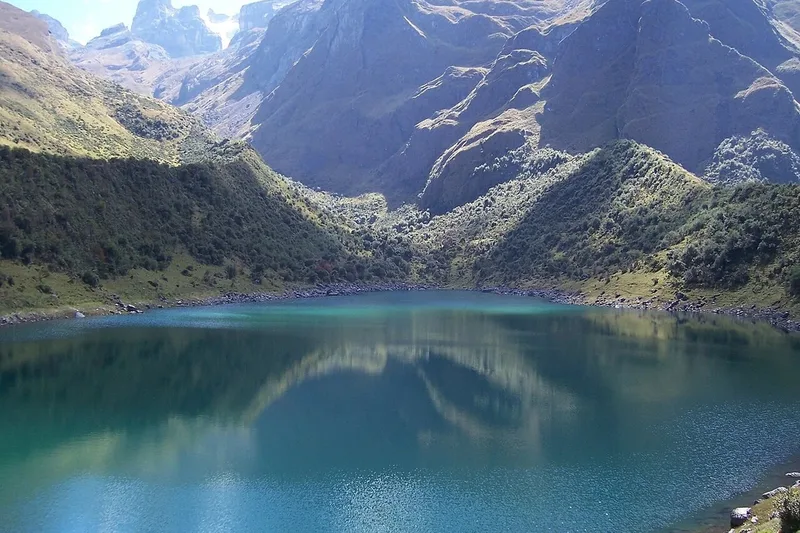
- Photo: Río Urubamba cerca de Urcos by Mx._Granger, CC0 (cropped and resized) ↗
Figures are as reported by the companies or cited outlets as of 22 November 2026. Check the source before quoting. Corrections: let us know through the solution form.