What happened
Restoring the buffer around a landfill required many young trees. Producing them centrally would concentrate the work and income in one place. A community nursery model opened part of the production process to households. The relevant question was how to reward that work while still paying attention to the condition of the future forest.
Local participants raised indigenous seedlings and exchanged them for credits redeemable for goods or services. Project teams then planted trees in the buffer zone. The exchange rewarded a household for supplying seedlings. Responsibility for establishing and maintaining trees on the site extended beyond that transaction.
A UN climate case profile recorded around 406,676 trees traded and 333,023 already planted across more than 300 hectares at that stage. The figures describe different stages at the reporting date. Their difference is not an estimate of dead trees. Later municipal reporting covers a longer period and should be kept on a separate line.
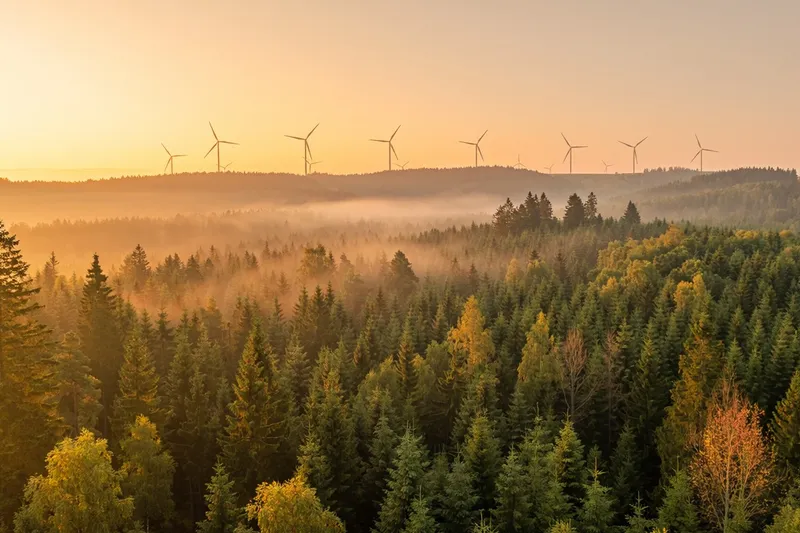
The Buffelsdraai Landfill Site Community Reforestation Project, near Durban, began in 2008 to restore indigenous forest in the buffer zone around a regional landfill. eThekwini Municipality partnered with the Wildlands Conservation Trust to involve local communities.
Community members, known as ‘treepreneurs’, grow indigenous seedlings at home and exchange them for credits that can be used for food, school fees, bicycles and other goods. Project teams then plant the trees.
A UN climate profile recorded about 406,676 trees traded and 333,023 planted across more than 300 hectares at that stage. The project was linked to offsetting the carbon footprint of Durban’s hosting of the 2010 FIFA World Cup.
Restored forest provides several benefits: it stores carbon, reduces soil erosion and flooding, supports biodiversity and creates a buffer between the landfill and nearby homes.
The project has been recognised by the United Nations as a Momentum for Change lighthouse activity, showing how climate action can deliver local livelihoods.
The treepreneur model addresses a common problem in restoration projects: how to share benefits with nearby communities. Instead of paying a contractor, the project pays many households for small batches of seedlings, spreading income across the area.
The credit system also encouraged participants to learn propagation skills and engage with the forest’s long-term success. Some participants used their credits for school fees and food, linking environmental work directly to household needs.
From a carbon-finance perspective, the value of a restored forest depends on how much carbon it stores over time and how long the trees survive. Verifying these figures requires monitoring, which adds cost but builds credibility with buyers of offsets.
Community-based reforestation programmes are now common across Africa, Latin America and Asia, and the Buffelsdraai model has been studied as one way to combine climate goals with local livelihoods.
The project sits within a buffer zone around an operating landfill, which gives the restored forest a practical role: it separates waste operations from nearby communities and helps manage runoff and erosion on surrounding land.
The case shows how a municipality can use climate finance to pursue several goals at once. Restoring land, offsetting emissions and supporting household income were combined in a single programme.
Key moments
Buffelsdraai community reforestation project begins.
Project linked to offsetting emissions from the FIFA World Cup in Durban.
eThekwini Municipality reports continued restoration.
Source: UNFCCC Momentum for Change profile of Buffelsdraai. Figures describe different stages.
The trade-offs at the heart of the case
Work through the evidence
Put three dates alongside a batch of seedlings. One marks exchange, one planting and one a survival count after a defined period. A seedling traded shortly before a reporting date may still be in a nursery. A tree that survives one rainy season may face a different risk in its first dry season. Compare like-aged groups before judging the success of one planting site against another. Credits can be recorded when a seedling is accepted. The condition of a tree years later cannot be known at that moment. A fair design should say which part of performance a nursery participant can control and which belongs to a team caring for the site. Requiring the wrong person to bear weather or maintenance risk can undermine participation.
Our assessment
Fund the handover from nursery to field as carefully as the initial exchange. For households, establish how readily credits can be used. For the landscape, check survival and species diversity at a defined age. A strong result on either measure deserves its own explanation. A household’s account of the project begins before a credit is issued. There is time spent raising seedlings, space occupied and the possibility that material will not reach the required condition. The project’s site account begins at a different point and includes preparation, planting and aftercare. Comparing the two accounts can reveal whether an attractive cost per seedling partly reflects unpaid effort carried elsewhere. It can also identify a benefit that a municipal payroll would miss, such as work that a household can organize around other obligations. Both observations matter before deciding whether to extend the model to a new neighborhood.
For your seminar, paper or interview
- Q1
Who could be missing from the reported measure of surviving native trees at a defined age?
- Q2
Which part of nursery exchange, planting and early aftercare must be financed every year?
- Q3
How would evidence on survival by planting season and site affect your choice?
- Carbon offsets
- Community incentives
- Ecosystem restoration
- Payment for services
How we would approach it
Simplifying Finance’s opinion, offered as a starting point for debate, not as fact or investment advice.
We think the Buffelsdraai project is a strong model for community-based restoration. Paying households for seedlings spreads income locally, while the forest delivers carbon storage, flood protection and biodiversity benefits.
Reward survival
Link some payments to tree survival, not just seedlings.
Diversify credits
Offer goods, school fees and services as rewards.
Monitor carbon
Measure carbon stored to support climate finance.
What this plan gives up
Community nurseries spread benefits widely but require careful quality control.
The strongest counter-argument
Some argue professional nurseries would produce seedlings more efficiently.
Metrics to watch
- Tree survival rates
- Hectares restored
Propose your solution
Pick a discussion question and set out what you would do, why, and what it would cost. Strong, well-argued answers are reviewed and published below with your first name and programme.
Published solutions
Loading published solutions…
- UNFCCC • Buffelsdraai community reforestation ↗
- eThekwini Municipality • spatial development framework and reforestation reporting ↗
- Photo: Restoration in action at Buffelsdraai by Douwes, CC BY-SA 4.0 (cropped and resized) ↗
Figures are as reported by the companies or cited outlets as of 22 November 2026. Check the source before quoting. Corrections: let us know through the solution form.