What happened
A household with irregular work may need some dependable earnings while leaving time for other paid activity and care. A full-time placement for one person and occasional days distributed among several people meet very different needs. Comparing only annual job counts hides the regularity that gives part-time public work much of its value.
The Community Work Programme offers eligible unemployed or underemployed people part-time work on useful local activities. Its implementation policy envisages sites generally offering two days per week and participants working up to eight days a month or 100 days a year. Local projects must identify work, arrange supervision and make payments.
The policy establishes a predictable schedule as a design objective. One hundred days is an annual ceiling in the cited policy, rather than an observed total for every participant. Eight days in each of twelve months would be 96 days. The two numbers should not be treated as independent promises that can be added together.
South Africa’s Community Work Programme began as a pilot in 2007. It was partly modelled on India’s rural employment guarantee scheme, which offers up to 100 days of paid work a year to rural households.
The South African version made an important change. Instead of short bursts of full-time work, the CWP spreads its 100 days across the year as regular part-time work, usually two days a week or eight days a month.
The aim is to provide an employment safety net: a minimum, predictable income that participants can combine with other activities, such as informal trading, care work or looking for a full-time job.
Sites are established in poor areas where unemployment is high. Each site is designed to enrol up to 1,000 people when operating at full capacity, and communities help decide what useful work should be done, such as caring for the sick, maintaining public spaces or running food gardens.
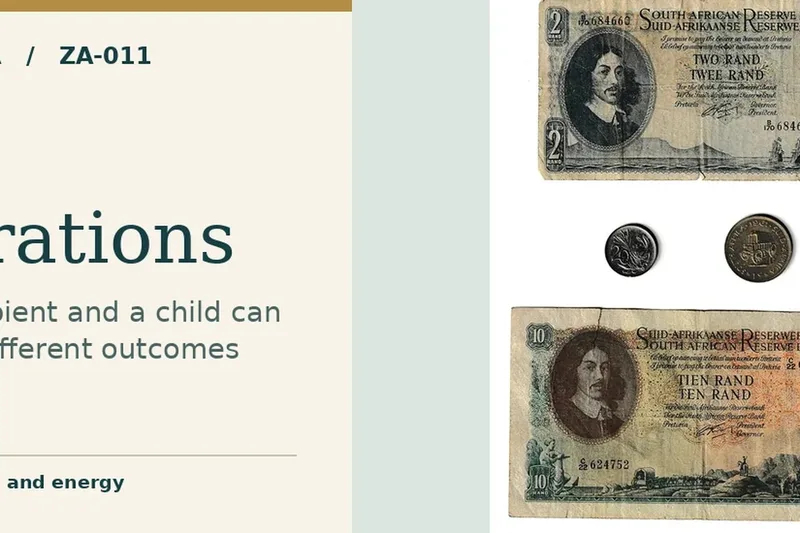
The daily rate has risen over time. It was increased to R60 a day in November 2010, and the government now describes a stipend of R81 a day for regular participants. Supervisors and storekeepers work five days a week and earn more.
Government figures indicate that about 94 percent of participants work the standard two days a week, with the remainder in supervisory roles.
Employment guarantee schemes are used worldwide to protect incomes during hard times. Their design choices, how many days, at what wage and doing what work, determine both their cost and their usefulness to participants.
Because the work is part-time and continuous, the CWP behaves more like a small, regular income than a temporary job. That makes it easier for households to plan spending, pay school costs and join savings groups, just as a steady salary does.
The trade-off is that a stipend for eight days a month is modest. The programme’s value lies in reach and reliability rather than the size of each payment.
Evaluating the programme therefore means asking whether participants receive their days and stipends as promised, not only how many people are enrolled.
Key moments
CWP begins as a pilot.
Daily wage raised to R60.
Participants paid R81 a day for two days a week.
Sources: TIPS policy brief (2010 rate); South African Government CWP FAQ (current rate).
The trade-offs at the heart of the case
Work through the evidence
Compare a calendar of days actually offered with a calendar of days paid. A predictable offer can lose value if the payday is uncertain. A participant may choose to miss a day for another job or care commitment. Record offered days as well as attendance so that an absence is not automatically interpreted as a failure to provide work. Then examine what useful local activity took place on those days. Ask the site for a roster and ask participants which days they could plan around. The roster shows the offer. Their accounts reveal cancellations, care conflicts and the real consequences of short notice. A change from two fixed days to two variable days can leave total pay unchanged while making it harder to accept complementary work.
Our assessment
Assess the program against income predictability and the condition of the community service it supports. A funding cut that leaves annual totals little changed can still disrupt household plans if it makes days irregular. Ask participants which dates they could confidently plan around. An assessment of predictable work should ask what happens between paid days. A person may use the regular income to sustain another activity, look for a job or cover household expenses. Someone else may be unable to take occasional work if the public schedule changes at short notice. A survey limited to the tasks completed at the site will capture neither outcome. Compare participants’ planned weeks with their actual weeks at several times of year. Then ask whether a different allocation of the same total number of workdays would give people more choice or weaken the continuity of the local activity.
For your seminar, paper or interview
- Q1
Who could be missing from the reported measure of paid days received on predictable dates?
- Q2
Which part of supervision, materials and reliable payment must be financed every year?
- Q3
How would evidence on months in which work or payment arrived late affect your choice?
- Employment guarantee
- Public works
- Income smoothing
- Programme design
How we would approach it
Simplifying Finance’s opinion, offered as a starting point for debate, not as fact or investment advice.
We think the CWP’s design, regular part-time work rather than short full-time contracts, is well suited to people who combine many sources of income. Its value lies in predictability, so delays in stipend payments undermine the very thing that makes it useful.
Pay on time
Make stipends reliable every month.
Choose useful work
Let communities identify tasks.
Track exits
Measure how many participants move into other work.
What this plan gives up
Part-time work spreads income widely but pays each person only a modest amount.
The strongest counter-argument
Some argue full-time public works build more skills and experience.
Metrics to watch
- Days worked per participant
- Timeliness of stipend payments
Propose your solution
Pick a discussion question and set out what you would do, why, and what it would cost. Strong, well-argued answers are reviewed and published below with your first name and programme.
Published solutions
Loading published solutions…
- South African Government • Community Work Programme ↗
- Community Work Programme • implementation policy ↗
- TIPS • Community Work Programme policy brief ↗
- TIPS • Predicted poverty impacts of expanding the CWP (2012) ↗
- South African Government • CWP participants and stipends ↗
- Image: original title graphic by Simplifying Finance
Figures are as reported by the companies or cited outlets as of 22 November 2026. Check the source before quoting. Corrections: let us know through the solution form.