What happened
BMW’s 2022 plan placed development and production of next-generation electric drives at Steyr. The company set out approximately €1 billion of investment through 2030. For a site known for combustion engines, the decision concerned people and engineering capability as well as new equipment. The announcement set a spending horizon, not an annual production result.
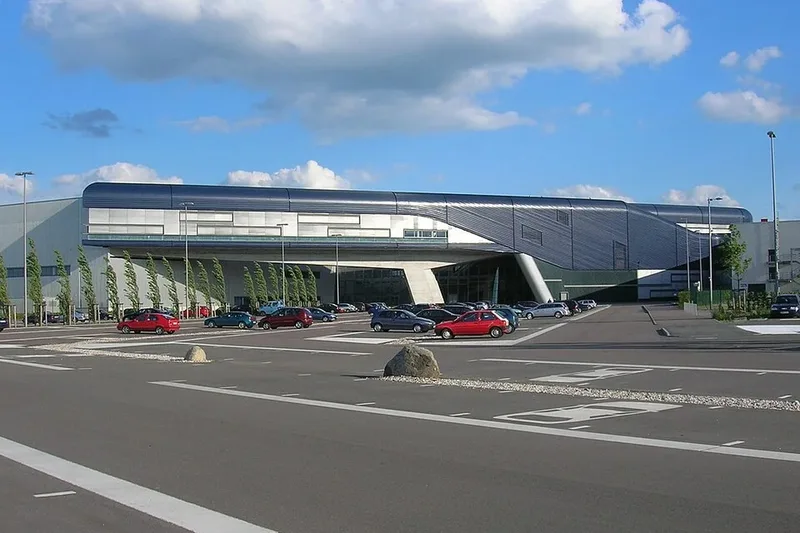
BMW’s plant at Steyr in Austria has developed and built combustion engines for BMW and MINI for more than 40 years. It is BMW’s largest engine plant.
In June 2022 BMW announced that Steyr would also develop and produce the next generation of electric drives from 2025, with an investment of around one billion euros by 2030.
Construction of new halls began in September 2022, and BMW later reported installing about 300 items of plant and equipment worth more than 500 million euros for e-drive production.
BMW said the plant would be able to produce more than 600,000 e-drives a year alongside petrol and diesel engines.
Series production of the electric motor for BMW’s sixth-generation eDrive, used in the new Neue Klasse models, began on 1 August 2025. Steyr was the first plant to build it.
Core parts of the e-drive, including the rotor, stator, transmission and power converter, are made at Steyr, while housings are cast at BMW’s foundry in Landshut.
BMW said that, depending on demand, half of Steyr’s workforce could be working in electric mobility by 2030. RWTH Aachen’s eDrive News reported about 4,400 people employed at the site.
The move shows how car makers are adapting existing plants rather than closing them as the industry shifts towards electric vehicles.
The exhibit breaks down BMW’s spending at Steyr. Most of the investment goes into production equipment, with the rest supporting development work at the site.
Net present value is a useful way to think about the decision. The investment is made today, while the returns come from e-drives produced over many years.
Those future returns depend on how fast customers adopt electric cars, which is uncertain. A plant that can build both engines and e-drives keeps options open.
Using an existing plant rather than a new site has advantages. It already has skilled workers, suppliers and infrastructure, and the company avoids closing a site with a long history.
But electric drives require different skills. Workers who know combustion engines need training in electrical systems, power electronics and new manufacturing methods.
That makes training a key part of the investment. A plant can install new machines quickly, but building expertise takes longer.
Steyr’s role as a development site as well as a production site helps, because engineers and production teams can work closely together.
Across Europe and beyond, many engine plants face similar transitions as car makers shift to electric vehicles, with large implications for jobs and local economies.
Students can compare BMW’s approach with companies that have built new battery and motor plants from scratch.
Keeping combustion engine production alongside e-drives also protects the plant against uncertainty in demand. If electric car sales grow more slowly than expected, the plant can continue supplying engines.
If they grow faster, it has capacity ready for e-drives. This flexibility has real value, sometimes described as a real option.
The investment also supports jobs in the region, which matters to employees, local government and the wider economy.
For managers, the Steyr case shows that the transition to electric vehicles is as much about people as about machines.
Students can debate how fast car makers should shift investment from engines to electric drives, given uncertain demand in different markets.
The first Gen6 e-motors from Steyr went into the Neue Klasse models, the new generation of electric BMWs, so the plant’s performance is directly linked to the success of the company’s most important new products.
That makes Steyr a useful case for following how well an established engine plant adapts to a new technology over the rest of this decade.
Its progress will be watched closely across the industry.
Key moments
Steyr e-drive investment announced
Next-generation e-drive production planned
Announced investment horizon
Source: BMW Group press releases, 2022 and 2024.
The trade-offs at the heart of the case
A closer look
Experience diagnosing a combustion engine does not transfer uniformly to every electric-drive operation. Ask which fault a trained worker can now diagnose independently, and which still requires a visiting specialist. The difference reveals where the next training euro buys independence. Counting everyone who attended a course could suggest that the component plant is ready before a receiving factory can rely on its output.
The alternative on the table
For comparison, consider the option to concentrate e-drive investment at an existing electrical-components centre. The related case “Choosing where electric-drive components should be made” supplies a useful reference point. BMW opened its Centre of Competence for E-Drive Production at Dingolfing in 2020. Dingolfing already offered an alternative industrial base. Steyr’s case becomes stronger when its development knowledge shortens qualification time or solves a bottleneck elsewhere. Keeping jobs and improving group economics are different claims with different evidence.
For your seminar, paper or interview
- Q1
How would you show that Steyr can support a drive system without outside engineering help?
- Q2
Which finding in the records on qualified drive systems accepted by vehicle plants would persuade you to concentrate e-drive investment at an existing electrical-components centre?
- Q3
Compare this decision with “Choosing where electric-drive components should be made”. Which difference between the cases would change your recommendation?
- Workforce transition
- Electrification
- Capability building
- Plant reinvention
How we would approach it
Simplifying Finance’s opinion, offered as a starting point for debate, not as fact or investment advice.
We think putting e-drive production at Steyr made sense. The plant already knew how to build drivetrains at high volume, and retraining its workforce kept that knowledge inside the company. The challenge is that skills for combustion engines do not transfer automatically, so training and new equipment must move together.
Retrain early
Prepare workers before new lines start.
Keep both technologies
Run engines and e-drives side by side.
Track capability
Measure what the plant can do independently.
What this plan gives up
Converting an existing plant costs less than a new site but needs major retraining.
The strongest counter-argument
Some argue a specialised electrical plant would learn faster.
Metrics to watch
- Share of workers trained
- E-drive output
Propose your solution
Pick a discussion question and set out what you would do, why, and what it would cost. Strong, well-argued answers are reviewed and published below with your first name and programme.
Published solutions
Loading published solutions…
- BMW Group PressClub • BMW Group brings e-drives to Austria: Expansion of production and development at Steyr engine plant ↗
- BMW Group PressClub • Milestone at BMW Group Plant Steyr: Production facilities for next-gen electric drives completed ↗
- BMW Group PressClub • BMW Group brings e-drives to Austria ↗
- BMW Group PressClub • Production facilities for e-drives completed at Steyr ↗
- BMW Group • Steyr launches series production of electric engines for Neue Klasse ↗
- RWTH eDrive News • BMW invests one billion euros at Steyr ↗
- Photo: BMW iX3 50 xDrive M Sportpaket Pro (NA5) – f 17052026 by © M 93, CC BY-SA 3.0 (cropped and resized) ↗
Figures are as reported by the companies or cited outlets as of 22 November 2026. Check the source before quoting. Corrections: let us know through the solution form.